


WCOR coin, also known as World Collective Oil Reserve, has rapidly emerged as one of the latest breakout searches across crypto markets. Searches for “WCOR crypto,” “WCOR token,” “WCOR coin price,” and “where to buy WCOR coin” have surged as traders explore a growing category of oil reserve-themed digital assets built on Solana.
Unlike traditional meme-driven tokens, WCOR is increasingly being described across market trackers and search results as an on-chain oil reserve registry or transparency-focused data project. The token appears to position itself around public oil reserve reporting, supply tracking, and real-world asset (RWA) narratives rather than direct commodity ownership.
However, despite rising attention and trading activity, traders should note that publicly verifiable information around reserve backing, institutional affiliations, and long-term project infrastructure remains limited.
What Is WCOR Coin?
World Collective Oil Reserve (WCOR) is a Solana-based digital asset linked to the broader oil reserve and commodity-token narrative currently gaining traction across crypto markets. According to publicly visible market data, WCOR positions itself as a blockchain-based oil reserve reporting focused on transparency and on-chain tracking rather than functioning as a direct claim on physical oil reserves.
This distinction is important for traders as the project is seen less as a traditional meme coin and more as a speculative oil-data narrative. Interest in commodity-linked blockchain narratives has increased sharply over recent months as traders look beyond traditional meme sectors and toward assets connected to real-world infrastructure and macroeconomic themes.
Why Is WCOR Trending?
WCOR is trending because it sits at the intersection of several fast-moving narratives currently dominating speculative crypto markets:
- oil reserve themes,
- Solana ecosystem momentum,
- real-world asset (RWA) tokenization,
- and low-cap narrative trading.
The token has seen growing visibility across market trackers like CoinGecko and Coinbase, while social discussions around oil-themed reserve tokens continue expanding. Part of this momentum also comes from the recent rise of similar reserve-themed Solana narratives. Traders have recently been tracking projects like GDOR and OSOR, which also gained traction through oil reserve speculation and commodity-linked token narratives.
Read more: What Is Global Digital Oil Reserve (GDOR)?
The broader market has simultaneously seen rising interest in real-world asset (RWA) tokenization as blockchain projects increasingly explore treasury products, commodities, and infrastructure-linked digital assets.
How Does WCOR Work?
Based on publicly available data, WCOR appears to function as a Solana-based registry or information-layer project tied to oil reserve reporting and tracking narratives rather than direct ownership of physical reserves. Search results and market summaries currently describe the project as:
- an oil reserve data registry,
- a transparency-focused reporting system,
- or a blockchain framework for tracking reserve-related information.
At the same time, the token itself trades like a speculative market asset, meaning its price remains heavily influenced by liquidity, market sentiment, and the social media attention. This creates a hybrid narrative where the project combines infrastructure-style positioning, with highly speculative trading behavior.
Also check out: Inside the Official Saudi Oil Reserve Token Hype
Is WCOR Really Backed by Oil Reserves?
This remains one of the biggest unanswered questions surrounding the project. While WCOR is closely associated with oil reserve narratives, there is limited information confirming direct ownership or backing by physical oil reserves at the time of writing.
Traders should therefore distinguish between a token connected to oil reserve reporting narratives,
and a fully audited commodity-backed digital asset. Currently, there is limited independently verifiable information regarding:
- reserve ownership,
- institutional custody,
- sovereign partnerships,
- or third-party audits tied to WCOR.
Because of this, the token should currently be viewed primarily as a speculative narrative-driven asset rather than a verified oil-backed product.
WCOR Tokenomics and Market Activity
According to CoinGecko data, WCOR’s trading volumes crossing the million-dollar range, circulating supply near 1 billion tokens, and active trading across Solana-based decentralized exchanges such as Meteora and Orca.
The token’s market behavior appears heavily sentiment-driven, with momentum largely influenced by:
- speculative trader participation,
- social media discussions,
- narrative rotation,
- and broader Solana ecosystem activity.
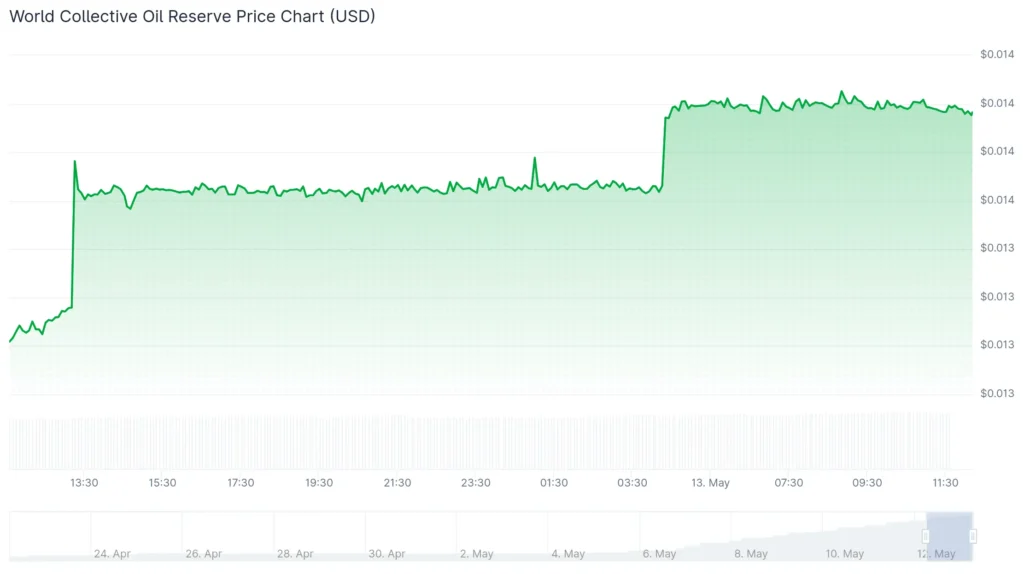
WCOR price and market activity. Source: CoinGecko
One challenge for traders is that low-cap narrative tokens can sometimes display inconsistent liquidity, pricing, or market capitalization data across different platforms. This makes contract verification and liquidity tracking especially important before interacting with the asset.
Why Traders Are Watching WCOR
WCOR has attracted trader attention because it combines several themes currently performing well in speculative crypto markets.
- First, commodity-linked narratives continue gaining traction as traders explore blockchain projects connected to oil, reserves, and macroeconomic infrastructure themes.
- Second, Solana remains one of the most active ecosystems for low-cap momentum trading, where narrative-driven tokens can experience rapid spikes in visibility and volatility. Traders following broader Solana ecosystem trends have increasingly rotated toward reserve-themed assets over recent weeks.
- Third, the token aligns with growing interest around real-world asset tokenization, where blockchain infrastructure is increasingly being explored for commodities, treasury products, reserve tracking, and transparency-focused financial systems.
Also Read: Top Solana Meme Coins by Market Cap
Risks Traders Should Know
Despite the growing attention, WCOR remains a high-risk speculative token. Several important questions around the project still require stronger public verification, including reserve-related claims, institutional partnerships, custody structures, and long-term governance transparency.
Narrative-driven low-cap tokens can experience aggressive volatility, particularly when momentum is driven more by social speculation than measurable fundamentals. Traders should therefore carefully verify contract addresses, liquidity conditions, exchange listings, and publicly available documentation before interacting with the asset.
Traders looking for more established and verified digital assets often explore larger ecosystem tokens and actively traded assets available on CoinDCX.
Trade Crypto in INR on 
Deposit and withdraw in INR (₹).
No Conversion to Crypto Required.

Conclusion
World Collective Oil Reserve (WCOR) has quickly become one of the latest breakout oil-themed Solana narratives attracting attention across crypto markets. However, publicly verifiable information around reserve backing and institutional infrastructure remains limited. For now, WCOR appears best understood as a speculative oil reserve-themed digital asset, and driven heavily by narrative-based trading activity.
As the broader market continues exploring commodity-linked blockchain projects and RWA infrastructure themes, traders will likely continue monitoring whether WCOR evolves beyond speculative momentum into a more verifiable long-term ecosystem project.
FAQs
1. What is WCOR coin?
WCOR, or World Collective Oil Reserve, is a Solana-based token connected to oil reserve reporting and real-world asset narratives. The project is increasingly discussed as an on-chain oil reserve registry or transparency-focused data layer.
2. Why is WCOR trending?
WCOR is trending due to growing interest in oil reserve narratives, Solana ecosystem trading activity, and real-world asset tokenization themes. Searches around WCOR coin price and reserve-linked tokens have increased sharply in recent days.
3. Is WCOR backed by physical oil reserves?
At the time of writing, publicly verifiable evidence confirming direct oil reserve backing remains limited. Traders should independently verify reserve-related claims before treating WCOR as a commodity-backed asset.
4. Where can traders track WCOR coin price?
WCOR price data currently appears on platforms such as CoinGecko and Coinbase. Traders should always verify token contract addresses and liquidity sources before interacting with low-cap narrative-driven tokens.
5. Is WCOR a meme coin?
WCOR is generally being positioned more as an oil reserve registry or data-layer narrative rather than a traditional meme coin. However, its trading behavior currently remains highly speculative and sentiment-driven.
6. Is WCOR risky?
Yes. WCOR remains a speculative low-cap token with elevated volatility and limited publicly verifiable information around reserve claims, institutional affiliations, and infrastructure transparency.
Additional Read:
1. Western Asset Reserve Fund vs WAR Token
2. USOR Crypto Trends in 2026
3. Crude Oil Price Prediction 2026
4. PM Modi’s 7 Appeals
Disclaimer:
WCOR is a highly speculative token and publicly available information around its reserve backing, audits, and institutional affiliations may remain limited at the time of writing. Traders should conduct independent research and verify token details before interacting with low-cap narrative-driven assets. This article is for informational purposes only and does not constitute financial advice.


