



Crude oil is caught between two opposing forces. In the short term, renewed US–Iran hostilities and risks around the Strait of Hormuz have pushed prices sharply higher, WTI is trading near $79.69 and Brent near $85.31, with Brent jumping 11% in recent sessions. But looking further out, the EIA and major banks still forecast softer prices later in 2026 as global supply expands and inventories build. This page covers the crude oil price prediction for today, this week, and through 2026–2028, across both WTI and Brent benchmarks.
This crude oil price prediction examines the short- and long-term outlook using technical indicators, geopolitical developments, OPEC+ policies and global supply-demand trends.
Crude Oil Price Prediction: Quick Outlook
| Timeframe | Outlook | Key Levels |
|---|---|---|
| Today | Bullish above the 50-day EMA, testing $80 | Support $78.82 / Resistance $80.11 |
| This Week | Volatile recovery, direction hinges on Hormuz headlines | $74.44–$83 |
| Rest of 2026 | Geopolitical premium vs rising supply is a two-way risk | $87+ on escalation, EIA sees Brent averaging $70/b by Q4 |
| 2027 | Bearish bias on supply growth | EIA: Brent ~$65/b average |
Key Takeaways
- Crude oil has staged a sharp short-term recovery, closing above its 50-day EMA for the first time since late May with RSI momentum confirming the move.
- The rally is driven by a geopolitical risk premium, renewed US–Iran strikes and Strait of Hormuz supply risk, not by demand strength.
- Institutional forecasts point the other way for later in 2026: the EIA projects Brent falling from ~$74/b in Q3 to ~$70/b in Q4, and J.P. Morgan sees Brent averaging near $60/b as supply growth outpaces demand.
- WTI and Brent are separate benchmarks and are analysed separately below. Traders should treat this as a headline-driven market with two-way risk, not a one-way trend.
Crude Oil Price Prediction Today, Tomorrow and This Week
| Timeframe | Outlook | Support | Resistance |
|---|---|---|---|
| Today | Short-term bullish above $78.82 | $78.82 / $74.44 | $80.00–80.11 |
| Tomorrow | Bullish while $78.82 holds, a close below negates | $78.82 | $80.11, then $83 |
| This Week | Volatile bullish recovery, headline-sensitive | $74.44–$79 | $83–$87.26 |
| July 2026 | Geopolitics-driven volatility | $67.50–68 | $87+ on escalation |
Crude Oil Price Prediction Today
Crude oil or CL/USDT is trading near $79.63, up 0.64%, holding above its 50-day EMA after rejecting $80.11 intraday. The bias today is bullish while price stays above $78.82, a decisive push through $80 opens the way toward $83.
Crude Oil Price Prediction Tomorrow
The setup remains bullish while the $78.82 breakout pivot holds on a closing basis. A close back below the 50-day EMA would negate the recovery same-day and shift focus to $74.44. Watch overnight Hormuz headlines and US inventory data as the immediate catalysts.
Crude Oil Price Forecast This Week
Expect a volatile bullish recovery within the $74–$87 band. Escalation in the Middle East targets the $83 zone first, then the 100-day EMA at $87.26, de-escalation or a ceasefire headline could unwind the risk premium quickly toward the mid-$70s.
Crude Oil Price Prediction July 2026
July’s range is being set by geopolitics. Analyst ranges for WTI in July span roughly $52–$77 from models built before the latest escalation, while spot has already broken above that band, a reminder that the risk premium, not fundamentals, is currently setting the price. Scenario framing: sustained blockade = $85–90+, status quo tension = $75–85, peace deal holding = $65–75.
WTI and Brent Crude Oil Price Forecast
WTI or West Texas Intermediate is the main US crude benchmark, Brent is the primary global benchmark and currently carries a larger geopolitical premium because Middle East supply flows off Brent more directly. Because they represent different markets, their prices and technical levels should be analysed separately.
| Benchmark | Current Price | Short-Term Outlook | Key Driver |
|---|---|---|---|
| WTI Crude | $79.69 | Volatile bullish recovery | US–Iran tensions, US inventories |
| Brent Crude | $85.31 | Elevated geopolitical premium | Strait of Hormuz supply risk |
Source: Trading Economics live and Reuters, July 15
On CoinDCX, CL-USDT tracks crude oil and BZ-USDT tracks Brent as separate tokenised futures pairs.
Crude Oil Technical Analysis (CL/USDT)
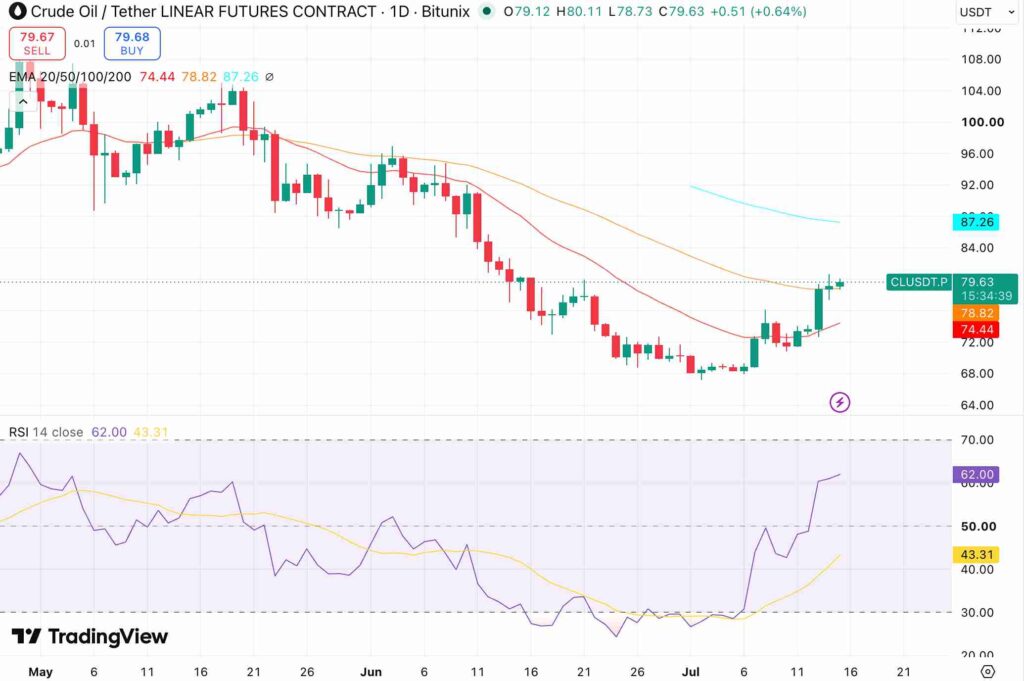
Note: Technical analysis below is based on the CL/USDT crude oil futures chart . Brent crude or BZ-USDT is a separate benchmark and may trade at different prices and levels.
CL/USDT is trading near $79.63, up 0.64%, after breaking above both its 20-day EMA at $74.44 and 50-day EMA at $78.82, the first close above the 50-day average since late May. The move marks a strengthening short-term recovery from the late-June base near $68. However, price remains well below the 100-day EMA at $87.26, which also aligns with the early-June breakdown zone, meaning the broader trend has not yet turned bullish.
The 14-day RSI at 62 is rising sharply from oversold territory three weeks ago and sits well above its moving average of 43.31, confirming positive momentum, though a further rally toward $83 would likely push RSI into overbought territory, raising the odds of a pullback.
| Level | Price of CL/USDT | Significance |
|---|---|---|
| Immediate resistance | $80.00–80.11 | Round number + rejected intraday high |
| Next resistance | $83.00 | Prior consolidation zone |
| Major resistance | $87.26 | 100-day EMA + June breakdown area |
| Immediate support | $78.82 | 50-day EMA — breakout pivot, close below negates recovery |
| Next support | $74.44 | 20-day EMA |
| Major support | $67.50–68.00 | Late-June base |
Why Are Crude Oil Prices Rising Today?
US–Iran hostilities flared again with strikes on energy targets, and moves around the Strait of Hormuz, through which roughly a fifth of global oil supply transits, have added a substantial supply-risk premium. Gasoline and refined product prices have surged alongside crude, amplifying the inflation impact. Supply-side disruption is compounding the move: Russian refining runs have dropped, Russian seaborne crude exports are under pressure with more barrels sitting in floating storage, and Asian buyers are pivoting toward US crude, reshaping trade flows and tightening near-term availability even as headline supply grows.
Note the second-order effect for gold and other commodities: energy-driven inflation is feeding hawkish Federal Reserve expectations, a dynamic covered in our Gold Price Prediction.
What Do EIA and Major Institutions Forecast for Crude Oil?
| Source | Forecast | Period | Main Reason |
|---|---|---|---|
| EIA | Brent ~$74/b average | Q3 2026 | Cut $27/b from prior outlook; inventory builds |
| EIA | Brent ~$70/b | Q4 2026 | Supply growth outpacing consumption |
| EIA | Brent ~$65/b average | 2027 | Continued inventory accumulation |
| J.P. Morgan | Brent ~$60/b average | 2026 | Softer supply–demand fundamentals |
Source: EIA Short-Term Energy Outlook, EIA global oil markets, EIA STEO, J.P. Morgan Global Research
The gap between spot prices $80–85 and these forecasts $60–74 is the risk premium the market is currently paying for Hormuz uncertainty. If tensions resolve, that premium, potentially $15–20 per barrel unwinds.
Crude Oil Price Prediction for the Rest of 2026
The rest of 2026 comes down to which force wins. The bull case is geopolitical: a prolonged blockade or wider conflict keeps the supply-risk premium elevated and targets $87+ on the chart. The bear case is fundamental: the EIA expects Brent to fall from an average of $103/b in Q2 to $70/b in Q4 as inventories build, and OPEC+ spare capacity plus rising non-OPEC output add downside pressure once headlines fade. History favours the fundamentals over time, risk premiums decay quickly after resolution, as June’s brief return to pre-war levels showed, but timing that decay is the hard part. Positioning for either scenario is a volatility trade, not a trend trade.
Crude Oil Price Forecast 2027–2028
Official forecasts lean bearish into 2027: the EIA projects Brent averaging around $65/b, with some scenarios in the $57–65 range unless OPEC+ intervenes with deeper production cuts. Slowing demand growth from EV adoption and efficiency gains is a gradual headwind, though it is a 2030s story more than a 2027 one. Treat multi-year point forecasts as scenarios: the 2026 experience, models projecting $52–77 while war pushed spot above $85, shows how quickly geopolitics can override fundamentals.
Factors That Could Affect Crude Oil Prices
| Factor | Potential Impact |
|---|---|
| Geopolitical tensions (US–Iran, Hormuz) | Raise supply-risk premium; fastest-moving driver right now |
| OPEC+ production decisions | Reset global supply expectations in either direction |
| Russian exports, refining & floating storage | Shifting trade flows tighten or loosen regional availability |
| US inventories (weekly EIA data) | Rising stocks pressure prices; draws support them |
| Global growth & demand | Determines the consumption side of the balance |
| US dollar strength | A stronger dollar makes oil costlier for non-US buyers |
Will Crude Oil Prices Rise or Fall?
In the short term, crude oil prices are more likely to stay elevated and volatile while US–Iran tensions and Strait of Hormuz risks persist, with technical momentum bullish above $78.82. Later in 2026, the EIA and J.P. Morgan expect prices to fall toward $60–70 Brent as supply growth outpaces demand, so the honest answer is: rise now, fall later, unless the conflict path changes.
Trade Crude Oil and Brent Futures on CoinDCX
CoinDCX offers tokenised commodity futures for Crude Oil (CL-USDT) and Brent Crude Oil (BZ-USDT). These are USDT-margined derivatives, enabling you to speculate on global energy prices using INR without owning the physical commodity, and they trade 24/7, including when MCX is closed. Under the current promotional fee schedule, commodity futures carry 0.01% brokerage on both maker and taker sides.
Additional Read:
1. Silver Price Forecast
2. Gold Price Prediction
FAQs
1. Where will crude oil prices go in 2026?
Crude oil prices may remain volatile in the short term but are expected to stabilize between $70 and $85 in the long run.
2. Is crude oil expected to go down?
Yes, crude oil prices may decline over time as supply increases and geopolitical tensions ease.
3. Why are crude oil prices rising?
Crude oil prices may rise due to various reasons like geopolitical tensions, supply disruptions, and market uncertainty.
4. What factors affect crude oil pricing?
Factors that affect crude oil pricing include geopolitics, supply-demand balance, economic conditions, currency strength, and energy transition trends.
5. What is the highest price of crude oil ever?
Crude oil reached an all-time high of around $147 per barrel in 2008.
6. Why are oil prices rising in July 2026?
The latest oil price hike is primarily linked to renewed military strikes between the United States and Iran and concerns about potential disruption to energy shipments through the Strait of Hormuz. Prices may remain volatile because the extent of the physical supply disruption is still uncertain.
Disclaimer: This article is for informational purposes only and does not constitute financial or investment advice. Crypto products and tokenised derivatives are unregulated and can be highly risky, with no regulatory recourse for losses. Prices mentioned are accurate as of the time of writing and subject to change. Always do your own research before making any trading decisions.