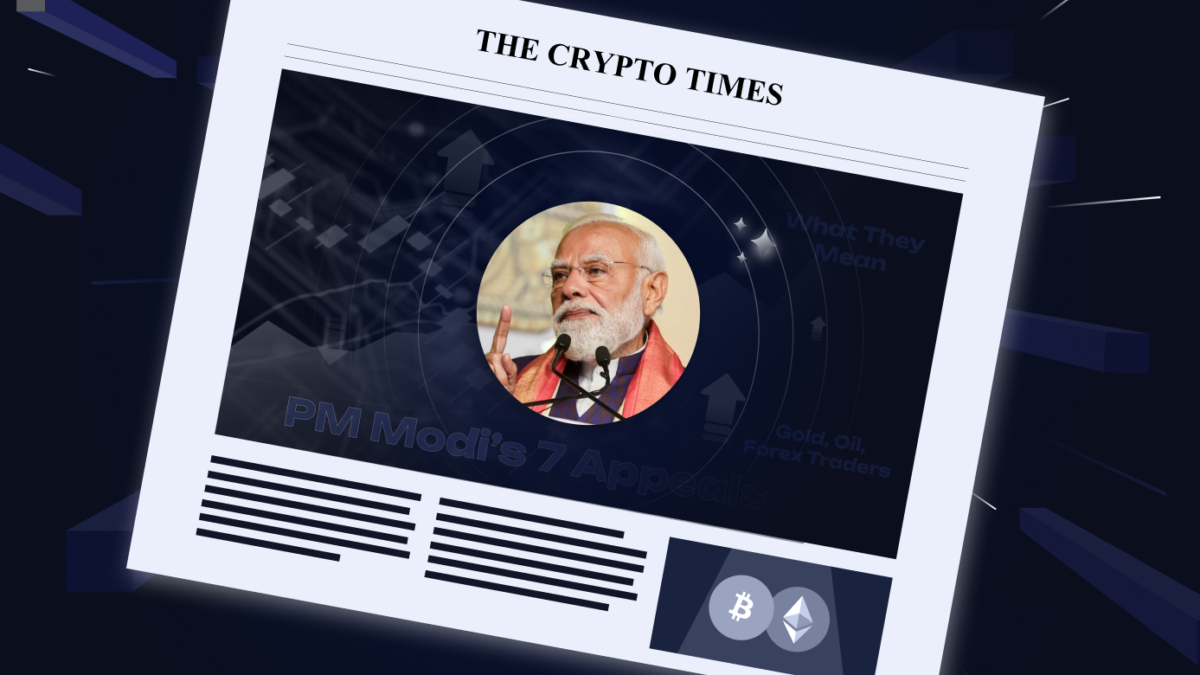


PM Narendra Modi made an unusual appeal to the nation on May 10, 2026. Speaking at a public gathering, he urged citizens to change their daily habits, like cutting down on gold purchases, working from home, avoiding foreign holidays, carpooling, and reducing cooking oil consumption
Below is the post, where Modi outlined the appeals directly to citizens:
However, when gold fall ₹8,700 per 100 grams in three sessions, jewellery stocks crash over 10%, and forex reserves bleed $7.8 billion in a single week, the implications go well beyond civic duty.
Here is what each appeal means, where the numbers stand, and what readers need to watch.
Why Modi Made This Appeal Now
The major catalysts are the West Asia crisis and a near-blocked Strait of Hormuz. Crude oil is trading above $100 per barrel and touched a 52-week high of $126 per barrel at the end of last month.
India imports over 88% of its crude requirements. The blockade has pushed fuel costs, the trade deficit, and the rupee under simultaneous stress. Indian rupee traded between 85–86 at the end of 2024, to above 90 in late 2025, and is now hovering around 94–95 in May 2026, the worst annual performance since the early 2010s. The Rajnath Singh-led 5th Informal Group of Ministers (IGoM) confirmed India currently holds 60 days of crude oil, 60 days of natural gas, and 45 days of LPG rolling stock.
Additionally, India’s forex reserves fell by $7.794 billion to $690.693 billion during the week ended May 1, per official sources. In the previous week of April 24, reserves had declined by $4.82 billion to $698.487 billion. The reserves hit an all-time high of $728.494 billion in late February before it tumbled amid the West Asia crisis.
Government sources have clarified there is no immediate shortage of essential commodities and have advised against panic buying, framing the message as responsible citizenship rather than austerity driven by crisis.
PM Modi’s 7 Appeals — The Full List
Modi outlined seven practical appeals centred on “Nation First, Duty Above Comfort.”
1. Avoid Gold Purchases for One Year
While India is one of the world’s largest consumers of gold, it produces very little domestically, and import most of its gold, jewellery, coins, bars, via US dollars. In FY26, India’s gold import bill reportedly touched approximately $72 billion, widening the trade deficit. Gold accounts for approximately 9–10% of India’s total import bill.
The sentiment hit prices immediately. The price of 24 Karat gold fell by ₹22 per gram to ₹15,213, while 22 Karat gold slipped ₹20 per gram to ₹13,945 on May 11. Over the last three trading sessions, 24K gold had fallen by a total of ₹8,700 per 100 grams. Similarly, Gold and jewellery stocks plunged over 10% following the appeal. The Jewellers Association sought a meeting with the PMO, protesting that the gold appeal had impacted their livelihoods.
For market observers, Gold’s dip is sentiment-driven, not structurally bearish. International gold prices remain elevated on safe-haven demand from the same geopolitical crisis Modi cited. Any easing of Hormuz tensions or a ceasefire signal will reverse India’s gold correction faster than the appeal caused it.
Read our Gold Price Prediction for a full breakdown of gold price levels and targets,
2. Avoid Non-Essential Foreign Travel for One Year
Modi asked citizens to temporarily avoid overseas vacations, foreign weddings, and non-essential foreign travel for at least a year. Close to 58% of total remittances under the Liberalised Remittance Scheme, which stood at $30 billion in FY25, have been for international travel, up from 35% in FY19.
A sustained drop in outbound travel spending would ease LRS outflows and provide mild support to the rupee. Watch USD/INR closely, any formal policy measure restricting travel or adding an LRS surcharge would be a sharper market event than the appeal alone.
3. Work From Home Wherever Possible
Modi said systems adopted during the pandemic, including online conferences, remote work, and video meetings had already proven effective and should now be revived “in the national interest.” The renewed push for remote work is aimed at reducing fuel consumption as the Strait of Hormuz crisis pushes energy costs higher.
4. Reduce Petrol and Diesel Consumption — Carpool, Use Public Transport
Modi urged citizens to conserve foreign exchange by reducing fuel consumption through public transport and carpooling, noting that oil accounts for 20% of India’s total imports. India’s strategic petroleum reserves were only approximately 64% filled, providing roughly 10 days of cover during disruptions well below the 90-day international benchmark. China, by comparison, holds six months of reserves.
India’s thin strategic reserve with $100+ crude and a blocked Strait is a critical vulnerability. Any escalation in Hormuz tensions will push Brent higher and widen India’s import bill directly.
See our Crude Oil Price Prediction for current crude price levels and targets.
5. Reduce Edible Oil Consumption
Next, the PM urged farmers to reduce dependency on imported chemical fertilisers while asking citizens to reduce edible oil consumption, both dollar-heavy import categories that widen the current account deficit during a crisis.
6. Adopt EVs and Use Railways for Cargo
Modi also urged citizens to adopt electric vehicles and asked businesses to utilize railway networks for parcel and cargo movement instead of road transport, saying this would lower fuel dependency and support long-term energy security.
7. Promote Vocal for Local, Prioritise Made-in-India
Championing the Vocal for Local movement, Modi stressed that self-reliance and organic farming are essential for India to achieve its Viksit Bharat goal by 2047. He further urged citizens to buy Indian-made shoes, bags, and accessories instead of imported equivalents.
What Analysts and Economists Say
JM Financial said: “We believe that the PM’s call for conserving forex reserves is a precursor to actual austerity measures in the coming weeks if the conflict does not end.” It added the speech “should be considered as market signalling before the actual measures are announced.”
Nomura India said the speech is a signal that the government is preparing citizens for potential policy announcements in coming weeks to reduce pressure on the twin deficits.
Another market analyst added “The call for austerity has a bit negative implication for economic growth in FY27. Particularly, the industries related to the austerity call like petroleum, chemical fertilisers, gold, air travel, hotel and related sectors will be sentimentally impacted.”
Prof. Arun Kumar, Distinguished Economist and Professor, argued that India needs both short and long-term structural responses. In the near term, he said the government must distinguish between essential and non-essential consumption. Long-term, he stressed investment in R&D, renewable energy, and strategic reserves. “Let us hope for the best, but prepare for the worst,” he said.
Prof. Santosh Mehrotra, Visiting Professor at the University of Bath and Research Fellow, said structural reform must accompany citizen appeals. “There is just no getting away from that. You have to raise prices. Let’s get down to serious macro-economic policy making.”
The Numbers Traders Are Watching
Here’s a snapshot of the key market indicators, traders in India are tracking in real time.
| Indicator | Current Level | Direction | What to Watch |
|---|---|---|---|
| Crude oil (Brent) | $100–$126/barrel | ↑ 52-week high | Hormuz ceasefire signal |
| India forex reserves | $690.69 billion | ↓ -$12.6B in 2 weeks | Weekly data release every Friday |
| USD/INR | ~94–95 | ↑ Rupee at decade low | LRS data, central bank intervention |
| 24K Gold (India) | ₹15,213/gram | ↓ -₹8,700/100g in 3 days | International XAU/USD + PMO follow-up |
| Gold/Jewellery stocks | Down 10%+ | ↓ Post-appeal selloff | Jewellers Association PMO meeting outcome |
| India strategic oil reserve | ~10 days cover | Critical | Any Hormuz resolution news |
What This Means If You Trade Gold, Oil, or Silver
Gold: The Modi appeal created a short-term sentiment dip. 24K gold has fallen ₹8,700 per 100 grams over three sessions. It does not change India’s structural position as a major gold buyer, cultural demand for weddings, festivals, and savings will reassert. A Hormuz resolution removes the safe-haven bid; an escalation pushes international gold higher.
Silver: Silver prices remained unchanged for the third consecutive day at ₹2,75,000 per kilogram as of May 11, after a sharp ₹10,000 jump in the previous session. Silver moves alongside gold but is also an industrial metal, any slowdown in domestic manufacturing from high oil costs adds downside pressure.
Crude oil: India’s thin strategic reserve and heavy import dependence mean any Hormuz escalation hits India harder than most economies. India holds only approximately 10 days of strategic petroleum reserve cover versus China’s six months. Traders positioned in oil should watch the Iran-US ceasefire timeline closely. The Week, citing CNN, reported that the month-long truce remains fragile, with the Strait of Hormuz still facing maritime tensions.
Forex (USD/INR): The rupee has depreciated over 10% in recent periods, from around 85–86 at end-2024 to 94–95 now. Modi’s appeal is the soft version of forex conservation policy. The hard version, formal LRS restrictions, travel taxes, or import duties on gold would be a sharper market event. JM Financial and Nomura both flagged formal measures as likely if the conflict continues.
FAQs
1. Why did PM Modi ask Indians not to buy gold?
India imports most of its gold using US dollars. In FY26, the gold import bill touched approximately $72 billion, making gold nearly 9–10% of India's total import bill. Every large-scale gold purchase adds to dollar outflows and pressures the rupee and foreign exchange reserves, a problem that compounds when crude oil prices are already elevated due to the West Asia crisis.
2. Is Modi's appeal mandatory, do Indians have to stop buying gold?
No. Modi's statement is an economic appeal, not a legal order. There are no penalties or restrictions on gold purchases. It is a voluntary call to reduce discretionary spending.
3. What are PM Modi's 7 appeals to the nation?
Modi's seven appeals, made on May 10–11, 2026 in Hyderabad and Vadodara, are: (1) avoid gold purchases for one year, (2) avoid non-essential foreign travel for one year, (3) work from home wherever possible, (4) reduce petrol and diesel consumption through carpooling and public transport, (5) reduce edible oil consumption, (6) adopt EVs and use railways for cargo, and (7) prioritise Made-in-India products under the Vocal for Local initiative.
4. How much have India's forex reserves fallen?
India's forex reserves fell by $7.794 billion to $690.693 billion in the week ended May 1, 2026, having also declined $4.82 billion the previous week. The reserves peaked at $728.494 billion in late February before the West Asia crisis triggered sustained outflows.
5. Why are gold prices falling in India after Modi's speech?
Over three trading sessions following Modi's appeal, 24K gold fell ₹8,700 per 100 grams in India, driven by profit booking and weakened demand sentiment. International gold prices remain supported by the same geopolitical uncertainty that prompted the appeal.
6. Will the government announce formal austerity measures?
JM Financial believes the PM's speech is a precursor to actual austerity measures in coming weeks if the conflict does not end, and that "such fiscal and monetary measures would cushion the currency from further depreciation."
Additional Read:
1. Silver Price Prediction
2. Crude Oil Price Prediction
3. Is Forex Trading Legal in India?
Disclamier: This article is for informational purposes only and does not constitute financial or investment advice on gold, silver, crude oil, foreign exchange, or any other commodity or asset class. The views of economists and analysts quoted in this article are their own and do not represent the views of CoinDCX or its affiliates. All market data, including gold rates, USD/INR, crude oil prices, and forex reserve figures, reflects information available at the time of writing (May 12, 2026) and may not reflect current market conditions. Always verify live prices before making any trading or investment decisions. CoinDCX does not guarantee the accuracy of third-party data cited in this article.