
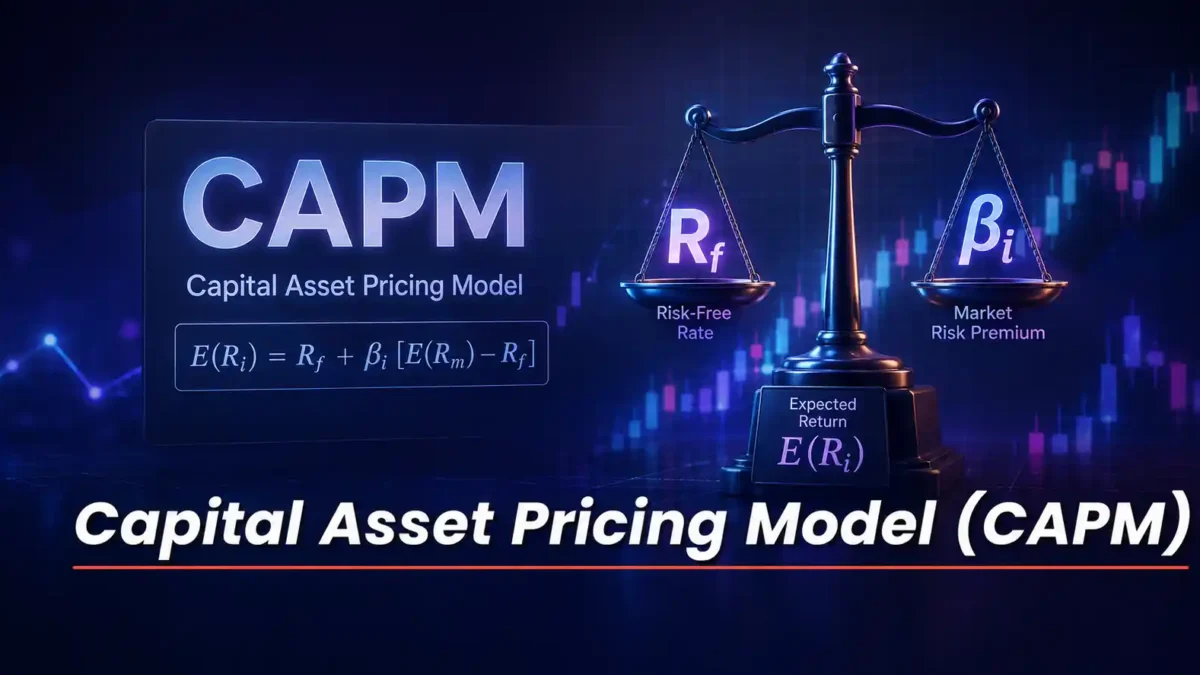


Introduction
One of the oldest questions in investing is how much return you should expect for the risk you take. In the 1960s, finance researchers built a model to answer exactly that, and it is still taught everywhere.
You will learn the full form and meaning of CAPM, the idea behind it, the formula and what each part does, how it links to the ‘cost of equity’, and where the model falls short, particularly for crypto.
What Is CAPM (Capital Asset Pricing Model)?
CAPM stands for the ‘Capital Asset Pricing Model’. It is a formula developed in the 1960s, principally by the economist William Sharpe, who later received the Nobel Prize in Economics for the work. It answers a single question: given how risky an asset is, what return should an investor reasonably expect from it?
The reasoning is intuitive. Put money into something very safe and you expect only a small return. Take on more risk and you should be compensated with the prospect of a higher one, because otherwise there would be no reason to accept the risk. CAPM formalises that relationship between risk and return.
How CAPM Links Risk and Return
CAPM splits risk into the part that gets rewarded and the part that does not. That split is the whole basis of the model.
Investors should only be rewarded for ‘market risk’, meaning risk you cannot escape by spreading money across many investments. Risk specific to one company, such as a factory fire or a failed product, can be reduced by diversifying, so the model assumes nobody pays you extra for carrying it. What does earn a reward is exposure to the whole market rising and falling, measured by ‘beta’.
The CAPM Formula
The formula looks technical, but each component is simple once separated out.
Expected Return = Risk-Free Rate + Beta x (Market Return – Risk-Free Rate)
Each part of the formula does a specific job.
Risk-Free Rate
The return you could earn with almost no risk, usually taken from a safe government bond. It is the baseline reward for parking money safely. Every expected return in the model is built on top of this floor.
Beta
A measure of how much an asset moves with the overall market. A beta of 1 moves broadly in line with the market, above 1 amplifies the market’s moves, and below 1 dampens them. Beta measures co-movement with the market rather than total volatility, so an asset can swing wildly on its own and still carry a low beta if those swings are unrelated to the market. A negative beta means the asset tends to move in the opposite direction.
Market Return
The average return expected from the whole market, for example a broad stock index, over time. It is an estimate rather than an observable figure, which is one of the model’s weaker points. Different analysts using different assumptions will produce different answers.
Market Risk Premium (Market Return minus Risk-Free Rate)
This is the extra return investors expect for accepting market risk rather than staying in safe assets. Beta then scales that premium up or down for the specific asset. If the premium were zero, there would be no reward for holding risky assets at all.
An Example of the CAPM Formula
Suppose the risk-free rate is 6 percent, the expected market return is 12 percent, and a stock has a beta of 1.5. The market risk premium is 12 minus 6, which is 6 percent. Multiply by the beta of 1.5 to get 9 percent, then add the risk-free rate of 6 percent.
The result is an expected return of 15 percent. Because this stock carries more market risk than the market itself, CAPM says investors should expect 15 percent to compensate them. Had the beta been below 1, the model would have produced a lower figure. This is an estimate produced by a theory, not a forecast.
How CAPM Calculates Cost of Equity
Companies use CAPM through the ‘cost of equity’: the return a company needs to offer shareholders to make holding its shares worthwhile, given the risk. It is the same number viewed from the other side, since what investors expect to earn is what the company must deliver.
Because CAPM estimates the expected return for a given level of risk, its output is used directly as the cost of equity, which is why the formula doubles as the standard ‘cost of equity formula’. Companies use the figure when valuing projects, comparing investments, and calculating their overall cost of raising money.
Limitations of the CAPM Model
It also leans on inputs that are hard to pin down. Beta is calculated from past price data, but the past does not reliably predict the future and beta itself drifts over time. The expected market return is an estimate, so two analysts can reach different conclusions from the same formula. Decades of research have also found that real returns do not line up with beta as neatly as the model implies. Treat CAPM as a framework for thinking about risk and return, and as one input among many.
Does CAPM Work for Crypto?
The principle behind CAPM, that higher risk should carry a higher expected return, is a useful lens for any investment. Crypto is high-risk, so investors reasonably demand the prospect of higher returns in exchange.
Applying the formula itself is another matter. Crypto is extremely volatile, its beta is unstable and hard to measure, and there is no agreed ‘market’ for it in the way a broad stock index represents equities. Correlations with traditional markets also shift, which undermines the stable beta the model assumes. Use CAPM to understand why risk and reward are linked, not as a calculator for crypto returns. In India, crypto is a Virtual Digital Asset taxed at a flat 30 percent plus a 4 percent cess and any applicable surcharge, with a 1 percent TDS on transfers and no set-off for losses.
FAQs
Q1. What is the full form of CAPM?
The full form of CAPM is the 'Capital Asset Pricing Model'. It is a finance formula from the 1960s, associated above all with the economist William Sharpe, that estimates the return an investor should expect from an asset based on its risk. Investors use it to think about expected returns, and companies use it to estimate their cost of equity.
Q2. What is the CAPM formula?
The CAPM formula is: Expected Return = Risk-Free Rate + Beta x (Market Return minus Risk-Free Rate). The risk-free rate is the return from a very safe investment such as a government bond, beta measures how much an asset moves with the market, and the bracket is the 'market risk premium', the extra return for accepting market risk.
Q3. What is beta in the CAPM model?
Beta measures how much an asset's price moves with the overall market. A beta of 1 moves in line with the market, above 1 amplifies market moves, and below 1 dampens them. It captures co-movement rather than total volatility, so a highly volatile asset can still have a low beta if its moves are unrelated to the market.
Q4. What is the cost of equity, and how does CAPM relate to it?
The cost of equity is the return a company must offer shareholders to make investing in its shares worthwhile, given the risk. Because CAPM calculates the expected return for a given level of risk, its output is used directly as the cost of equity. Companies use the figure to value projects and work out their cost of raising money.
Q5. What are the limitations of the CAPM model?
CAPM is a simplified theory rather than a reliable predictor. It assumes all investors think alike, share the same information, and can borrow at the risk-free rate. Its inputs are also hard to pin down: beta comes from past data and drifts over time, and the expected market return is only an estimate. Research has found real returns do not track beta as closely as the model suggests.
Q6. Can I use CAPM to value crypto?
Not the formula itself. The principle, that higher risk should come with higher expected return, applies to crypto as to anything else. But crypto is extremely volatile, its beta is unstable, its correlation with traditional markets shifts, and there is no agreed 'market' for it, so the maths does not transfer cleanly.
CAPM captures one of investing's most important truths, that risk and expected return travel together, even though the formula itself has real limits. Build your understanding of risk, return, and crypto with CoinDCX's education guides, treat any model as a guide rather than a guarantee, use only FIU-IND registered platforms, and never invest more than you can afford to lose.