


Introduction
If you spend time reading about crypto trading, you will come across the ‘Wyckoff method’, sometimes called ‘Wyckoff theory’. It is one of the oldest and best-known approaches to technical analysis, the study of price charts.
You will learn the meaning of Wyckoff theory, something about Richard Wyckoff himself, key ideas such as accumulation and distribution, what a ‘Wyckoff pattern’ is, and how cautiously it should be used in crypto.
What Is Wyckoff Theory?
Wyckoff theory and the Wyckoff method are two names for the same thing: a framework for studying how prices move by looking closely at price action and trading volume together. The core idea is simpler than the terminology suggests.
Markets tend to move in repeating cycles driven by the balance between buying and selling. Wyckoff’s approach interprets those cycles by watching how price and volume behave, aiming to work out roughly what stage of a cycle a market might be in. It is a way of reading charts and a lens for thinking about market behaviour. It is not a formula that tells you what happens next, and it produces no guaranteed signals.
Who Was Richard Wyckoff?
Richard Wyckoff was a real historical figure rather than a modern invention, and a little background puts the method in context.
Wyckoff, who lived from around 1873 to 1934, was an American stock trader, investor, and financial educator in the early twentieth century. He studied the markets of his day closely, developed his approach to analysing price and volume, and taught it widely through his writing. The core ideas were formed for the stock markets of a century ago, which is worth remembering when applying them to modern crypto markets.
The Three Wyckoff Laws and the Composite Man
Wyckoff’s method rests on two central ideas that come up repeatedly: his three laws and the Composite Man.
The three laws are supply and demand, cause and effect, and effort versus result. The first looks at whether buyers or sellers are in control. The second links a period of quiet preparation to the size of the move that follows. The third compares the effort a market makes, seen in volume, with the result it achieves, seen in price, on the reasoning that heavy volume producing little movement suggests something has changed. Wyckoff also used a teaching device called the ‘Composite Man’, which invites you to imagine all the buying and selling being done by one large operator. That is a mental model for learning, not a literal claim that you can detect and follow what large players are really doing.
Wyckoff Accumulation, Distribution and Patterns
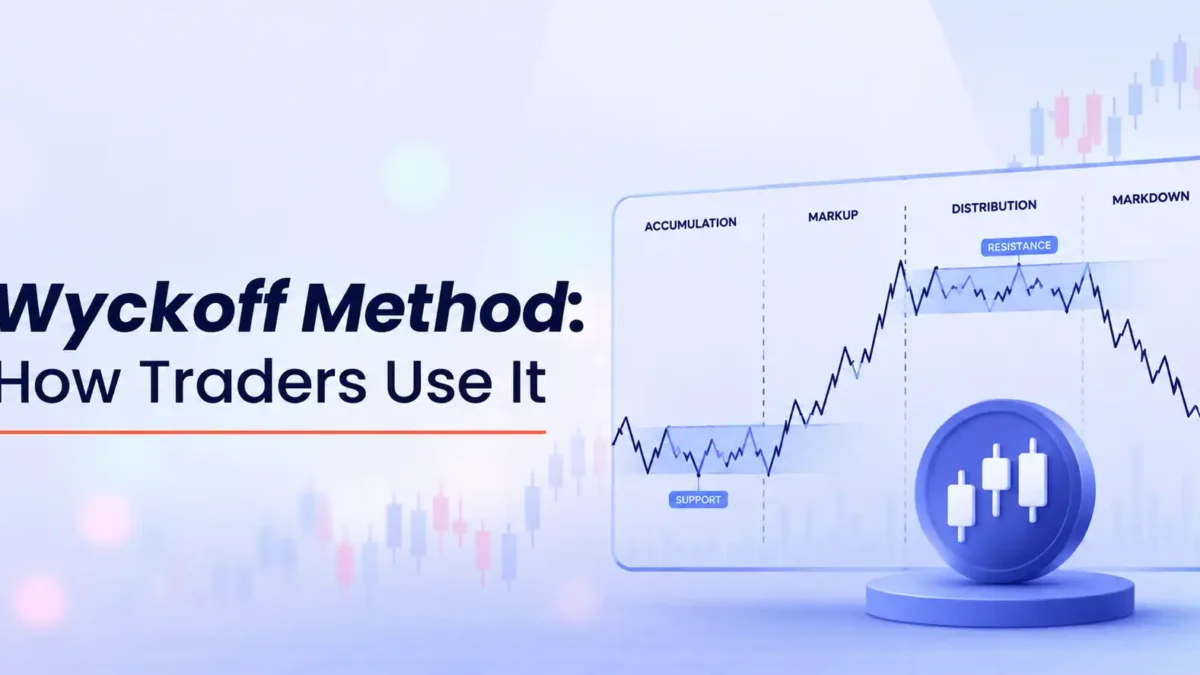
The most recognisable part of Wyckoff’s work is how it describes market cycles in stages, usually drawn as diagrams. Those diagrams are what people mean by a ‘Wyckoff pattern’.
Wyckoff describes a full market cycle as moving through four broad phases: accumulation, markup, distribution, then markdown. Accumulation is a period where buying is said to happen quietly, often after a decline, and markup is the rise that may follow. Distribution is a period where selling happens quietly, often after a rise, and markdown is the fall that may follow. Accumulation and distribution attract the most attention because they are the turning points. They are frequently drawn as idealised diagrams breaking a phase into labelled stages, often lettered A through E.
How Traders Use Wyckoff Theory in Crypto
Some crypto traders apply Wyckoff ideas to crypto charts, using its phases and diagrams to interpret market cycles. The cautions below are serious enough to keep in mind.
Wyckoff, like all technical analysis, is descriptive rather than predictive. It offers a way to interpret what price and volume may be doing, and it does not tell you what will happen or generate buy and sell signals. Anyone presenting Wyckoff as a system that reliably reveals what ‘smart money’ is doing, or that lets you front-run large players, is overstating what it can do.
Using Wyckoff Theory Safely in India
Wyckoff theory is a respected, century-old framework for thinking about price and volume, and it can be interesting to learn as a way of organising how you look at charts. It is a way of interpreting markets rather than predicting them, and it is least reliable of all in crypto.
If you are learning, focus on market basics and risk rather than chasing patterns, and treat any framework as a tool for thinking rather than a source of signals. Most traders lose money over time, and no chart method changes that. In India, crypto is a Virtual Digital Asset taxed at a flat 30 percent plus a 4 percent cess and any applicable surcharge, with no set-off for losses and a 1 percent TDS deducted on transfers, so keep good records and consult a qualified chartered accountant. Use only FIU-IND registered platforms, protect your seed phrase, and never invest more than you can afford to lose.
FAQs
Q1. What is Wyckoff theory?
Wyckoff theory, also called the Wyckoff method, is an approach to technical analysis that studies price movements and trading volume together to interpret how markets move through cycles. It was developed by Richard Wyckoff in the early twentieth century. It is a framework for interpreting charts, not a formula that predicts prices.
Q2. Who was Richard Wyckoff?
Richard Wyckoff (around 1873 to 1934) was an American stock trader, investor, and financial educator active in the early twentieth century. He studied the markets of his time and developed a method of analysing price and volume, which he taught through his writing. His ideas were formed for stock markets a century ago.
Q3. What is a Wyckoff pattern?
A 'Wyckoff pattern', also called a schematic, is an idealised diagram showing how a market phase such as accumulation or distribution is said to unfold, broken into labelled stages often lettered A through E. They are simplified textbook pictures: real markets often do not follow them, and it is usually only clear in hindsight that a phase occurred.
Q4. What is accumulation and distribution in Wyckoff?
Accumulation describes a period where buying is said to happen quietly, often after a decline. Distribution describes a period where selling happens quietly, often after a rise. They sit at the turning points of a four-phase cycle running accumulation, markup, distribution, markdown. In real markets it is hard to know at the moment which phase you are in.
Q5. Does the Wyckoff method work in crypto?
Some traders do, but it is especially unreliable there. Crypto markets are extremely volatile, trade around the clock, are often thinly traded, and can be manipulated. Idealised patterns built for century-old stock markets frequently fail in crypto, so treating a Wyckoff setup as a reason to buy or sell is a fast way to lose money.