
IThe convergence of decentralized ledgers and legacy financial infrastructure requires standardized communication frameworks. Traditional banking networks rely on strict data formats to process international payments, whereas early public blockchains developed isolated data architectures that do not naturally integrate into interbank settlement channels.
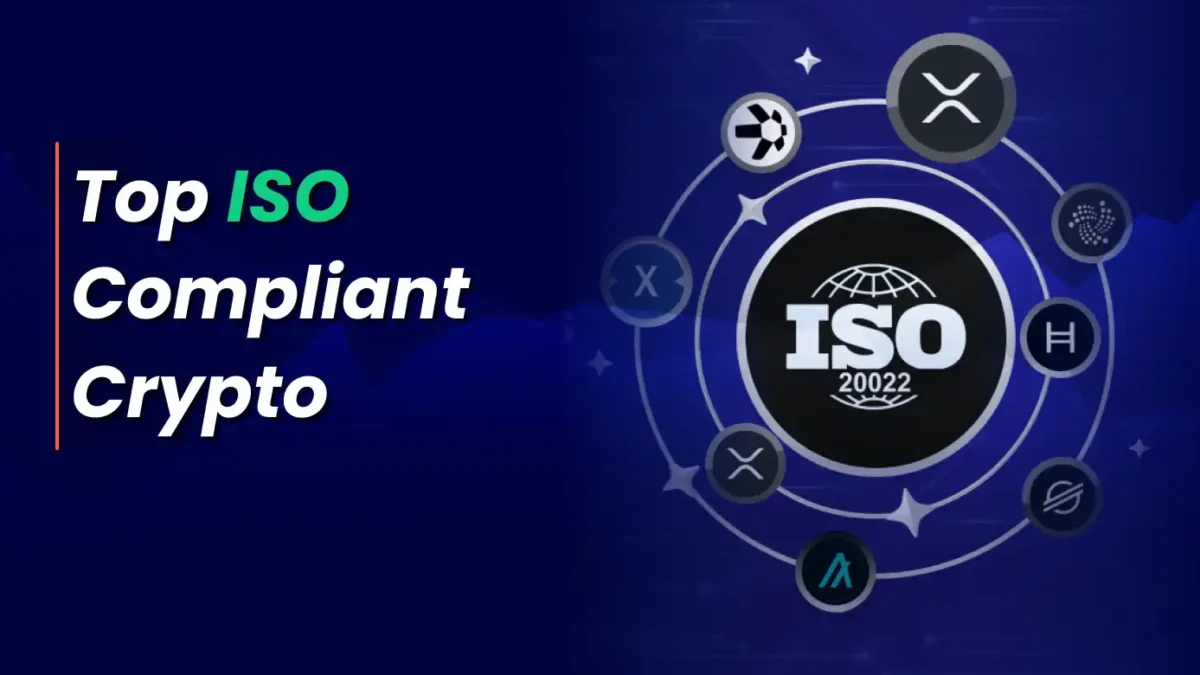
The ISO 20022 standard addresses this friction by establishing a universal, open financial messaging architecture. This guide examines the leading ISO 20022 compliant crypto assets, explores how standardized data formatting supports institutional adoption, evaluates primary network use cases, and outlines how Indian investors can access these assets securely.
What Is ISO 20022?
ISO 20022 is an international messaging framework established to standardize electronic data interchange between global financial institutions. It replaces legacy messaging protocols with structured, XML-based data packets that carry comprehensive payment descriptions, compliance records, and counterparty data.
When applied to digital assets, ISO 20022 alignment means a blockchain’s native transaction architecture can carry standardized data fields recognized by central banks and clearinghouses.
Key Points:
- ISO 20022 provides a consistent structure for financial data.
- It improves accuracy and reduces errors in transactions.
- This alignment makes crypto more compatible with existing financial systems.
- There is no formal ISO 20022 certificate a blockchain can hold. Networks are described as aligned or compatible when their data structures and messaging support the standard.
List of ISO 20022-Compliant Crypto (2026)
Here is the list of top ISO-compliant crypto in 2026, along with their price, use case, and network focus.
| Token | Price | Market Cap | Primary Use Case |
|---|---|---|---|
| XRP | $1.41 | $88,880,000,000 | Cross-border payments |
| XLM (Stellar) | $0.19 | $6,050,000,000 | Global remittances |
| XDC (XDC Network) | $0.028 | $588,000,000 | Trade finance |
| IOTA (IOTA) | $0.05 | $225,000,000 | Data and IoT payments |
| ALGO (Algorand) | $0.10 | $920,000,000 | Scalable finance |
| QNT (Quant) | $64.13 | $774,000,000 | Network interoperability |
| HBAR (Hedera) | $0.0767 | $3,360,000,000 | Enterprise-grade payments |
Price and market cap data updated 17 September 2026. Source: CoinMarketCap.
1) XRP (Ripple)
XRP focuses on fast cross-border settlements for payment corridors. It aims to reduce delays that happen in traditional international transfers. Ripple builds tools that help institutions move value with clearer messaging. ISO alignment enables structured transaction data to be shared across systems. This can help banks reconcile and process transfers with less friction. XRP also aims to keep transaction costs relatively low. It remains the largest asset on this list by market capitalisation and is the one most often discussed in the context of payment infrastructure.
Also Read: XRP Price Prediction
2) XLM (Stellar)
XLM supports global value transfers with a focus on accessibility. It is often linked to low-cost remittances and simple payment flows. Stellar helps connect financial services, especially in regions with limited access to them. ISO compatibility supports easier interaction with formal payment systems. The network also supports asset issuance, which can represent real-world value, and its Soroban smart contract environment has extended that into lending and tokenised asset applications. This makes Stellar relevant for payments and tokenised assets alike.
Also Read: XLM (Stellar) Price Prediction
3) XDC Network
XDC targets enterprise blockchain use, with a strong focus on trade finance. It supports workflows linked to invoices, supply chains, and settlement processes. Many trade finance systems require structured, auditable data formats. ISO alignment supports consistent financial data exchange across parties, and XDC is among the networks formally registered with the ISO 20022 standards body. XDC also supports hybrid setups that mix private and public access. This model can suit institutions that need controlled participation.
Also Read: XDC Price Prediction
4) IOTA
IOTA focuses on data integrity and microtransactions within IoT ecosystems. It aims to support machine-to-machine value exchange at scale. Many IoT use cases need frequent, small transfers with clear data trails. ISO compatibility supports standardised messaging for those data-heavy environments. IOTA is also known for its approach to scalable network design built on a directed acyclic graph rather than a conventional chain. It supports scenarios where devices exchange both data and value, which can fit logistics, mobility, and smart infrastructure systems.
5) Algorand (ALGO)
Algorand supports scalable blockchain applications built for speed and security. It aims to offer fast finality and consistent network performance. Many institutional use cases require predictable settlement behaviour. ISO alignment improves the network’s fit with enterprise integration needs. Algorand supports tokenisation, enabling assets to be represented on-chain, and carries a fixed maximum supply of 10 billion ALGO. It also supports payment and settlement-style applications, making it relevant for structured finance and digital asset infrastructure.
6) Quant (QNT)
Quant focuses on interoperability across blockchain networks and systems. It uses Overledger to connect different ledgers and technologies. Many institutions operate across multiple platforms and databases. ISO alignment supports standardised communication between these environments, and Quant is one of the few projects on this list with direct participation in ISO 20022 standards work. Quant often appears in discussions about enterprise connectivity layers. It aims to simplify cross-network integration so organisations can build solutions without locking into one chain.
Also Read: Quant Price Prediction
7) Hedera (HBAR)
Hedera supports enterprise-grade distributed ledger services for payments and data. It uses hashgraph consensus to enable high throughput and fast confirmation. Many business use cases need predictable speed and stable fee structures. ISO compatibility supports clearer interaction with financial systems and standards. Hedera also focuses on governance models suited to enterprise adoption, with a council of global organisations operating its nodes. It supports token services, smart contracts, and data integrity tools, making it relevant for institutions that want structured, high-performance infrastructure.
Also Read: HBAR Price Prediction
Why ISO Compliance Matters for Crypto
Financial institutions process trillions of dollars daily using standardized messaging systems that prioritize data security, automated reconciliation, and strict regulatory reporting. Early public blockchains were developed with proprietary data formats that cannot communicate natively with legacy banking infrastructure.
Adopting ISO 20022 formats eliminates this structural barrier by establishing a shared communication protocol between decentralized ledgers and centralized clearinghouses.
With structured messaging, transaction packets contain clear legal identifiers, sender addresses, tax information, and remittance data. Commercial banks can ingest these on-chain transfers directly into their automated compliance, fraud-detection, and auditing pipelines without requiring manual data intervention. This compatibility reduces operational costs and lowers technical adoption hurdles for institutional participants.
Benefits of ISO-Compliant Coins
ISO-compliant crypto offers faster cross-border payments and better integration with traditional financial systems, as discussed below.
- Faster Cross-Border Settlements: Standardised messaging reduces delays in transaction processing. Payment instructions become easier for systems to interpret. Automation improves settlement speed across borders. This reduces manual intervention and operational friction. Efficient settlements support smoother international payment flows.
- Improved Readiness For Institutional Adoption: Banks prefer systems that follow recognised standards. ISO alignment makes crypto networks easier to assess and integrate. Institutions can test blockchain solutions with fewer technical barriers. This supports controlled experimentation and gradual adoption. Standardisation builds operational confidence over time.
- Better Integration With Legacy Financial Systems: Legacy banking systems rely on ISO-based messaging formats. Compatible crypto networks reduce the need for custom integrations. This lowers implementation complexity and costs. Systems can exchange data with fewer translation layers. Integration becomes smoother and more reliable across platforms.
Future of ISO 20022-Compliant Crypto
The ongoing migration of global financial infrastructure toward ISO 20022 standards marks a structural transition in international payment routing. As major central banks, commercial clearinghouses, and payment switches complete their migration schedules, interoperability with standardized messaging will become mandatory for institutional finance.
Crypto networks that prioritize technical alignment with these standards establish a durable foundation for enterprise utility. While technical compliance does not guarantee token price appreciation or protect against market volatility, it positions aligned networks to function as settlement infrastructure in an increasingly digitized global economy.
How Can I Invest in ISO-Compliant Coins?
You can explore ISO-compliant coins on CoinDCX if they are listed on the platform. CoinDCX lets you view token details, market data, and basic risk information before you place any order. Crypto carries market risk, so it helps to start slowly and learn as you go.
Step 1: Create your CoinDCX account
Download the CoinDCX app or use the web platform and sign up with your details. Use a strong password and enable security options, such as 2FA, if available. This helps protect your account from unauthorized access.
Step 2: Complete KYC verification
Finish the identity verification steps as required on CoinDCX. KYC helps the platform follow compliance requirements and supports safer account access. Keep your documents ready so the process stays smooth. After approval, you can use more account features.
Step 3: Add funds to your wallet
Deposit INR using the payment methods supported on CoinDCX. Check deposit limits, fees, and processing times before you confirm. Start with an amount you are comfortable using for learning. Avoid using money meant for essentials.
Step 4: Find ISO-compliant coins on the platform
Use the search bar to look up coins often discussed in ISO 20022, such as XRP, XLM, XDC, ALGO, QNT, HBAR, or IOTA. Availability can change based on listings and policies, so confirm inside the app. Open each token page to review key details. Focus on the use case, network purpose, and recent updates.
Step 5: Study the token before you act
Read the token description and understand what the project aims to solve. Check liquidity indicators, such as volume and order book depth, if available. Review price history to understand volatility patterns. Learn what drives demand for that network beyond hype.
Step 6: Choose an order type and place your order
Decide whether to place a market or a limit order based on what CoinDCX offers. Market orders execute fast but may vary in final price during volatility. Limit orders let you set a preferred price but may not fill quickly. Confirm the quantity and re-check the final order summary.
Step 7: Track your holdings and manage risk
After purchase, monitor your portfolio inside CoinDCX. Use price alerts if available, since crypto can move quickly. Avoid frequent trades if you are still learning. Consider using small test buys to understand how orders work.
Step 8: Store and review periodically
Keep your coins in your CoinDCX wallet unless you have a clear reason to move them. Review your holdings periodically instead of reacting to daily price noise. Focus on learning the project fundamentals and on the ecosystem’s progress. Make decisions based on information, not urgency.
Bringing Digital Assets Closer to the Financial World
The alignment of blockchain protocols with ISO 20022 standards represents a significant milestone in bridging decentralized technology with traditional finance. By speaking a shared electronic language, aligned networks enable traditional financial institutions to experiment with distributed ledger settlement without replacing their core software stacks.
Standardization emphasizes long-term utility, audit transparency, and cross-platform reliability over short-term market speculation. As international financial systems continue to modernize, ISO 20022 compliant crypto assets provide the technical infrastructure necessary for seamless collaboration between traditional banking and the digital asset economy.
As global finance continues to evolve, compatibility becomes increasingly important. ISO-compliant crypto supports long-term relevance in this changing environment. CoinDCX helps users understand such foundational developments within the crypto ecosystem. These standards reflect a gradual shift toward more connected financial systems. ISO-compliant crypto represents progress toward smoother collaboration between digital and traditional finance.
FAQs
Q1: What does ISO 20022 mean for crypto?
ISO 20022 compliance means a blockchain network's data structures and messaging formats are technically compatible with the international financial messaging standard used by global banks. This compatibility allows on-chain transactions to carry detailed payment metadata that legacy banking systems can process automatically.
Q2: Are ISO-compliant coins safer?
ISO compliance improves the way transaction information is processed and shared across systems. It helps reduce errors caused by unclear or inconsistent financial messages. However, it does not protect users from market volatility or price fluctuations. Crypto assets remain subject to market risks. ISO standards focus on technical efficiency rather than investment safety.
Q3: Which crypto is ISO 20022 compliant?
The networks most often described as ISO 20022 aligned are XRP, Stellar (XLM), XDC Network, IOTA, Algorand (ALGO), Quant (QNT), and Hedera (HBAR). XDC and Quant are among the few with direct involvement in ISO 20022 standards work. Note that no blockchain holds a formal ISO 20022 certificate, so treat compliance claims as descriptions of technical compatibility rather than accreditation.
Q4: Will banks adopt ISO-aligned crypto?
Banks generally prefer systems that follow established financial communication standards. ISO-aligned crypto networks are easier to connect with existing banking infrastructure. This reduces technical complexity during integration. However, adoption also depends on regulatory clarity and internal risk policies. ISO alignment improves the chances of long-term institutional integration.
Q5: Is Bitcoin ISO 20022 compliant?
No, Bitcoin does not use ISO 20022 messaging structures because its architecture was designed as an independent peer-to-peer electronic cash system. It operates without traditional banking data fields and does not prioritize integration with centralized clearinghouses.
Q6: Is Shiba Inu ISO 20022 compliant?
Shiba Inu does not support ISO 20022 standards for financial messaging. It operates as a token within the Ethereum blockchain ecosystem. Its development focuses mainly on community engagement and ecosystem utilities. It does not target institutional financial integration. ISO alignment is not a core objective of the project.
Additional Read:
1. Best Crypto to Invest in by Market Cap
2. Cheapest Crypto to Invest In
3. Top Coins with 1000x Potential