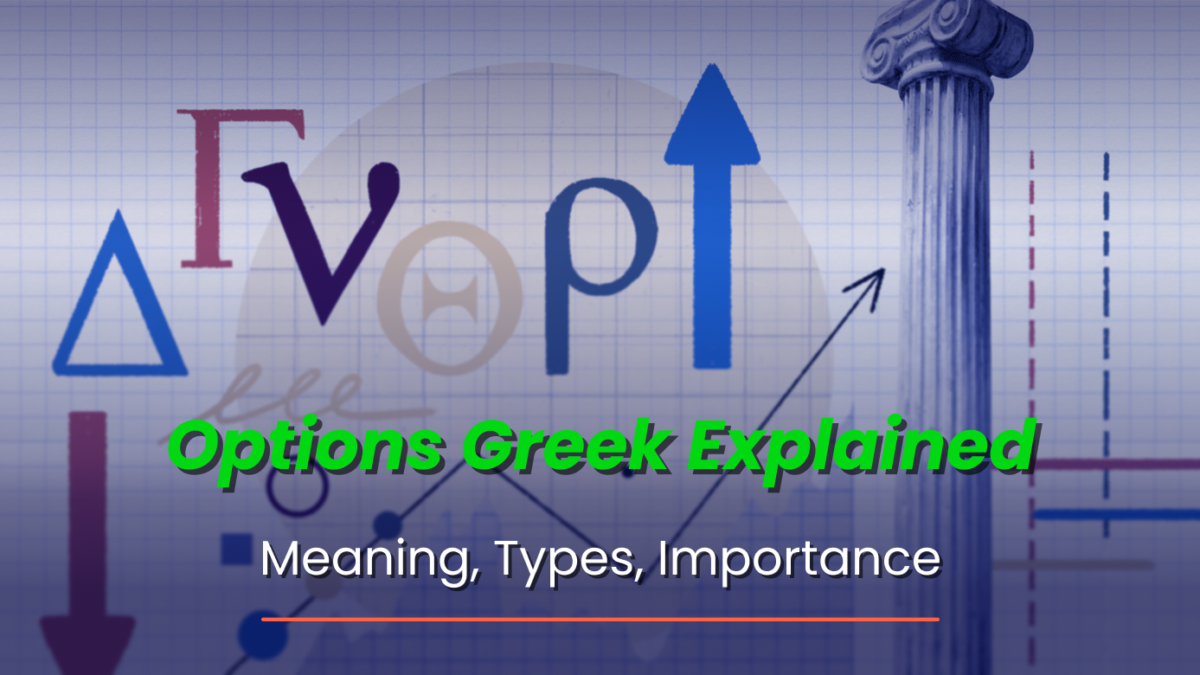


Option Greeks are mathematical measures used in options trading to understand how different factors affect the price of an option contract. In simple terms, they help answer questions such as:
- How much will the option price change if the underlying asset moves?
- How does time affect an option’s value?
- What happens when market volatility changes?
These metrics are represented by Greek letters and include, Delta, Gamma, Theta, Vega and Rho. Each metric measures a specific factor affecting option prices. Together, they act as a risk management toolkit for traders, helping them analyze potential gains, losses, and market exposure.
Types of Options Greeks
There are five primary option Greeks used in options trading. Each Greek measures a different aspect of option price sensitivity.
Delta Option Greek
The Delta option Greek measures how much the price of an option is expected to change when the underlying asset moves by $1. For example: If an option has a delta of 0.50, the option price may increase by $0.50 when the underlying asset rises by $1.
Delta values typically range from:
- 0 to 1 for call options
- 0 to –1 for put options
Delta is one of the most widely used metrics in trading option Greeks because it helps traders estimate directional exposure.
Gamma Option Greek
The Gamma option Greek measures the rate of change of Delta when the underlying asset price changes. In other words, gamma shows how quickly delta itself will change. If gamma is high: The option price becomes more sensitive to price movements in the underlying asset.
Gamma is especially important for traders managing short-term positions because it indicates how rapidly option risk can change.
Theta Option Greek
Theta measures time decay, which refers to the gradual reduction in an option’s value as it approaches its expiration date. Since options have a fixed expiry, their value naturally decreases over time. For example: If theta is –0.05, the option may lose $0.05 per day, assuming all other factors remain constant.
Theta affects short-term options more significantly, making it a crucial factor for traders holding options close to expiry.
Vega Option Greek
The Vega option Greek measures how sensitive an option price is to changes in implied volatility. Implied volatility reflects the market’s expectation of future price fluctuations.
If volatility increases, Option prices generally rise. But, if volatility decreases, Option prices may fall.
Option Vega Formula
While not a simple standalone equation, Vega represents the change in option price for a 1% change in implied volatility.
This metric is particularly important during:
- major economic announcements
- earnings reports
- market uncertainty
Rho Option Greek
Rho measures how sensitive an option price is to changes in interest rates. Although less influential than other Greeks, Rho can affect longer-dated options where interest rate changes have a greater impact.
Why Options Greeks Are Important for Traders
Understanding option Greeks explained in trading helps traders manage risk and improve decision-making. Here are the main reasons traders rely on these metrics:
Risk Management
Option Greeks allow traders to measure exposure to:
- price movements
- volatility changes
- time decay
This helps reduce unexpected losses.
Better Strategy Planning
By analyzing Greeks, traders can design strategies such as:
- delta-neutral strategies
- volatility trading strategies
- hedging positions
Understanding Option Price Behavior
Options prices may change even if the underlying asset price remains stable. Greeks explain why this happens by analyzing factors like volatility and time decay.
How Options Greeks Affect Option Prices
Several variables influence option prices, and the option Greeks help quantify these effects. The major factors affecting option prices include:
- Underlying Asset Price: Changes in the asset price directly impact options through the delta option Greek.
- Time to Expiration: The closer an option gets to expiry, the faster its value may decline due to theta.
- Market Volatility: Higher volatility increases option premiums because larger price swings increase the probability of profit. This is measured by vega option Greek.
- Interest Rates: Changes in interest rates can influence option prices, especially for long-term contracts. This effect is measured using rho.
Together, these factors determine the final price of an option contract.
How Beginners Should Use Options Greeks
For beginners, the concept of option Greeks explained may initially feel complicated. However, traders can start by focusing on the most important metrics.
- Start with Delta: Delta helps understand how the option price may move relative to the underlying asset.
- Watch Theta for Short-Term Trades: Time decay becomes more significant as expiry approaches.
- Monitor Vega During Volatile Markets: Large market events can quickly increase volatility, affecting option prices.
By combining these metrics, traders can better understand market behavior and improve trading strategies.
Conclusion
Option Greeks are essential tools in options trading because they help traders measure risk and understand how option prices react to different market conditions. Metrics such as delta, gamma, theta, vega, and rho explain the impact of price movements, time decay, volatility, and interest rates on option premiums.
By learning how option Greeks work, traders can make more informed decisions, manage risk effectively, and design better trading strategies. Whether you are a beginner or an experienced trader, understanding option Greeks explained in trading can significantly improve your ability to navigate the options market.
Read more: Check all our other Crypto options Blogs