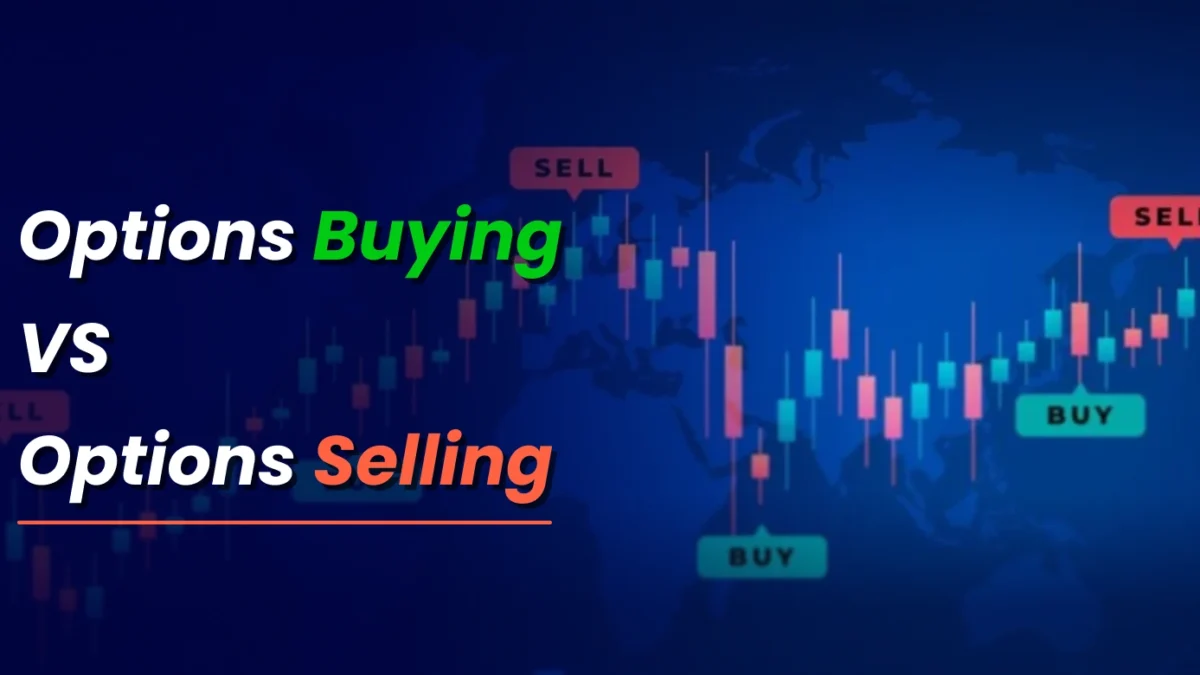


If one is new to derivatives, one question comes up very quickly: option buying vs option selling, which is better? The answer is not the same for every trader.
Some traders prefer options buying because the risk is limited to the premium paid and the setup is easier to understand. Others prefer options selling because it allows them to earn premium and benefit from time decay, especially in range-bound markets. But that comes with higher responsibility and much tighter risk control.
So, which one should you choose?
It depends on four things: your risk appetite, market view, capital, and experience level. In this guide, we break down what is options buying, what is options selling, the pros and cons of both, and how to decide between buying and selling options based on the kind of trader you are.
What Are Options Buying?
Options buying means purchasing an options contract by paying a premium upfront. In return, the buyer gets the right, but not the obligation, to buy or sell an asset at a fixed price before expiry.
There are two basic types:
- Buying a call option: used when a trader expects prices to rise
- Buying a put option: used when a trader expects prices to fall
For example, if a trader believes Bitcoin could move sharply higher after a major market trigger, they may buy a call option. If they expect a drop, they may buy a put option.
This is why many traders asking what options to buy are usually looking at it as a way to take a directional view with limited downside. The maximum loss is generally restricted to the premium paid.
Pros of Options Buying
1. Limited risk
The biggest advantage is that the maximum loss is usually limited to the premium paid.
2. High upside potential
If the market makes a strong move in the expected direction, returns can be significant relative to the premium invested.
3. Easier to understand
Options buying is more straightforward for traders who want to express a bullish or bearish view.
4. Lower upfront capital requirement
Compared to selling, buyers usually do not need to post large margins, which makes the entry barrier lower.
Cons of Options Buying
1. Time decay works against the buyer
As expiry gets closer, the option loses value. Even a correct market view may not help if the move comes too late.
2. The market needs to move enough
A small move in the right direction may still not be enough to make the trade profitable.
3. Premiums can get expensive
When volatility is high, options can become costly to buy.
4. Winning may be less frequent
Many option buying setups rely on timing, momentum, and volatility expansion, which can make consistency harder for beginners.
What Is Options Selling?
Options selling means writing an options contract and receiving premium in return. In this case, the seller takes on an obligation if the contract is exercised.
There are two common forms:
- Selling a call option: often used when the trader expects the price to remain below a certain level or stay range-bound
- Selling a put option: often used when the trader expects the price to remain above a certain level or stay stable
This is the key point behind what options sell: the seller earns premium first, but takes on more risk and responsibility.
Many traders prefer options selling because they can benefit from time decay. If the market does not make a large move, the option can lose value over time, which helps the seller.
Pros of Options Selling
1. Premium is earned upfront
The seller receives a premium when the trade is opened.
2. Time decay works in the seller’s favor
As expiry approaches, options usually lose value, which can benefit the seller.
3. Useful in sideways markets
If the market stays within a range, selling options may work better than buying.
4. Higher probability setups are possible
Some sellers prefer strategies where they profit if the market simply does not move too far.
Cons of Options Selling
1. Risk can be very high
Unlike buying, selling can expose traders to very large losses depending on the strategy.
2. Margin is required
Options selling usually needs more capital and tighter position management.
3. More advanced risk management is needed
Sellers need to understand margin pressure, stop-loss planning, and position sizing.
4. Not ideal for most beginners
The complexity and risk profile make options selling harder for new traders.
Options Buying vs Options Selling: Key Differences
When comparing option buyer vs option seller, the real difference is not just who pays or receives premium. It is also about how they make money, how much risk they take, and what kind of market suits them best.
| Factor | Options Buying | Options Selling |
| Upfront cash flow | Pay premium | Receive premium |
| Maximum loss | Limited to premium paid | Can be very high depending on strategy |
| Maximum reward | Can be large if the market moves sharply | Usually limited to premium received |
| Capital requirement | Usually lower | Usually higher due to margin |
| Time decay | Works against buyer | Works in favor of seller |
| Best market view | Strong bullish or bearish move | Neutral, range-bound, or mildly directional |
| Volatility preference | Often better when volatility may expand | Often better when volatility may cool or stay stable |
| Complexity | Lower | Higher |
| Monitoring needed | Moderate | Higher |
| Beginner suitability | More suitable | Less suitable |
How do option buyers and sellers make money?
An option buyer usually makes money when the market moves strongly in the expected direction before expiry and enough to offset the premium paid. On the other hand, an option seller usually makes money when the option loses value over time, expires worthless, or stays away from levels that would create losses.
This is why the debate around option buying vs option selling is really about market behavior. One side benefits from movement. The other often benefits from the lack of movement.
When Do Traders Choose Options Buying?
Traders usually choose options buying when they expect a sharp move in price and want clearly defined risk.
Common situations include:
- A breakout or breakdown is expected
- A major event or macro trigger is approaching
- Volatility may increase
- The trader wants capped downside
- The trader has a strong directional view
For example, if a trader expects Ethereum to rally sharply after a major market event, buying a call option may make sense. If they expect a fast decline, buying a put option may fit better.
Options buying is often preferred when a trader wants asymmetric upside with limited downside.
When Do Traders Choose Options Selling?
Traders choose options selling when they expect the market to stay within a range, remain stable, or avoid a major directional move.
Common situations include:
- The trader expects sideways price action
- The trader wants to earn premium income
- The trader is comfortable with margin and risk management
- The trader wants time decay to help the trade
- The trader uses hedged or non-directional strategies
Options selling can look attractive because of the premium collected upfront. But it should not be mistaken for “easy money.” A sudden sharp move can quickly turn a high-probability setup into a stressful loss-making trade.
Check all our other Crypto options Blogs
Which Is Better for Beginners?
For most beginners, options buying is usually the better place to start because of the reasons discussed below:
- the risk is generally limited to the premium paid
- the payoff structure is easier to understand
- the capital requirement is usually lower
- the trader can focus first on market direction before handling advanced risk
That said, beginners should not assume option buying is always easy or automatically profitable. A lot of new traders lose money because they ignore time decay, volatility, expiry timing, and poor position sizing.
So, is options trading profitable? Yes, it can be. But profitability depends less on whether you choose buying or selling, and more on whether your strategy matches the market and whether you manage risk properly.
A practical beginner path usually looks like this:
- Understand how calls and puts work
- Learn premium, expiry, and time decay
- Start with simple buying setups
- Practice position sizing and risk control
- Explore selling only after gaining experience
Common Mistakes to Avoid
Whether you are buying or selling options, a few common mistakes can hurt performance:
- Buying too close to expiry without a plan
- Paying high premium in overheated conditions
- Selling options without understanding margin risk
- Assuming high win rate means low risk
- Ignoring stop-loss and position sizing
- Trading without a clear market view
These mistakes are one reason why buying and selling options should never be treated as a shortcut to quick profits.
Conclusion
There is no one universal winner in option buying vs option selling. Options buying is generally better for traders who want limited risk, lower capital commitment, and exposure to strong directional moves. Options selling is usually better for traders who understand margin, can manage risk actively, and want to benefit from time decay in stable or range-bound markets.
For most beginners, options buying is easier to understand and safer to begin with. For more experienced traders, options selling can be a useful strategy, but only when backed by discipline and solid risk management. Before choosing between option buyer vs option seller, ask yourself three things:
What is my market view? How much risk can I take? And do I fully understand how this strategy behaves before expiry?
That matters much more than simply choosing the side that sounds more profitable.