



The U.S. Federal Reserve has kept interest rates unchanged following its first policy meeting of the year, with Chair Jerome Powell indicating that current rates now sit within a “neutral range.” While the decision itself met market expectations, the accompanying messaging has once again captured the attention of crypto markets, where investor sentiment often reacts sharply to Federal Reserve signals.
The cumulative effect of changes in U.S. monetary policy, especially during the years 2022-2025, has been a significant driver of volatility in digital asset markets. Thus, in addition to the Fed’s policy moves, traders are also examining how market participants emotionally and behaviorally respond to these decisions.
While the Fed’s decision met expectations, Bitcoin and Ethereum showed muted price reactions, reflecting cautious positioning across major crypto assets. Historically, such FOMC outcomes have triggered volatility driven less by policy changes and more by leverage, derivatives positioning, and retail sentiment dynamics.
Source: Santiment
Powell’s Guidance and the Broader Economic Context
Powell indicated in his speech that the central bank would be fine with keeping interest rates unchanged if there were no significant economic changes. By neutralizing the rate policy, the Fed hinted that it was moving away from rapid tightening or loosening and placed future decisions under data dependence.
Typically, financial markets see less uncertainty when rates stabilize. But crypto markets can sometimes be quite complicated in their reactions. Rather than policy outcomes directly triggering specific reactions, crypto market prices are often influenced by traders’ expectations, their positions, and short-term sentiment.
In the past, times when rates have stayed stable have been good for risk assets; however, crypto markets have often gone against this trend. The wild swings in prices around Federal Open Market Committee (FOMC) meetings are driven more by leverage, speculative behavior, and emotional trading than by economic fundamentals.
Retail Sentiment and Market Behavior
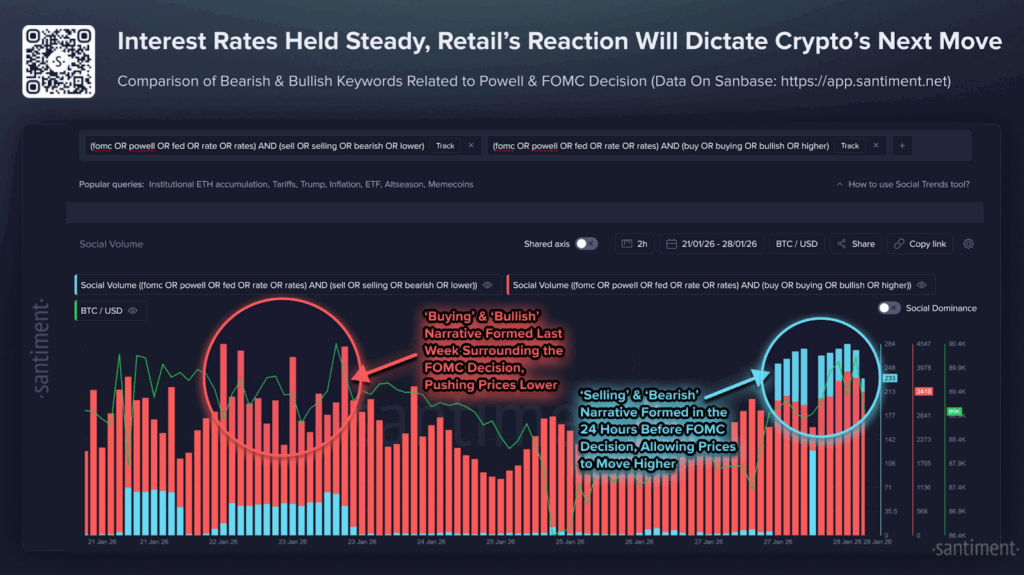
The social media response to the FOMC decision was analyzed, and it was found that a pattern keeps repeating in crypto markets. The soaring, optimistic, bullish posts are mostly seen before major policy announcements, whereas fear and bearish sentiment appear either at the event or immediately afterwards.
Market watchers report a long-standing pattern in which crypto prices move in the opposite direction from prevailing retail sentiment. The periods when investors had euphoria were often followed by price consolidation or reversals, whereas slowdowns in strong buying or outright pessimism has generally accompanied the market moving upward again.
Trade Crypto in INR on 
Deposit and withdraw in INR (₹).
No Conversion to Crypto Required.

Implications for Crypto Markets Going Forward
As the central bank has paused rate hikes, money markets, including crypto, could be more influenced by factors such as sentiment, liquidity, and positioning than by the latest policy announcement. A stable macroeconomic environment is beneficial in that it eliminates one source of uncertainty; however, it also means that the focus shifts to how market participants interpret and react to the information.
The top cryptos, including Bitcoin, have increasingly shown that it is not just government policies that matter, but also sentiment extremes. When the market is excessively optimistic, it results in a capped price rise; on the other hand, a high level of fear in the market could be the trigger to a price bottom formation or a rally.
Read more: Bitcoin Price Prediction
Bitcoin and Crypto Market Reaction
Bitcoin and Ethereum showed limited directional movement following the Fed’s decision, reflecting market indecision rather than strong conviction. Derivatives data indicated neutral positioning, while spot volumes remained subdued, suggesting traders were waiting for clearer macro signals before committing capital. This reinforces the view that sentiment, rather than policy outcomes alone, is currently the dominant market driver.
Sentiment analytics platforms such as Santiment highlight how retail psychology often leads price action, with social sentiment peaks frequently preceding local market tops.
Market watchers advise that sentiment gauges alone are unreliable tools. It is when sentiment indices are used with charts, derivatives data, and the overall market picture that they reveal their full potential.
Conclusion
By keeping interest rates unchanged, the Fed signals a period of stable monetary policy. However, for the crypto market, investor sentiment remains the main factor.
Historically, the market reaction to Fed announcements has often overshadowed the actual policy decisions in terms of impact. As retail participation still plays a major role in short-term price fluctuations, deep knowledge of sentiment changes could be key to successfully navigating this stage of the crypto markets.