



Momentum is building around a long-awaited U.S. crypto market structure bill, as President Donald Trump has said he hopes to sign the legislation “very soon.” The statement, delivered during recent public appearances including the World Economic Forum in Davos, has renewed attention on one of the most significant regulatory efforts the digital asset industry has seen in years.
The bill is one of several efforts by U.S. lawmakers aimed at clarifying crypto regulation. The legislation addresses long-standing concerns, such as oversight, asset classification, and consumer protection. It has bipartisan support, and regulators have backed it as well. Therefore, the bill is now being considered as a major change for the crypto industry in the United States.
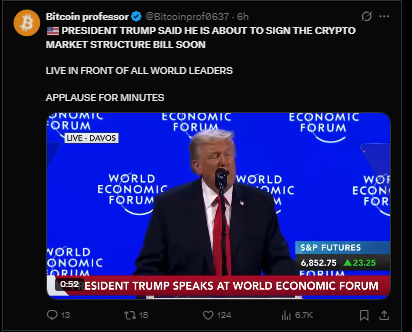
Source: Bitcoin Professor
What the Crypto Market Structure Bill Covers
The crypto market structure bill is essentially about setting the regulatory framework for the digital asset market in the United States financial markets. A main feature of the bill is to clarify the existing legal ambiguity by defining which cryptos are securities and thus fall under securities laws, and which are treated as commodities. Essentially, this has been the biggest source of confusion for exchanges, developers, and investors.
It further outlines the roles of the regulator bodies such as the Securities and Exchange Commission (SEC) and the Commodity Futures Trading Commission (CFTC), eliminating their overlapping authority, which has been one of the main reasons for enforcement-driven regulation in recent years. Regular users might benefit from more uniform rules regarding trading platforms, disclosures, and custody of digital assets.
Besides, consumer protection has also been a major focus of the legislation. It is done through transparency requirements for crypto companies and by putting in place measures to limit the risk of fraud and market manipulation. Though decentralized finance and tokenized assets are still areas that are being developed, it is believed that the bill will offer a framework within which innovations can be allowed while there still is a set of base standards.
Trade Crypto in INR on 
Deposit and withdraw in INR (₹).
No Conversion to Crypto Required.

Political Momentum and Regulatory Signals
Support for the crypto market structure law has been steadily increasing. In mid-2025, the U.S. House removed the major procedural obstacles, so the way to broader legislative action is now open. Last year’s approval of the GENIUS Act, which focused on stablecoin regulation, paved the way for the passage of crypto regulations in their entirety and demonstrated Congress’s readiness to act.
The SEC’s top management, in public announcements, has conveyed that they anticipate a crypto market structure bill to be enacted, thus indicating a changing tune whereby regulators and lawmakers are moving closer to cooperation. At the same time, they have pointed out that regulatory clarity is indispensable not only for protecting investors but also for keeping the U.S. a leading country in financial innovation.
Trump’s repeated public support has further accelerated expectations. By positioning crypto regulation as part of America’s economic leadership strategy, the administration has tied digital assets to broader themes of innovation, jobs, and global influence.
Read more: Official Trump Price Prediction
Impact on Crypto Markets and Industry Sentiment
News surrounding the crypto bill has had a noticeable impact on market sentiment. Historically, regulatory uncertainty has weighed heavily on crypto prices and investment decisions. As a result, signs of legislative progress often lead to short-term volatility and longer-term optimism.
Industry participants generally view regulatory clarity as a positive development, particularly for institutional adoption. Clear rules could encourage more traditional financial firms to enter the market, expand crypto-related products, and invest in infrastructure.
For regular users, the impact probably will be slower but still quite significant. Better supervision may result in a safer trading environment, more transparent crypto platforms, and a better understanding of rights and duties. But analysts warn that the devil is in the details and that the crypto sectors won’t be affected uniformly.
Conclusion
The move to a U.S. crypto market structure bill is a defining moment in the regulation of digital assets. President Trump has hinted that the signing may take place very soon, and the industry is at the verge of a regulatory framework that is not only clearer but also more predictable.
Although there are still hurdles to overcome and the finer details are not completely sorted out, the bill is a move away from uncertainty and towards established rules. The next few months can be very decisive in shaping the future of crypto in the US and setting a standard for the regulation of digital assets worldwide.


