



CME Group has officially launched futures contracts for Cardano (ADA), Chainlink (LINK), and Stellar (XLM), marking an expansion of its regulated crypto derivatives offerings. The contracts are now live and trading on CME’s platform, confirming reports published over the past two days by multiple digital asset news outlets. With this move, CME extends its crypto product suite beyond Bitcoin and Ethereum, reinforcing its role as a primary gateway for institutional participation in digital asset markets.
CME Group has unveiled this new offering in accordance with its public agenda of increasing the availability of regulated crypto products, while meeting strong demand from professional traders, asset managers, and institutions. Moreover, by offering both the standard and micro contract sizes, the message that all types of risk and different trading strategies are encouraged is clear.
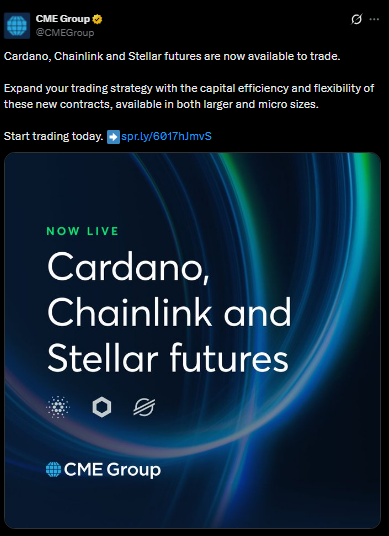
Source: CME Group
Regulated Futures Go Live for ADA, LINK, and XLM
The newly introduced futures contracts are based on three major blockchain networks which are widely used, and each has a unique function within the crypto ecosystem. Cardano stands out for its research-oriented smart contract framework; Chainlink is essential for providing decentralized data feeds to on-chain applications; and Stellar is best known for its focus on cross-border payments and banking the unbanked.
CME has announced that it has listed these contracts on its CFTC-regulated exchange, hence market participants are exposed to price and can manage their risk in a compliant environment. All of them are listed in both standard and micro contracts. Standard contracts allow for larger exposure, whereas micro contracts offer a more accurate position sizing.
The contract specifications show the variation in each asset’s market structure. Cardano futures come in 100,000 ADA standard contracts and 10,000 ADA micro contracts. Chainlink futures are 5,000 LINK standard contracts and 250 LINK micro contracts. Stellar futures are 250,000 XLM standard contracts and 12,500 XLM micro contracts.
Besides, through this product arrangement, CME allows traders to gradually scale their positions while saving on margin. Such a layout is also an opportunity to implement hedging strategies for firms that have already been exposed to these assets through spot markets or related products.
Trade Crypto in INR on 
Deposit and withdraw in INR (₹).
No Conversion to Crypto Required.

Institutional Demand Drives Product Expansion
This product launch reflects increased institutional demand for regulated access in the digital asset space. As the world’s largest derivatives exchange, CME Group has long been a leading player in supporting and recognizing new asset classes. It set the first milestones for regulated crypto trading with the introduction of Bitcoin futures in 2017 and later with its Ethereum products.
Read more: How to Start Crypto Trading in 2026
Building on that foundation, the introduction of ADA, LINK, and XLM is driven by increased interest in altcoins with real-world applications and vibrant developer communities. Futures contracts are a good way for institutional investors to mitigate the impact of price fluctuations, use their balance sheets efficiently, and gain exposure to market sentiment without directly holding the underlying tokens.
This regulated structure also appeals to firms bound by strict compliance requirements. By trading on a CFTC-regulated exchange, participants gain legal clarity, standardized settlement, and transparent pricing mechanisms. These factors contribute to deeper liquidity and a more resilient market structure over time.
The availability of micro contracts further extends access. Smaller contract sizes reduce capital requirements and allow firms to fine-tune exposure. This feature has already proven effective in CME’s existing crypto products and is expected to play a similar role for these newly listed assets.
Market Impact and Long-Term Significance
Early market commentary following the launch has focused less on short-term price movement and more on structural implications. Futures listings on CME influence market maturity rather than immediate valuation. They introduce standardized risk management tools and attract participants who prioritize stability and regulatory oversight.
Furthermore, this development adds to the price discovery of Cardano, Chainlink, and Stellar. Having futures trading alongside spot markets allows arbitrage and hedging, improving efficiency and reducing market fragmentation. This process leads to healthier market dynamics over time and increased trust from professional market players.
This launch corresponds to a well-defined timeline. In January 2026, CME announced plans to list these contracts, with trading expected to commence in early February after regulatory approval. The contracts have been confirmed live, thus closing the gap between announcement and implementation.
Conclusion
By launching futures on Cardano, Chainlink, and Stellar, CME Group is making a major move towards the maturation of regulated crypto derivatives. The availability of both standard and micro contracts on a CFTC-regulated platform gives CME an opportunity to meet institutional demand for a compliant, capital-efficient way to gain exposure to major altcoins. The move does not point to short-term speculation. On the contrary, it shows the continued shift of the crypto market toward becoming more structured and accessible to institutions.
Additional Read:
1. Cardano Price Prediction
2. Chainlink Price Prediction
3. Stellar Price Prediction