



Bitcoin’s latest dip below the $69,000 level has revived a familiar narrative: large market participants are “buying the dip.” As BTC trades near recent cycle highs after a sharp rebound from sub-$60,000 levels, Binance, Strategy (formerly MicroStrategy), and other major entities have increased their Bitcoin exposure during the latest phase of volatility.
These participants are acting based on distinct objectives, sending mixed signals to the broader market. This divergence helps explain the ongoing choppy price action. Accumulation is occurring, but it is not driven by uniform conviction. Instead, investors are positioning themselves based on their roles, mandates, and long- or short-term horizons.

Source: CoinMarketCap
Binance: SAFU Rebalancing, Not a Directional Bet
Binance’s recent Bitcoin purchases are tied to its SAFU (Secure Asset Fund for Users), not a discretionary market call. The exchange has been converting a $1 billion user protection fund into Bitcoin, recently adding roughly $300 million worth of BTC. This lifted the fund’s Bitcoin reserves to over $720 million.
This move reflects treasury management rather than trading strategy. SAFU exists to protect users in extreme scenarios, such as security breaches. Holding Bitcoin aligns the fund with the core asset of the crypto ecosystem, but it also introduces short-term volatility. Binance is not signaling a view on near-term price direction. It is adjusting asset composition to match long-term operational needs.
That distinction is critical. While headlines frame this as “buying the dip,” the intent is structural. Binance is not chasing a bounce or calling a bottom. It is managing risk and reserves within a predefined framework. This context helps explain why Binance’s actions, while supportive, do not automatically translate into bullish momentum.
Related Read: Bitcoin Price Prediction
Strategy and Long-Term Accumulators Stay the Course
In contrast, Strategy’s latest purchase reflects a clear and consistent thesis. The company added over 1,100 BTC, spending around $90 million, even after missing a deeper dip near $60,000. Strategy now holds more than 714,000 BTC, reinforcing its role as the most committed corporate holder of Bitcoin. Similar accumulation behavior was seen during prior drawdowns in 2022 and early 2024, reinforcing Strategy’s cycle-agnostic approach.
This behavior aligns with recent on-chain and social sentiment signals showing capitulation-level pessimism, detailed in our analysis of Bitcoin’s rebound from extreme fear.
Read more: Bitcoin Rebounds 19% as Social Sentiment Hits Capitulation Levels
This is not tactical accumulation. The strategy’s approach treats Bitcoin as a long-term monetary asset rather than a trade. The company has followed this model through multiple cycles, including periods of deep drawdowns. It’s buying signals the durability of conviction, not expectations of immediate upside.
Other long-term focused entities, such as mining firms and crypto investment vehicles, have shown similar behavior. These players tend to add exposure during weakness to average their cost basis over time. Their actions support the idea that long-term demand remains intact, even as short-term sentiment weakens. That long-term view provides a stabilizing force, but it does not eliminate downside risk in the near term.
On-Chain Data Shows Bitcoin Accumulation and Distribution
On-chain metrics add another layer to the story. Data indicate that large investors like whales, and institutions are accumulating again. This suggests a gradual return of long-term conviction. At the same time, significant distribution is underway, as some holders sell into rallies to reduce exposure.
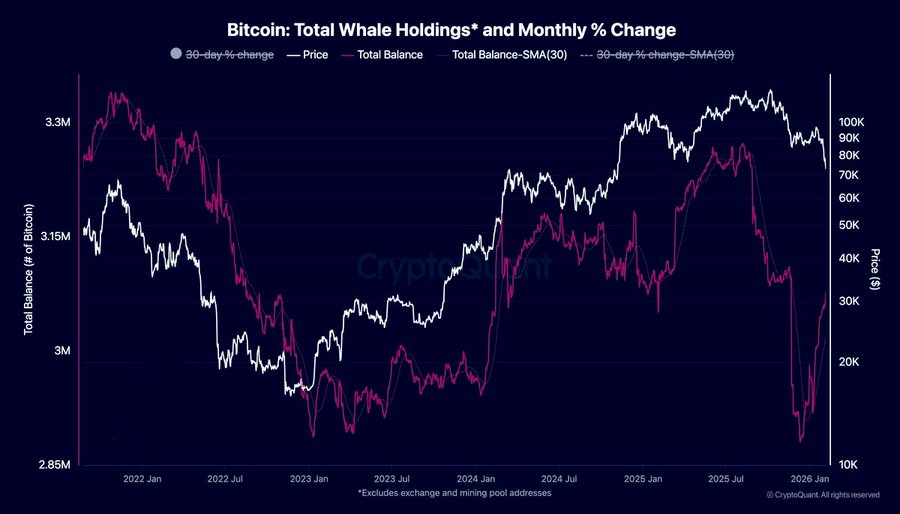
This two-sided behavior reflects current macro conditions. Inflation concerns, interest rate uncertainty, geopolitical tensions, and ongoing regulatory scrutiny continue to shape risk appetite. Exchange-related fear, uncertainty, and doubt have not fully cleared either.
As a result, the market lacks a dominant narrative. Strong hands are absorbing supply during dips, while others use strength to de-risk. This dynamic leads to range-bound movement and sharp reactions at key technical levels.
Historical cycle analysis adds to the debate. Some analysts argue that previous cycles saw large institutional buying before deeper drawdowns. Others point to Fibonacci retracement zones and parallel channels that often mark local or cycle lows. Both perspectives coexist, keeping expectations divided.
Trade Bitcoin in INR on 
Deposit and withdraw in INR (₹).
No Conversion to Crypto Required.

Conclusion
Crucially, institutional accumulation does not automatically mark a market bottom. In previous cycles, large players often accumulated weeks or months before volatility fully subsided, allowing price to remain range-bound even as long-term supply tightened. The takeaway is not that “smart money” agrees on direction. It does not. Binance is reallocating reserves. Strategy is the execution of a long-term accumulation strategy. Other players are balancing conviction with caution.
For the market, this explains why volatility persists without clear trend confirmation. Accumulation is real, but so is selling pressure. Until macro clarity improves or a decisive catalyst emerges, Bitcoin is likely to remain in a two-sided battle.
Big players are buying the dip, but the reasons behind those buys matter more than the buys themselves. Understanding that difference helps separate structural support from speculative optimism.