



Bitcoin staged a sharp rebound in early February after a wave of panic selling, with on-chain data suggesting the market briefly entered a capitulation phase. According to analytics firm Santiment, extreme bearish sentiment across social platforms coincided with Bitcoin’s rapid recovery, a pattern that has historically aligned with short-term market bottoms.
After briefly touching levels near $60,000, Bitcoin rebounded nearly 19% within 24 hours, stabilizing broader crypto market sentiment after a volatile start to the month. Analysts say the speed of the recovery reflects how quickly positioning can reverse once fear reaches extreme levels.
Bearish Social Sentiment Peaks as Prices Find Support
Santiment’s social analytics show a sharp rise in negative commentary around Bitcoin during the selloff, with terms such as “crash,” “selling,” and “going to zero” dominating online discussions. At the same time, mentions of buying activity dropped sharply, signaling waning confidence among retail participants.
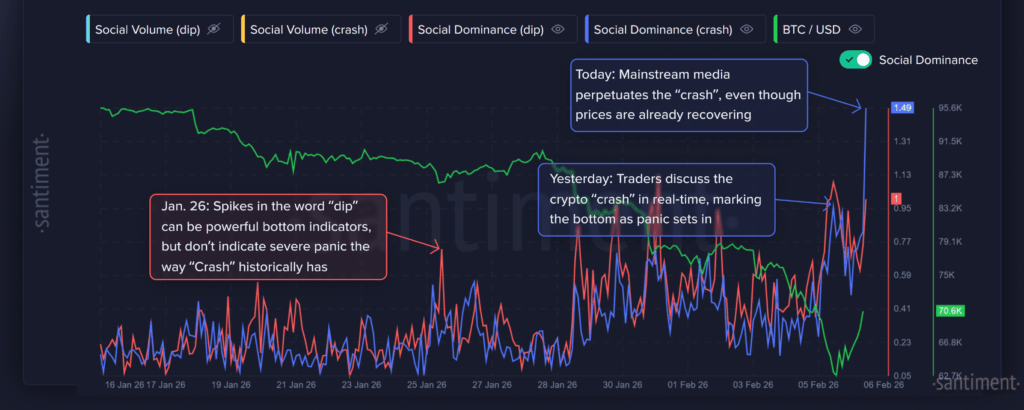
Historically, such sentiment extremes tend to appear near price inflection points rather than during the early stages of prolonged downtrends. When fear becomes widespread and engagement turns decisively negative, selling pressure often exhausts itself, creating conditions for short-term relief rallies.
Data tracking the ratio of positive versus negative crypto commentary supports this view, showing sentiment reached levels that have previously coincided with local market bottoms.
On-Chain Metrics Signal Short-Term Undervaluation
Beyond social sentiment, on-chain indicators also pointed to growing stress among short-term holders. Santiment’s 30-day Market Value to Realized Value (MVRV) metric for Bitcoin dipped into historically undervalued territory, indicating that many recently active wallets were holding unrealized losses.
MVRV measures whether the average investor is sitting on profits or losses. When the indicator moves into deeply negative ranges, it often reflects capitulation behavior, where weaker hands exit positions and selling pressure begins to ease.
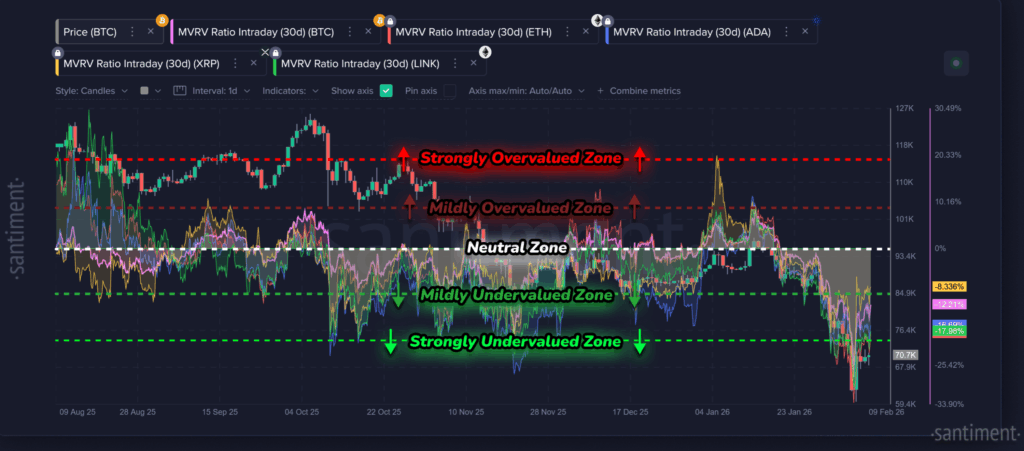
Similar MVRV patterns were observed across several large-cap assets, including Ethereum, XRP, Cardano, and Chainlink, suggesting that the pullback was broad-based rather than isolated to Bitcoin alone.
Crowd Sentiment Continues to Drive Short-Term Market Swings
Market observers note that crypto price action frequently moves counter to crowd expectations during periods of heightened emotion. As fear peaks and confidence erodes, marginal sellers diminish, allowing prices to stabilize or rebound even in the absence of major fundamental catalysts.
While sentiment-based signals are not predictive on their own, they often help contextualize short-term market behavior. Extreme pessimism, when combined with on-chain stress indicators, has historically preceded periods of consolidation or recovery rather than immediate continuation of sharp declines.
Also Read: Sentiment Analysis in Crypto Market Trading
Caution Remains Despite Short-Term Recovery
Analysts caution that the recent rebound does not automatically signal the start of a sustained uptrend. Broader macroeconomic uncertainty, liquidity conditions, and regulatory developments continue to influence crypto markets, and volatility remains elevated.
However, the convergence of extreme bearish sentiment and on-chain undervaluation suggests the recent selloff may have flushed out short-term excess, allowing prices to stabilize for now. Whether the recovery can extend further will depend on follow-through demand and broader risk appetite in the weeks ahead.
For now, Bitcoin’s rebound highlights a familiar dynamic in crypto markets: when fear reaches its peak, price action often begins to move in the opposite direction.
Additional Read:
1. Bitcoin Price Prediction
2. Ethereum Price Prediction
3. XRP Price Prediction
4. Cardano Price Prediction