

Vitalik Buterin, co-founder of Ethereum, has said that Ethereum’s original Layer 2 scaling model “no longer makes sense” as the base layer becomes capable of scaling on its own. While he still considers Ethereum L2 networks essential to the ecosystem, he questions whether the earlier idea of treating them as Ethereum’s primary scaling solution reflects the reality today.
His remarks suggest that Ethereum L1 is now scaling independently, prompting a rethink of what the role of Ethereum L2 networks should be going forward and how their performance should be measured.
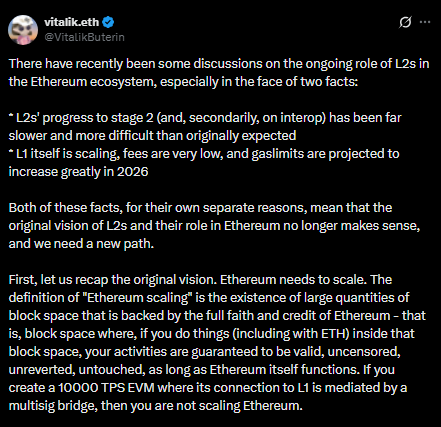
Source: Vitalik Buterin via X
Why Ethereum’s Original Scaling Plan Has Aged
In Ethereum’s early days, scaling was one of its most urgent problems. The network could only handle a limited number of transactions, leading to congestion and high fees during heavy demand. To address this, Ethereum’s roadmap became centered on Layer 2 rollups as the main scaling solution.
The original vision treated Ethereum L2s as “branded shards” of Ethereum. These networks were meant to act as extensions of L1, inheriting its security, decentralization, and censorship resistance. As long as an L2 was tightly integrated with Ethereum rather than relying on weak bridges or multisig controls, it could safely handle transactions at scale without compromising trust.
But Buterin now says the landscape has changed.
Transaction fees on Ethereum’s main chain are currently far lower than in previous cycles, and the gas limit is expected to rise significantly by 2026, allowing Ethereum itself to process more activity without depending entirely on L2s. These improvements in Layer 1 efficiency are also reflected in how analysts frame long-term network value in our Ethereum price prediction outlook.
At the same time, many Ethereum L2 networks have not yet reached “stage 2” decentralization. Some teams are cautious due to technical risks around zero-knowledge systems, while others intentionally retain centralized control for compliance or operational reasons. Buterin acknowledges these choices may be reasonable, but they no longer fit neatly into the old rollup-centric vision.
Trade ETH in INR on 
Deposit and withdraw in INR (₹).
No Conversion to Crypto Required.

A New Direction for Ethereum L2 Networks
Rather than forcing L2s into a single role, Buterin proposes a broader and more realistic framework. In this updated view, Ethereum L2 networks should not be seen purely as scaling tools for Ethereum, but as specialized chains with distinct purposes, trade-offs, and levels of dependence on L1.
Some L2s may remain closely tied to Ethereum’s settlement and security. Others may prioritize speed, experimentation, privacy, or regulatory flexibility, even if that means looser integration with L1. This marks a shift from the idea that all Ethereum L2s must behave like shards. Instead, they can evolve as independent ecosystems that still benefit from Ethereum’s infrastructure.
Core Ethereum developers also plan to support L2 growth through improved tooling and precompiles, allowing innovation without forcing every project to fit a strict definition of what “scaling Ethereum” should mean.
Conclusion
Vitalik Buterin’s remarks reflect a broader evolution in Ethereum’s scaling narrative. As Layer 1 becomes cheaper and more capable, the role of Ethereum L2 networks is shifting from being mandatory scaling extensions to becoming specialized, purpose-driven chains within the ecosystem.
By encouraging L2s to move beyond the “branded shard” model, Buterin signals confidence in Ethereum’s progress while opening the door for a more flexible, creative, and resilient future for Ethereum L2 development.