
Aschenbrenner’s $20B Situational Awareness fund liquidates to Citadel as Kospi surges 18%, SK Hynix limits up, and Wall Street rebounds on Azure and AWS beats.
TLDR
- Leopold Aschenbrenner’s Situational Awareness LP, a roughly $20 billion AI-thesis hedge fund, sold the bulk of its public equity book to Ken Griffin’s Citadel Thursday after margin calls from Goldman Sachs, JPMorgan and Bank of America hit a portfolio that was leveraged approximately four times over.
- Fund AUM has slumped to about $10 billion, keeps a ~$5 billion Anthropic stake, and will now operate as a private investment vehicle.
- Kospi closed +17.91% at 6,595.45 overnight, its largest single-session gain since the index was created in 1980. SK Hynix hit its 30% daily limit and Samsung Electronics rose 26.81%. Nikkei 225 added 4.03% to 64,362.02.
- Wall Street rebounded Thursday: S&P 500 +1.7% at 7,437.64, Nasdaq +2.8% at 25,122.18, Dow +1.2% at 52,208.06. Microsoft closed +15.51% after Azure grew 43% and Intelligent Cloud revenue crossed $100 billion in a single quarter for the first time.
- Amazon added over 9% in the after-hours session on AWS +37%, its fifth consecutive quarter of cloud acceleration.
- Apple beat on iPhone and total revenue but fell 6.65% after hours to $311.25 as Services missed, Greater China missed, and Q1 guide came in at 9 to 11% revenue growth against 12% expected. This was Tim Cook’s final earnings call; John Ternus takes over as CEO on September 1.
Market Regime
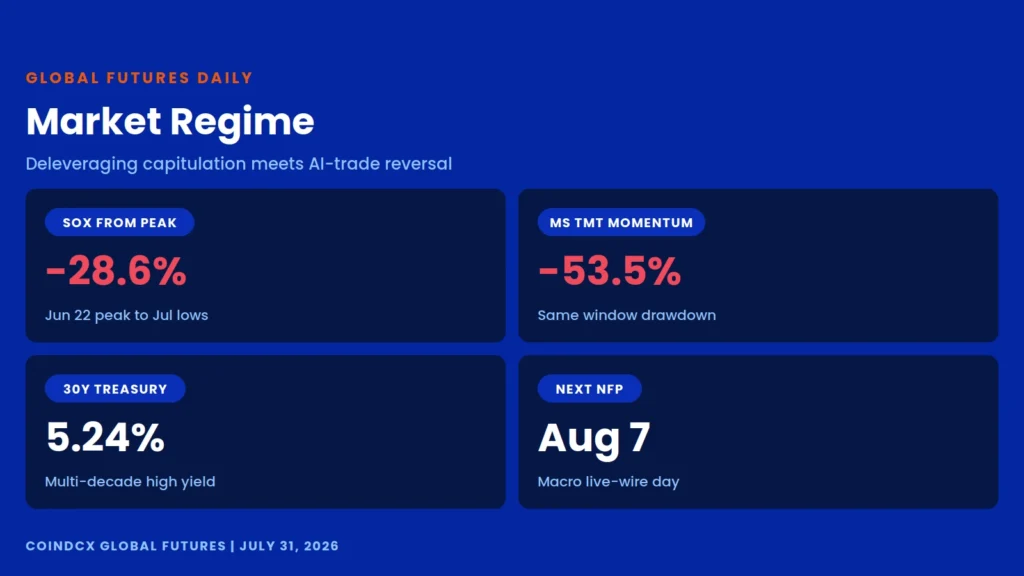
The setup this morning is a deleveraging capitulation running straight into an AI-trade reversal. The Philadelphia Semiconductor Index had already fallen 28.6% from its June 22 peak, and the Morgan Stanley TMT Momentum basket had dropped 53.5% over the same window. When the market’s most visible AI-thesis vehicle is force-selling its public book at prime-broker margin call, that is usually late-cycle-of-pain behavior, not the start of new pain. JPMorgan analysts flagged Wednesday that hedge fund tech deleveraging was likely close to done. The overnight Kospi print, +17.91% in a single session with SK Hynix limit-up, is that thesis getting stress-tested in real time.
What can break the tape from here is the message inside Apple’s guide, not the headline beat. Even without a memory-chip cost crisis, hyperscaler capex growth does not automatically translate into every megacap’s next quarter, and Apple management flagged the current memory pricing environment as a 100-year flood. The 30-year Treasury yield sitting near 5.24% at a multidecade high and the Fed on hold means the equity rally has to be paid for out of earnings, not rate cuts. The August 7 nonfarm payrolls print and any re-escalation in the Middle East are the next two live wires.
Bullish Factors
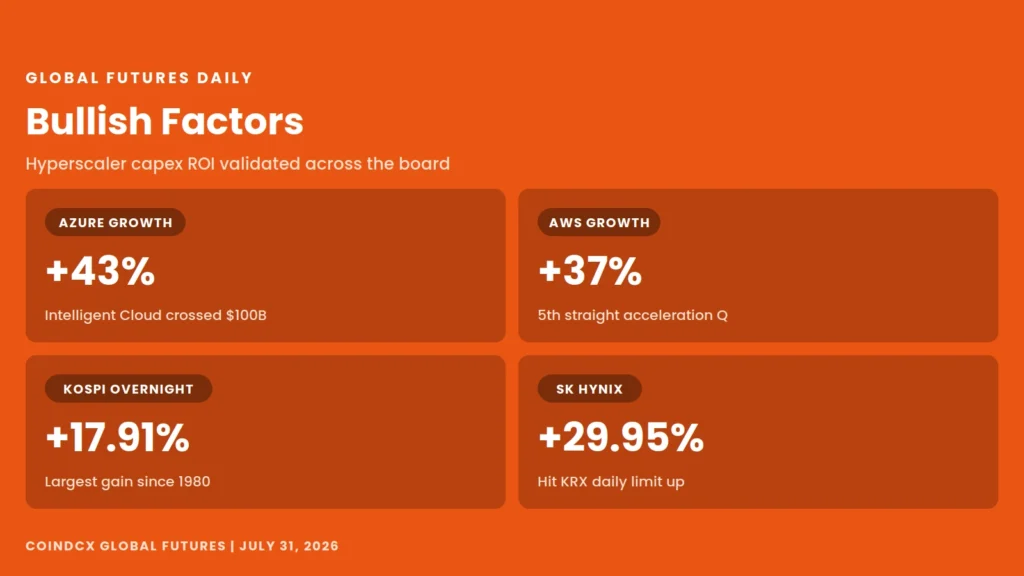
- Hyperscaler AI capex is showing up in revenue: Azure grew 43% and Microsoft’s Intelligent Cloud crossed $100 billion in a single quarter for the first time. AWS grew 37%, marking a fifth consecutive quarter of re-acceleration.
- Historic Kospi print: The +17.91% single-day gain is the largest since the index was created in 1980. SK Hynix hit its 30% daily limit and Samsung Electronics rose 26.81%. Memory names are the most direct read-through to US-listed chip equities.
- Forced-seller exhaustion: Situational Awareness’s public book has now moved to Citadel. JPMorgan flagged this week that hedge fund tech deleveraging was likely close to done, and Thursday’s US session bounce plus the overnight Asian move are consistent with that read.
- Softer core PCE: The Fed’s preferred inflation gauge came in below expectations Thursday, reaffirming that core inflation pressure remains contained even after the July FOMC hold.
- Broad earnings breadth: Fortinet added over 12% after a Q2 revenue and Q3 guide beat, giving the tape non-Magnificent Seven leadership.
Bearish Factors
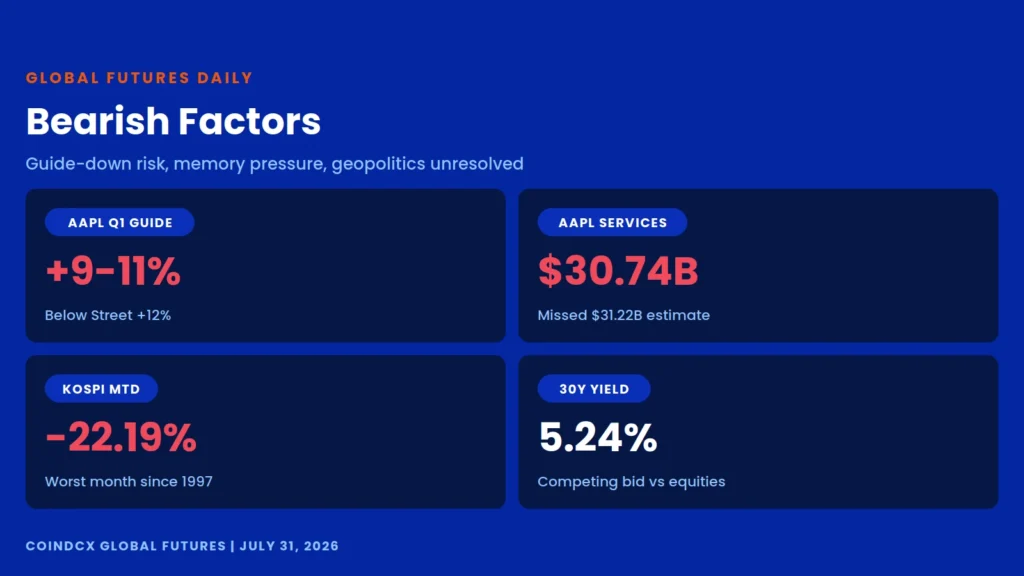
- Apple Q1 guide: Management guided current-quarter revenue growth of 9 to 11%, below Street expectations of 12%. The stock fell 6.65% after hours to $311.25 from a $333.43 regular-session close.
- Apple margin story: Services revenue at $30.74 billion missed the $31.22 billion estimate, and Greater China at $18.8 billion missed the $19.5 billion estimate. Both are the higher-margin, structurally sticky lines that carry Apple’s valuation.
- Memory pricing pressure is real: Apple described the memory pricing environment as a 100-year flood on the call and confirmed it drove Mac and iPad price increases. Every non-hyperscaler that ships hardware faces the same COGS math.
- Kospi still down for July: Even after the historic bounce, the Kospi is down 22.19% for July, its worst monthly performance since 1997.
- Bond market remains a competing bid: The 30-year Treasury yield near 5.24% is a multidecade high. That is the cost of pricing equities against a rising risk-free rate.
- Middle East is not resolved: Iran struck US bases in Kuwait, Jordan and Bahrain mid-week, with US retaliatory strikes on Iranian targets following. Any re-escalation puts oil back in the mix.
Asian Markets This Morning
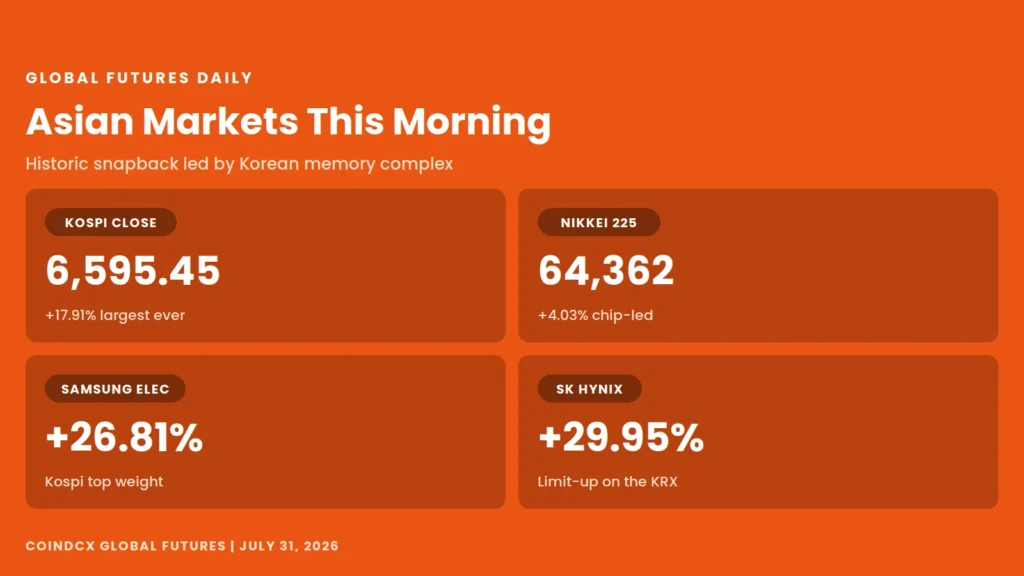
- Kospi: +17.91% at 6,595.45, largest single-day gain since the index was created.
- Nikkei 225: +4.03% at 64,362.02, recovering a portion of the June-July drawdown.
- SK Hynix: +29.95%, hit the daily 30% limit-up on the KRX.
- Samsung Electronics: +26.81%, the largest weight in the Kospi.
- Monthly context: Despite the print, Kospi remains down 22.19% for July, its worst monthly performance since 1997. The move looks like a forced-liquidation clear-out rather than a fundamental re-rating.
What Moved Wall Street Today
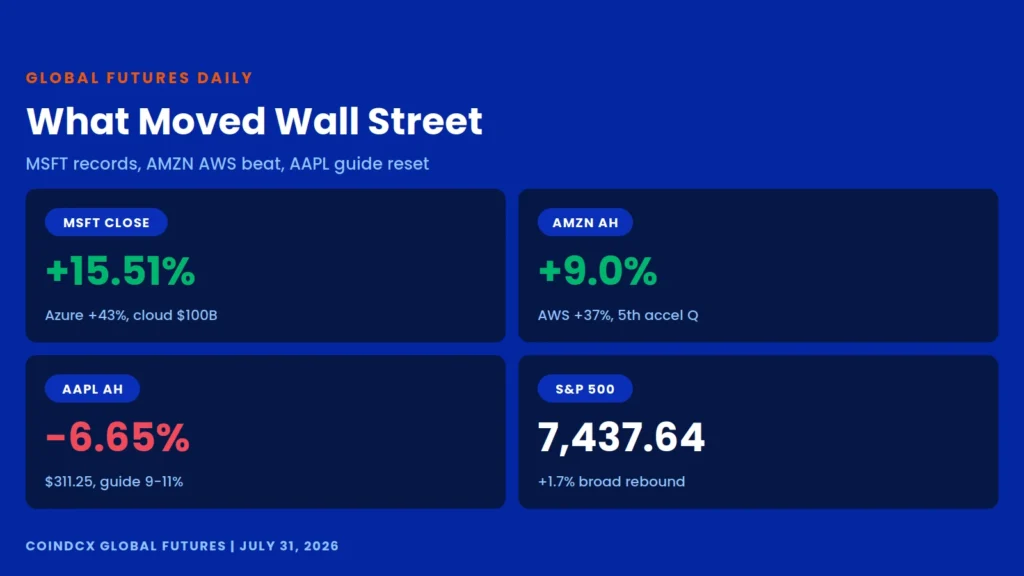
Wall Street posted a broad rebound Thursday after Wednesday’s post-FOMC selloff. The S&P 500 gained 1.7% to close at 7,437.64. The Nasdaq Composite added 2.8% to 25,122.18, and the Dow rose 1.2% to 52,208.06, adding 613.92 points.
Microsoft was the tape. The stock closed +15.51%, marking one of the largest single-day dollar-value gains in company history, after Q4 FY26 revenue grew 18% to $90 billion, adjusted EPS of $4.74 topped estimates, Azure grew 43%, and Intelligent Cloud revenue crossed $100 billion in a single quarter for the first time. Amazon reported after the close: revenue and EPS beat expectations, AWS grew 37% for a fifth consecutive quarter of acceleration, and the stock added over 9% in extended hours.
Apple’s after-hours session went the other way. Total revenue of $109.42 billion and EPS of $2.02 both beat, and iPhone revenue rose 22% year over year to $54.25 billion. But Services revenue at $30.74 billion missed the $31.22 billion estimate, Greater China at $18.8 billion missed the $19.5 billion estimate, and management guided Q1 FY27 revenue growth of 9 to 11% versus Street 12%. The stock fell 6.65% in extended trade to $311.25. On the call, Cook said Apple was raising Mac and iPad prices in response to a 100-year flood in memory pricing. It was his final earnings call as CEO; SVP of Hardware Engineering John Ternus takes over as CEO on September 1.
The macro read supported the tape as well. Core PCE, the Fed’s preferred inflation gauge, came in softer than expected. The 30-year Treasury yield remained near 5.24%, a multidecade high, with the bond market still absorbing the FOMC hold on Wednesday and the Q2 GDP miss.
Assets in Focus
MSFT
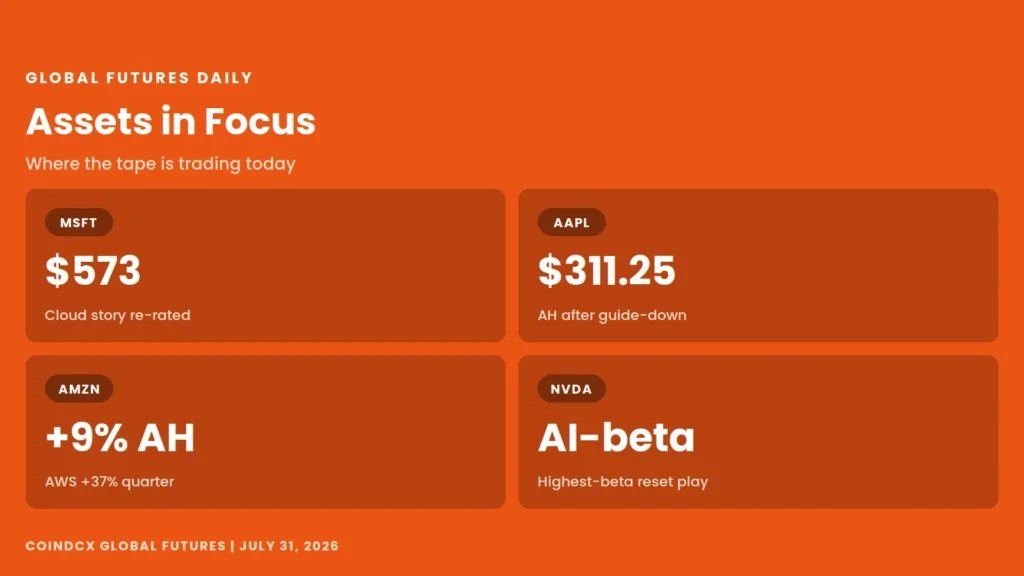
Closed at all-time high after +15.51% on Thursday’s session. Azure +43% and Intelligent Cloud crossing $100 billion in a single quarter for the first time reset the ceiling of what hyperscaler capex ROI looks like on the print. Every AI-adjacent name in the index re-rates against this reference.
AAPL
Down 6.65% in extended trade to $311.25 after guiding Q1 FY27 revenue growth of 9 to 11% against Street expectations of 12%. Watch the response in the regular session on Friday. iPhone at +22% year over year and the strongest June-quarter revenue in company history is the beat; Services and Greater China are the concern. Cook’s last quarter as CEO.
AMZN
Up over 9% in extended trade. AWS at +37% marks a fifth consecutive quarter of acceleration, a direct answer to the concerns that had built up around AWS during the July drawdown. Advertising continued its high growth trajectory.
NVDA
The most obvious read-through from Kospi’s overnight move, MSFT’s Azure print, and AMZN’s AWS number is to Nvidia. Nvidia gave up its most-valuable-company crown to Apple this week during the memory-led selloff and comes into Friday’s session as the highest-beta way to trade any continuation of the AI-trade reset. Watch for follow-through in the semiconductor complex.
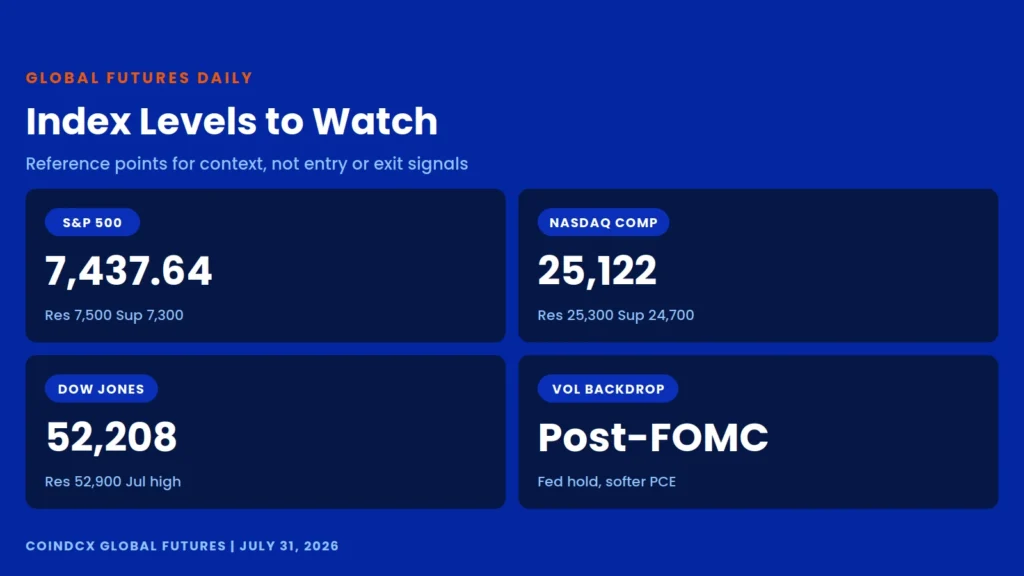
Index Levels to Watch
Reference points for context, not entry or exit signals.
- S&P 500: closed at 7,437.64 on Thursday. Next reference zone above is the July high near 7,500. Below, 7,300 sits as recent consolidation support.
- Nasdaq Composite: closed at 25,122.18 after a 2.8% rebound. Watch 25,300 as the nearest resistance zone; below, 24,700 marked the July support before Wednesday’s post-FOMC drop.
- Dow Jones Industrial Average: closed at 52,208.06. The July high near 52,900 remains the upside reference.
Disclaimer
The information provided in this blog is for educational and informational purposes only. It should not be considered financial or investment advice. Trading in futures and other derivatives carries a high level of risk and may not be suitable for all investors. Past performance is not indicative of future results. Please conduct your own research and consult with a qualified financial advisor before making any investment decisions. CoinDCX and its affiliates are not liable for any losses arising from the use of this information.
Frequently Asked Questions
Q1. What is Situational Awareness LP and why does its forced liquidation matter?
Situational Awareness LP is the roughly $20 billion hedge fund founded in 2024 by Leopold Aschenbrenner, a former OpenAI Superalignment researcher. The fund runs a concentrated bet on the AI infrastructure buildout, including semiconductors, compute, memory and power. It matters here because it was one of the most visible expressions of the AI-thesis trade and the largest single forced seller into the July 2026 chip selloff. Its unwind sets a marker for how far leverage in the AI trade has been reset.
Q2. Did Citadel really buy the entire public equity book?
Yes. According to reporting from Bloomberg and The Wall Street Journal, Ken Griffin's Citadel acquired the bulk of Situational Awareness's public stock positions Thursday. Fund AUM has fallen to about $10 billion. The remaining balance is largely private-market exposure, including a roughly $5 billion stake in Anthropic. Situational Awareness will operate going forward as a private investment vehicle.
Q3. Why did the Kospi print its biggest single-day gain in history?
The +17.91% Kospi close at 6,595.45 was driven by two things at once. First, SK Hynix and Samsung Electronics, which together make up a large share of the index by weight, hit their daily upper limits after the July memory selloff. Second, the tape read the Situational Awareness forced-liquidation news as a signal that the last leveraged seller had been cleared out of AI-adjacent equities. The Kospi remains down 22.19% for July, its worst monthly performance since 1997.
Q4. What exactly did Microsoft report?
Microsoft's Q4 FY26 revenue grew 18% year over year to $90 billion, and adjusted EPS came in at $4.74, above estimates. Azure grew 43%, and Intelligent Cloud revenue crossed $100 billion in a single quarter for the first time. The stock closed +15.51%.
Q5. Why did Apple fall after beating estimates?
Apple beat on total revenue ($109.42 billion vs $108.86 billion expected), EPS ($2.02 vs $1.89), iPhone ($54.25 billion, +22% year over year), and Mac ($10.35 billion). But Services revenue at $30.74 billion missed the $31.22 billion estimate, Greater China at $18.8 billion missed, and forward guidance for Q1 FY27 revenue growth of 9 to 11% came in below Street expectations of 12%. Management also flagged memory pricing pressure, which is driving Mac and iPad price increases. The stock fell 6.65% in extended trade to $311.25.
Q6. Is the July 2026 AI selloff over?
Two conditions have now been met that historically mark local capitulation lows: forced liquidation of a large concentrated leveraged holder, and a violent single-session snapback in the most beaten-down index. Neither guarantees the low is in. What matters from here is whether hyperscaler capex earnings continue to validate the AI-trade thesis, and whether memory pricing normalizes without a hardware demand shock. The August 7 US nonfarm payrolls print is the next major macro data point.