
Wall Street cools from Friday’s record as oil climbs and traders wait for Wednesday’s July CPI. Nvidia falls 3%, Rocket Lab drops after hours.
TLDR
- Wall Street slipped from Friday’s record close as oil climbed on Iran and Strait of Hormuz uncertainty; traders sat on hands into Wednesday’s July CPI release.
- Nvidia fell about 3% after a Financial Times report on a $500 billion AI infrastructure fund with Apollo and Blackstone; Bank of America stayed Buy into the August 26 print and called memory and circular financing concerns overblown.
- July CPI Wednesday at 6:00 PM IST is the pivot: consensus 3.4% YoY headline and 2.5% core; Kalshi assigns under 55% probability to a print above 3.3%.
- Rocket Lab posted record Q2 revenue of $234M but the stock closed 3.37% lower and dropped another 6.8% after hours to about $74.60 on wider adjusted losses tied to the pending Iridium takeover.
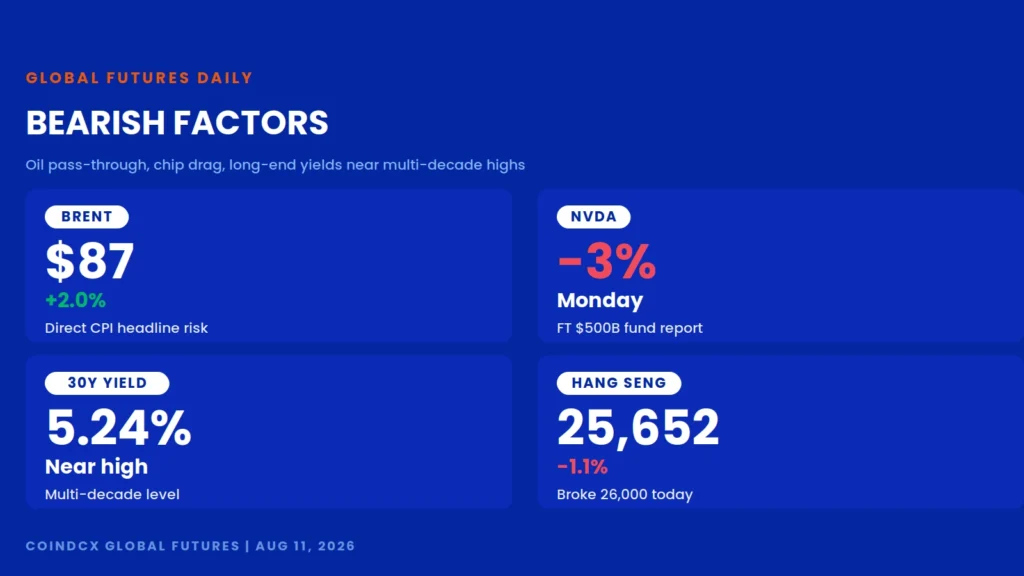
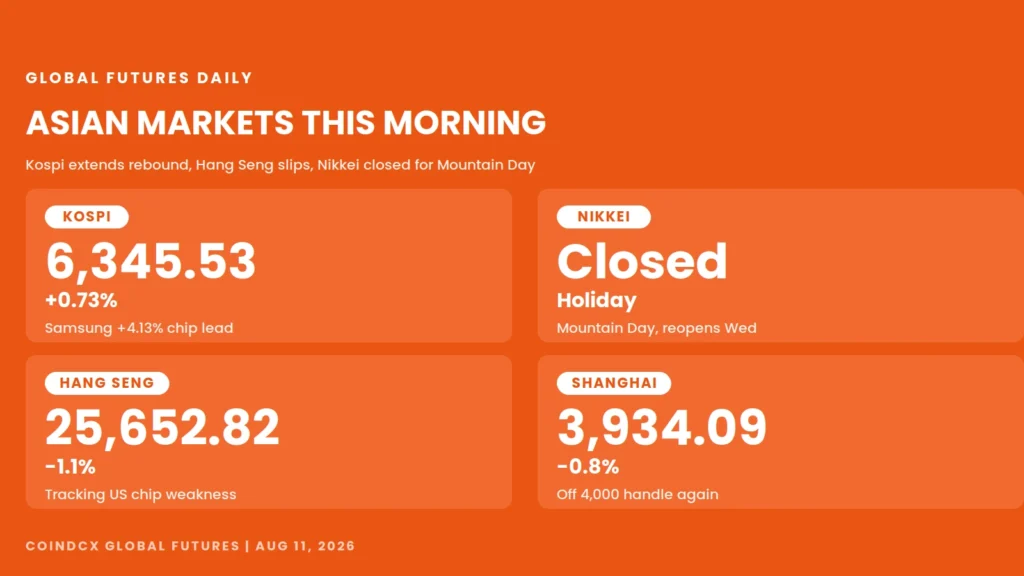
- Kospi added 0.73% at 6,345.53 with Samsung Electronics up 4.13%; Hang Seng lost 1.1% to 25,652.82; Nikkei was closed for Mountain Day.
Market Regime
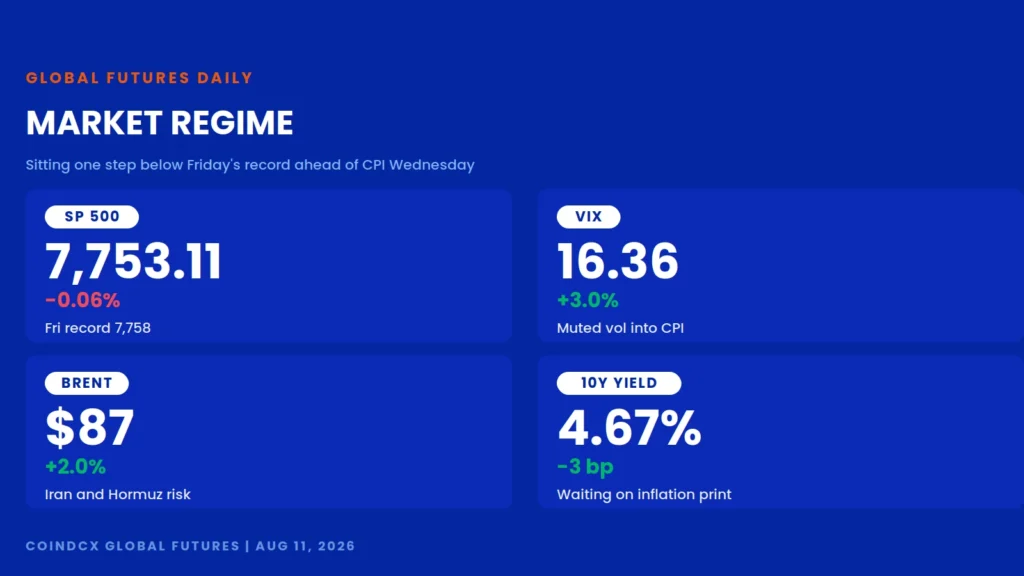
The tape is sitting one notch below Friday’s record and stalled on purpose. The July nonfarm payrolls miss last week already reset September rate expectations lower once, and Fed funds futures have been rebuilding hike odds since. What breaks the deadlock is Wednesday’s CPI. Positioning ahead of the print is defensive, not directional, and the intraday range in the S&P 500 on Monday, less than 20 handles, reads exactly like that.
Under the index averages, the split remains AI infrastructure versus memory sustainability. Nvidia’s dip today on the Apollo and Blackstone fund report leans into that question directly: is the AI capex loop self-reinforcing, or does financing engineering start to matter for the multiple. Brent crude back at $87 adds a second live channel into tomorrow’s CPI headline that is already inside the consensus range.
Bullish Factors
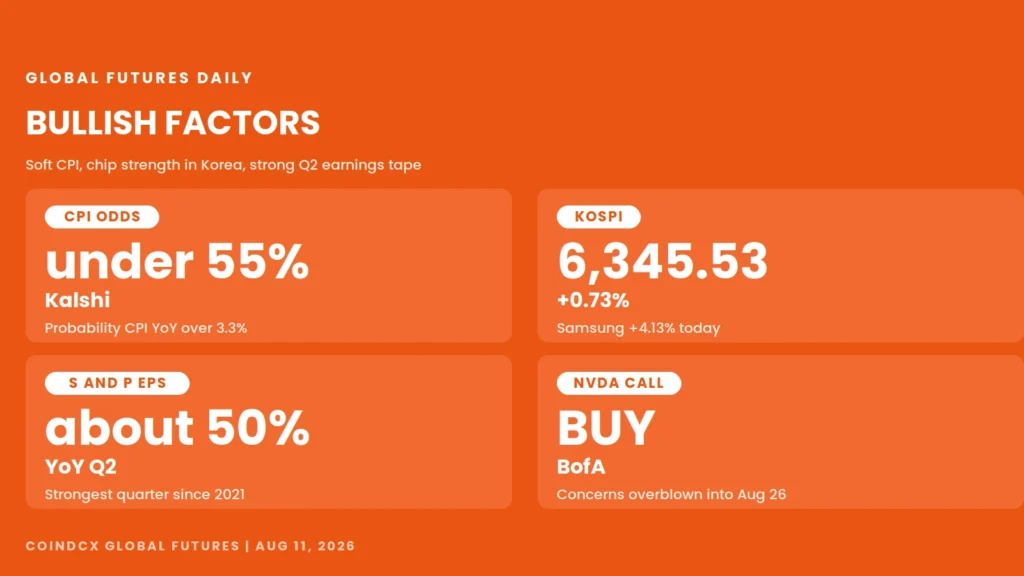
- Kalshi prediction markets put under 55% probability on July headline CPI above 3.3%. A soft print would reprice September odds back toward dovish.
- Kospi extended its rebound with Samsung Electronics up 4.13%, showing Korean chip strength holding even as US semis weakened overnight.
- Q2 earnings season is nearly complete with S&P 500 EPS growth tracking around 50% year over year per FactSet, the strongest quarter since 2021.
- Riot Platforms landed a reported 20-year, $9.1B Anthropic cloud computing deal, validating that AI capacity demand is now pulling in non-hyperscaler operators.
- Bank of America reiterated Buy on Nvidia and called memory-cost and circular financing concerns overblown ahead of the August 26 report.
Bearish Factors
- Brent crude back above $87 on renewed Strait of Hormuz uncertainty. This is direct pass-through risk into tomorrow’s CPI headline.
- Nvidia off about 3% on the Financial Times report of a $500B Apollo and Blackstone AI infra funding package, dragging the semiconductor group lower.
- US 10-year Treasury yield at 4.67% and 30-year around 5.24%, near a multi-decade high. The real-yield backdrop stays tough for growth multiples.
- Hang Seng down 1.1% and Shanghai off 0.8%, both tracking overnight US chip weakness. Regional risk appetite is thinner than Korea’s.
- Rocket Lab down about 7% after hours on the wider Q2 adjusted loss and cash burn tied to the pending Iridium deal. High-beta space names are selling any dilution overhang.
Asian Markets This Morning
Kospi added 0.73% to close at 6,345.53. Samsung Electronics gained 4.13% and SK Hynix ticked fractionally higher, extending Monday’s rebound in Korean chips even as US semis were soft overnight. The South Korean government confirmed a KRW 5 trillion special semiconductor fund. Japan’s Nikkei 225 was closed for Mountain Day and reopens Wednesday. Hong Kong’s Hang Seng dropped 1.1% to 25,652.82 and the Shanghai Composite gave up 0.8% to 3,934.09, both tracking overnight US chip weakness. Australia’s S&P/ASX 200 rose 0.2% to 9,250.60 after the RBA held its cash rate at 4.35%. Taiwan’s Taiex added 0.4% and India’s Sensex shed 0.5%.
What Moved Wall Street Today
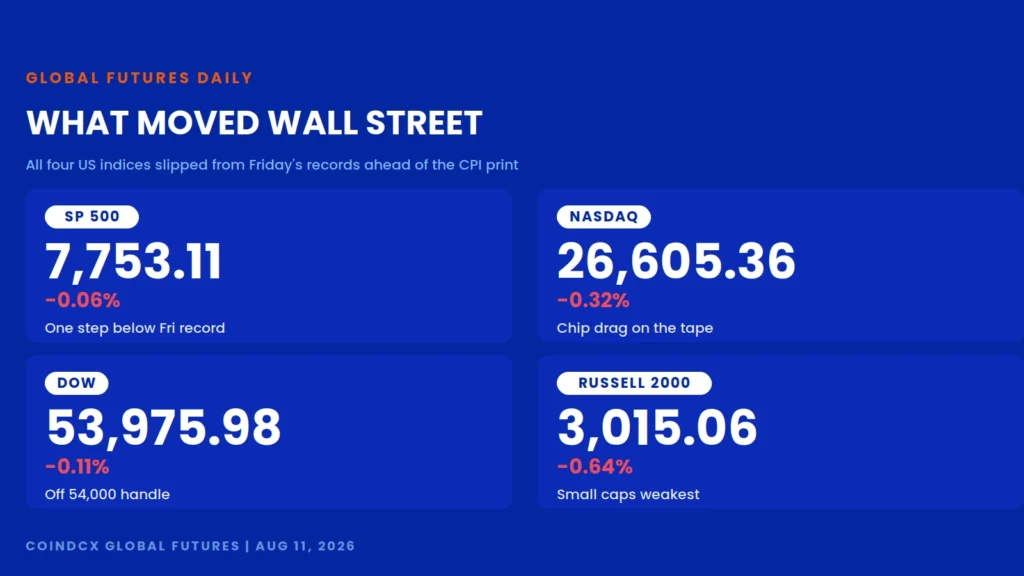
The S&P 500 finished at 7,753.11, down 0.06%. The Dow Jones Industrial Average slipped 0.11% to 53,975.98 and the Nasdaq Composite lost 0.32% to 26,605.36. The Russell 2000 fell 0.64% to 3,015.06. The VIX pushed up to about 16.36. The 10-year Treasury yield held near 4.67% and the 30-year sat around 5.24%. Brent crude added roughly 2% to trade above $87 as Iran signaled a Strait of Hormuz deal was very close without a firm timeline. Gold hovered near $4,128 after Friday’s push.
Nvidia dropped about 3% after a Financial Times report the chipmaker is working with Apollo Global and Blackstone to structure a $500 billion AI infrastructure funding package. Bank of America reiterated Buy on NVDA and called related memory-cost and circular financing concerns overblown ahead of the August 26 fiscal Q2 report. Rocket Lab closed the regular session at $80.04, down 3.37%; the stock fell another 6.8% after hours to about $74.60 following Q2 earnings that beat on revenue but posted a wider adjusted loss tied to acquisition integration costs – Mynaric, Motiv, and the pending Iridium takeover. Separately, Anthropic and Riot Platforms signed a reported 20-year cloud computing deal worth $9.1 billion, a fresh signal that AI capacity demand is now pulling in non-hyperscaler operators.
Assets in Focus
NVDA
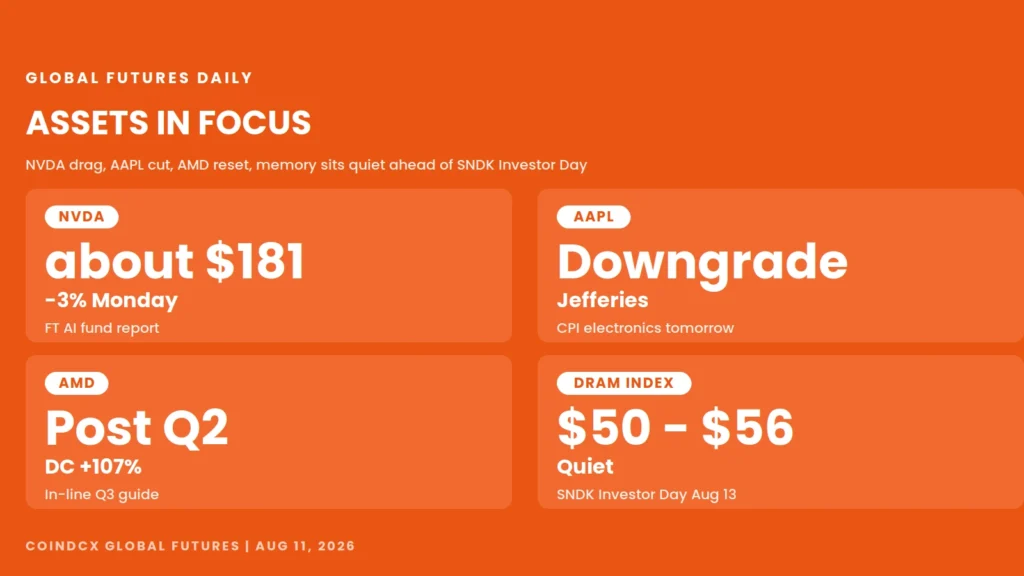
Nvidia closed near $181 down about 3% on the Financial Times report about a $500 billion AI infrastructure fund with Apollo Global and Blackstone. Bank of America stayed Buy into the August 26 fiscal Q2 report, framing memory-cost inflation and financing circularity concerns as overstated. Reference range for context: $175 to $190. The two variables to watch remain the Vera Rubin launch timeline and Q2 gross-margin durability under memory-cost pressure. Reference points only, not entry or exit signals.
AAPL
Apple came into Monday’s session with a fresh Jefferies downgrade. The next micro catalyst is Wednesday’s CPI and the consumer-electronics component inside it. Wells Fargo flagged Apple pricing hikes as an incremental driver of core-goods inflation for the July print. Reference range for context: $210 to $225. Reference points only, not entry or exit signals.
AMD
AMD is still working through the air pocket after its Q2 print. Record revenue of $11.5B and Data Center up 107% year over year did not clear the raised bar; Q3 guidance of $12.7B to $13.3B versus the $12.5B Street estimate was in-line rather than a beat. Reference range for context: $460 to $500. Reference points only, not entry or exit signals.
NSDQ100
Nasdaq 100 has led the S&P 500 higher for two weeks and is now consolidating just below the record ahead of the CPI print. The chip sector’s Monday drag is the incremental swing factor into Wednesday. Reference range for context: 26,500 to 27,000. Reference points only, not entry or exit signals.
DRAM
The memory-cycle proxy for retail. After last week’s roughly 7% reset on WDC and SNDK guidance disappointments, DRAM is quiet ahead of any fresh datapoints. SanDisk Investor Day is August 13 and remains the near-term catalyst inside the memory group. Reference range for context: $50 to $56. Reference points only, not entry or exit signals.
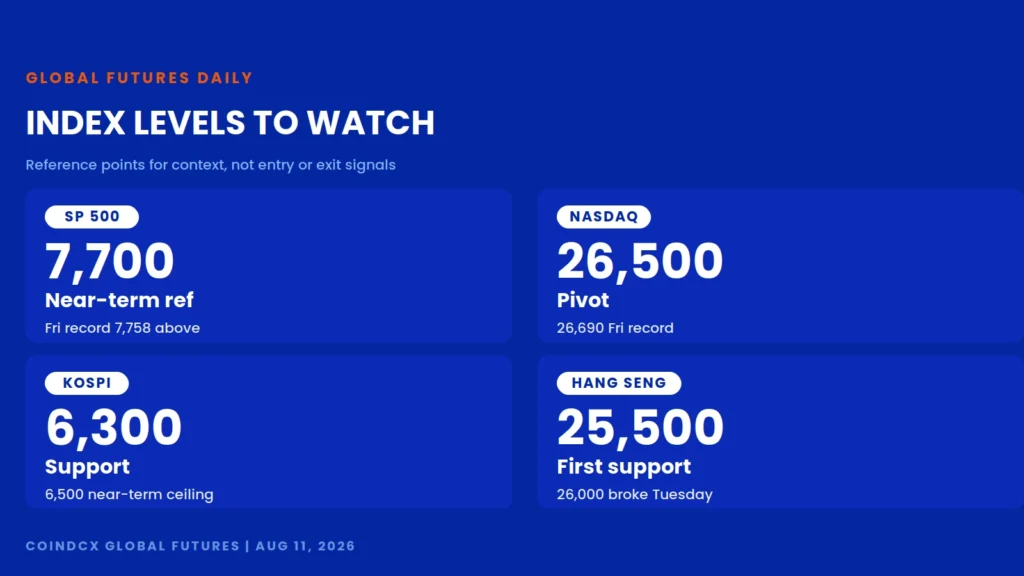
Index Levels to Watch
- S&P 500: near-term reference at 7,700; upside pivot back to Friday’s record 7,758.
- Nasdaq Composite: 26,500 pivot; 26,690 was Friday’s record close.
- Dow Jones: 54,000 handle back in play; 54,349 is the Aug 5 record.
- Kospi: 6,300 support tested overnight; 6,500 is the near-term ceiling.
- Hang Seng: 25,500 first support; 26,000 is the level that broke today.
- 10-Year Treasury: 4.60% to 4.70% band; a soft CPI reads dovish for the long end.
- Brent crude: $85 was Friday’s low; $90 is the shock-in level for CPI pass-through.
Disclaimer
This content is for informational purposes only and does not constitute investment advice, a recommendation, or an offer to buy or sell any security or derivative. Global Futures involve significant risk and may not be suitable for all investors. Levels and price ranges referenced here are context for the day’s setup, not entry or exit signals. Please conduct your own research and consult a SEBI-registered advisor before making any investment decision. CoinDCX and its affiliates are not liable for any trading losses arising from the use of this information.