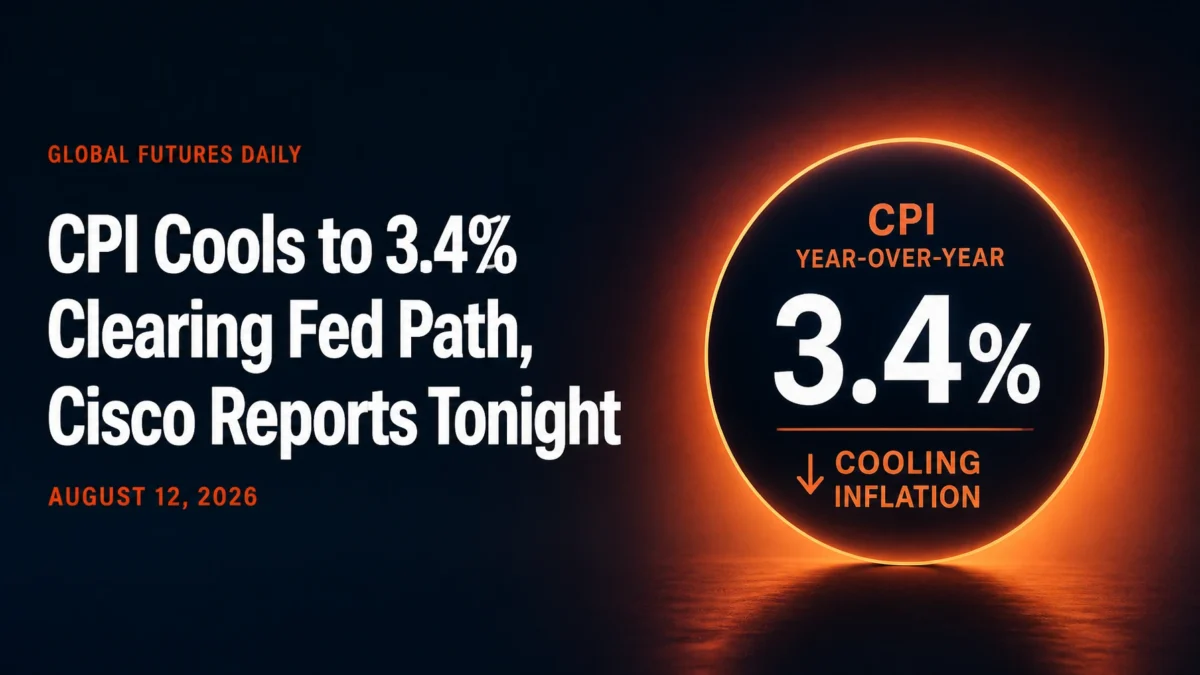

July CPI printed 3.4% headline and 2.5% core in-line with estimates, easing Sept hike pressure. Kospi rallied 3.7%; Cisco reports Q4 tonight.
TLDR
- July CPI printed 3.4% year-on-year, matching consensus and easing from 3.5% in June.
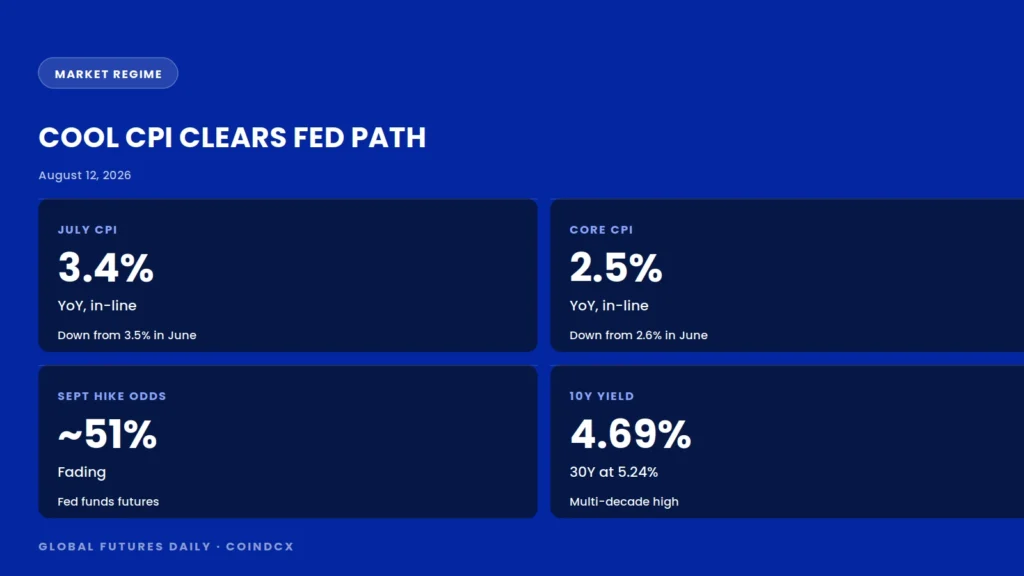
- Core CPI came in at 2.5% year-on-year, also in-line and down from 2.6%.
- Monthly headline rose 0.1% and monthly core rose 0.2%, both matching Dow Jones estimates.
- Fed funds futures were pricing a September hike near 51% into the print and softened on the release.
- Kospi finished 3.68% higher at 6,579.04 on heavy foreign net buying and a Samsung / SK Hynix rally.
- CoreWeave delivered a Q2 beat AH Tuesday, guiding Q3 to $3.4B to $3.6B against a $3.43B Street mark.
- Cisco reports fiscal Q4 after the US close tonight with Wall Street looking for $1.17 EPS on $16.83B revenue.
- Producer price index prints Thursday, followed by Applied Materials earnings AMC.
Market Regime
The July inflation reading landed exactly where the tape had positioned. Headline at 3.4% and core at 2.5% both matched consensus, cooling by 10 basis points on each measure and giving Federal Reserve Chair Kevin Warsh the softer print he needed after a hawkish Fedspeak week. Fed funds futures were coin-flipping on a September hike into the release. The in-line result nudged that probability lower, keeping the base case tilted toward a hold at the September 16 meeting.
Underneath the headline print, the tape is still stretched. The S&P 500 sits within 30 basis points of its 7,757.64 record from Friday even after two straight down sessions. The 30-year Treasury yield is anchored near a 19-year high above 5.20%, and Cleveland Fed President Beth Hammack said on Monday that multiple hikes may still be needed. What could break the calm: a hot Producer Price Index on Thursday, a soft Cisco guide tonight that questions the AI capex bid, or fresh Middle East headlines that push Brent back above $90.
Bullish Factors
- July CPI printed at 3.4% year-on-year, the second consecutive month of headline cooling and matching Street expectations.
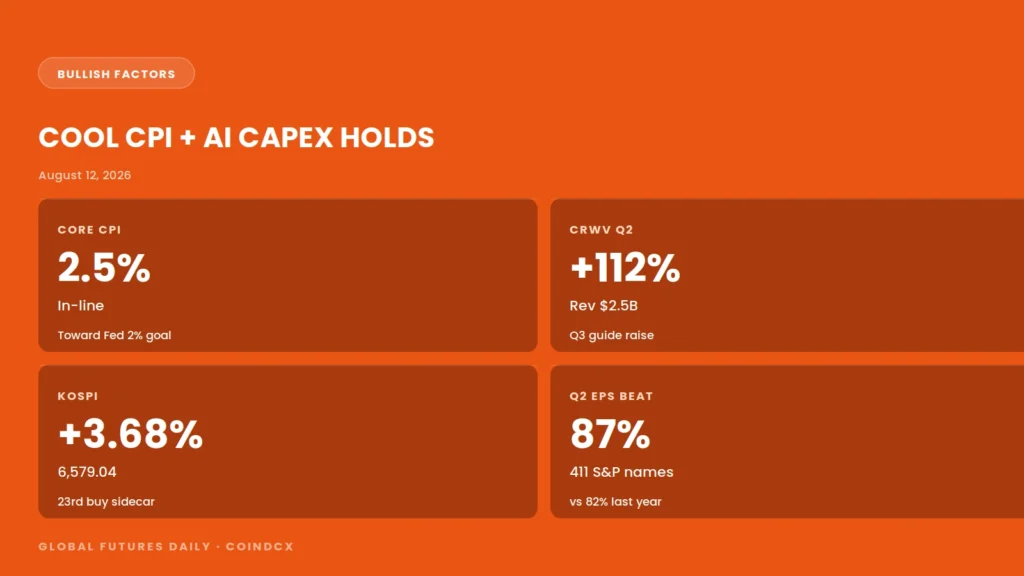
- Core CPI held at 2.5% year-on-year, down 10 basis points and consistent with a gradual return toward the Fed 2% target.
- CoreWeave posted a Q2 revenue beat at $2.5B and guided Q3 to $3.4B to $3.6B against a $3.43B Street mark, backlog jumped from $104B to $129B in six weeks.
- Kospi ripped 3.68% to 6,579.04 with foreign net buying of KRW 2.84 trillion, triggering the 23rd buy-side sidecar of the year.
- 411 S&P 500 companies have reported Q2 with 87% beating on EPS versus 82% a year ago, tracking 25% year-on-year earnings growth.
- July jobs report showed the economy shed 23K positions against +83K expected, giving the Fed political cover to hold in September.
Bearish Factors
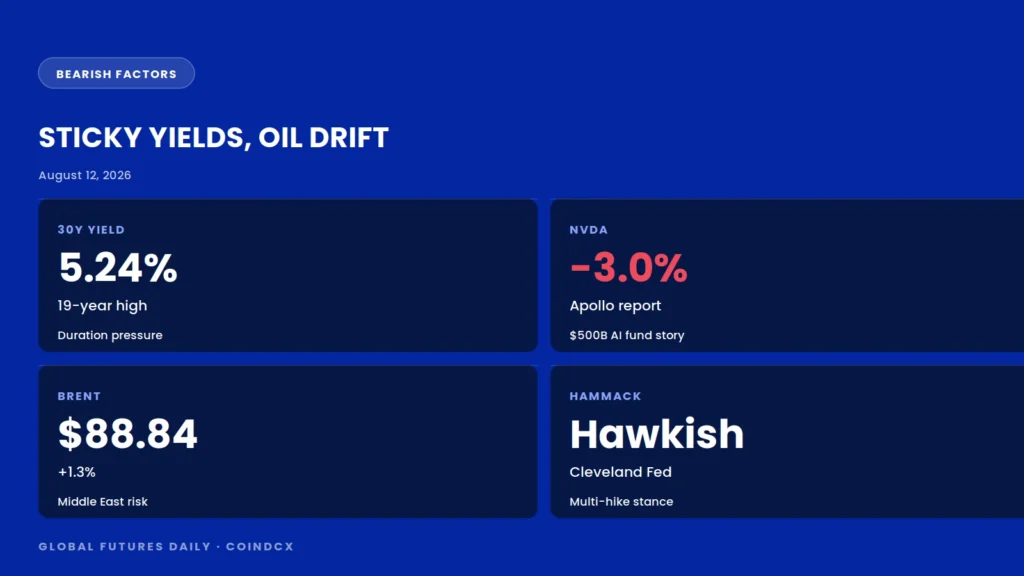
- 30-year Treasury yield holding near 5.24%, a 19-year high, keeping duration and valuation pressure on growth stocks.
- Cleveland Fed Hammack said Monday that multiple 25 basis point hikes may be needed to return inflation to the 2% goal.
- Brent crude firmed to $88.84 on Tuesday and WTI settled at $83.29, both up over 1% as Middle East de-escalation stalled without a timeline.
- Nvidia dropped 3% on Monday after an FT report on Apollo Global and Blackstone assembling a $500B AI infrastructure funding package.
- Apple absorbed a Jefferies downgrade on Monday, adding to the AAPL narrative fade after the Services Q3 miss last quarter.
- Post-CPI bounces during the summer have been short-lived, with the S&P 500 dropping in each of the two sessions leading into the print.
Asian Markets This Morning
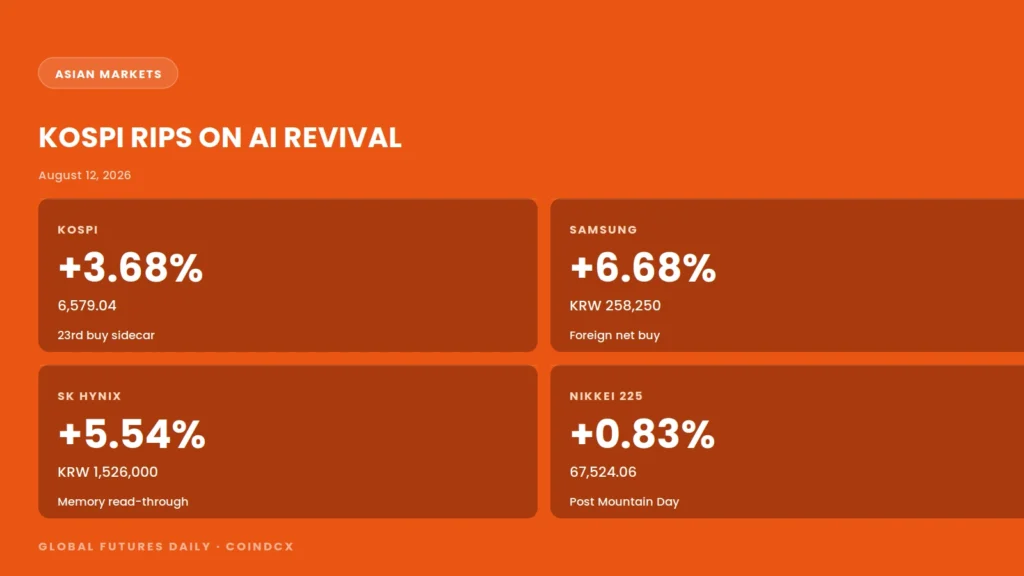
The Kospi delivered its most conviction session in a fortnight, closing 3.68% higher at 6,579.04 with a +233.51 point advance. The move triggered the 23rd buy-side sidecar of the year on the Kospi 200 futures, and foreign investors were the story. Overseas funds net bought KRW 2.84 trillion (roughly $2 billion) while institutions added another KRW 527.7 billion. Retail was the counterparty, net selling KRW 3.19 trillion. The won firmed to 1,415.7 per dollar. Reports on the tape suggested Temasek is preparing a direct investment in Korean semiconductor leaders.
Samsung Electronics closed at KRW 258,250, up 6.68% on the day, and SK Hynix finished at KRW 1,526,000, up 5.54%. SK Square outperformed the parent complex with a 10.16% gain. The catalyst was CoreWeave Q2 blowout after the US close on Tuesday, which reset the AI capex conversation from concern back to conviction and pulled memory chip demand narratives higher with it.
Japan reopened after the Mountain Day holiday. The Nikkei 225 rose 0.83% to 67,524.06 with Kioxia adding roughly 4% on the memory read-across. Hang Seng dipped 0.9% to about 25,415, Shanghai edged 0.3% higher near 3,946, and Australia ASX slipped 0.24%. India Sensex was down about 0.5% into the close.
What Moved Wall Street Today
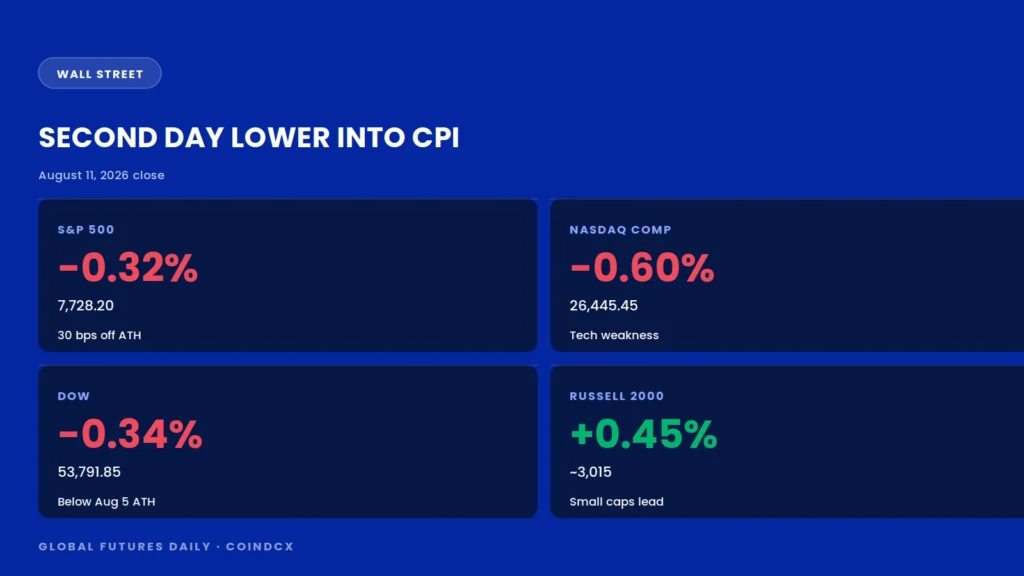
Tuesday closed lower for a second consecutive session as traders held back from adding risk into the CPI print. The S&P 500 slipped 0.32% to 7,728.20, the Nasdaq Composite dropped 0.6% to 26,445.45, and the Dow lost 0.34% to 53,791.85. The Russell 2000 was the only major green print, up 0.45% to about 3,015, as small caps ran ahead of the release on softer rate expectations.
Sector leadership was thin. Nvidia extended Monday 3% drop on the FT report about the Apollo Global and Blackstone $500B AI infrastructure package, with BofA reiterating a Buy into the August 26 fiscal Q2 print and calling memory and circular financing concerns overblown. Apple stayed heavy following the Jefferies downgrade. Anthropic and Riot Platforms announced a 20-year, $9.1B cloud computing deal, validating non-hyperscaler AI capacity. After the close, CoreWeave beat on Q2 revenue and guided Q3 above Street, with the stock trading up around 8% in extended hours.
Ten-year Treasury yields held at 4.69% into the print. Brent crude closed at $88.84, up 1.3%, and WTI added 1.4% to $83.29 as Iran-linked headlines around the Strait of Hormuz shifted through the session without a clear timeline. Gold stayed anchored near $4,128.
Assets in Focus
NSDQ100
The Nasdaq 100 futures index gapped higher in premarket after the CPI came in-line, with contracts up roughly 0.7% into the US open. The cash index closed Tuesday at a 0.33% loss and sits below the July record. Cool inflation and a soft July jobs print are giving duration back to growth. The setup into Cisco tonight and Applied Materials on Thursday is a test of whether AI capex can absorb the yields backdrop.
NVDA
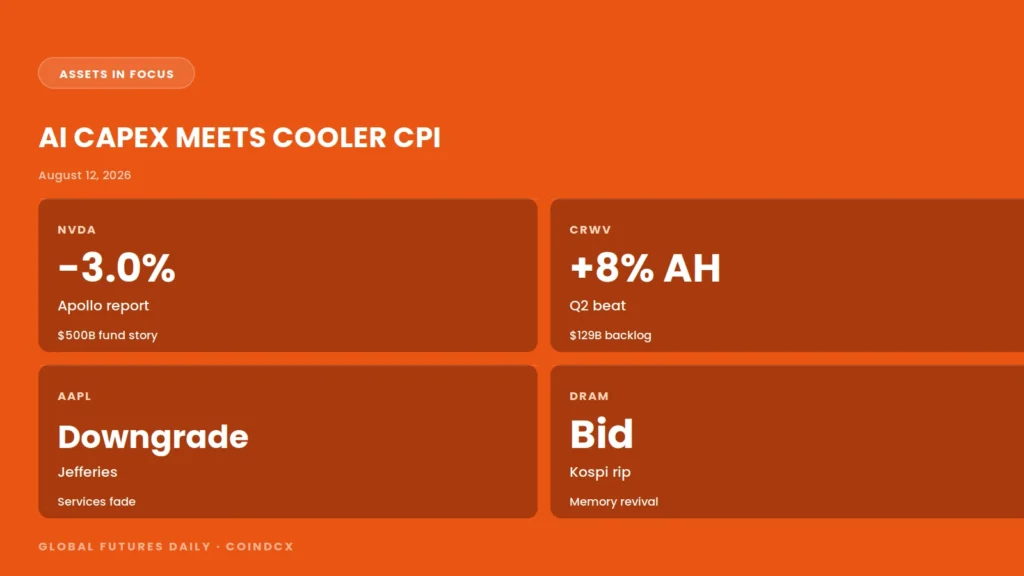
Nvidia extended its Monday drop through Tuesday session on the FT report about Apollo and Blackstone assembling a $500B AI infrastructure funding vehicle. BofA reiterated a Buy heading into the August 26 fiscal Q2 print and said memory and circular financing concerns are overblown. The stock response to today cooler CPI matters for the broader tech setup ahead of the print.
DRAM
The semiconductor and memory read-through was clean overnight. Samsung and SK Hynix both closed over 5% higher in Seoul on CoreWeave Q2 beat and Q3 guide raise, and Kioxia added roughly 4% in Tokyo as Japan reopened. The DRAM complex remains the tradable proxy for the memory cycle in the CoinDCX Global Futures universe.
AMD
AMD is still working off the -7% weakness that followed the Q2 print, with the Q3 guide of $12.7 to $13.3 billion topping the $12.5 billion consensus but failing to clear a fully priced-in AI datacenter narrative. Data center revenue grew 107% year-on-year to $6.7 billion. Cool CPI and continued AI infra validation from CoreWeave could set up a reset attempt.
AAPL
Apple absorbed a Jefferies downgrade on Monday, extending the fade that began after the Services segment missed $30.74B versus consensus last quarter and Greater China printed $18.8B against expectation. Tim Cook last earnings call is done, and John Ternus takes over September 1. Any post-CPI bounce here reveals whether the tape wants to look through the guide.
Index Levels to Watch
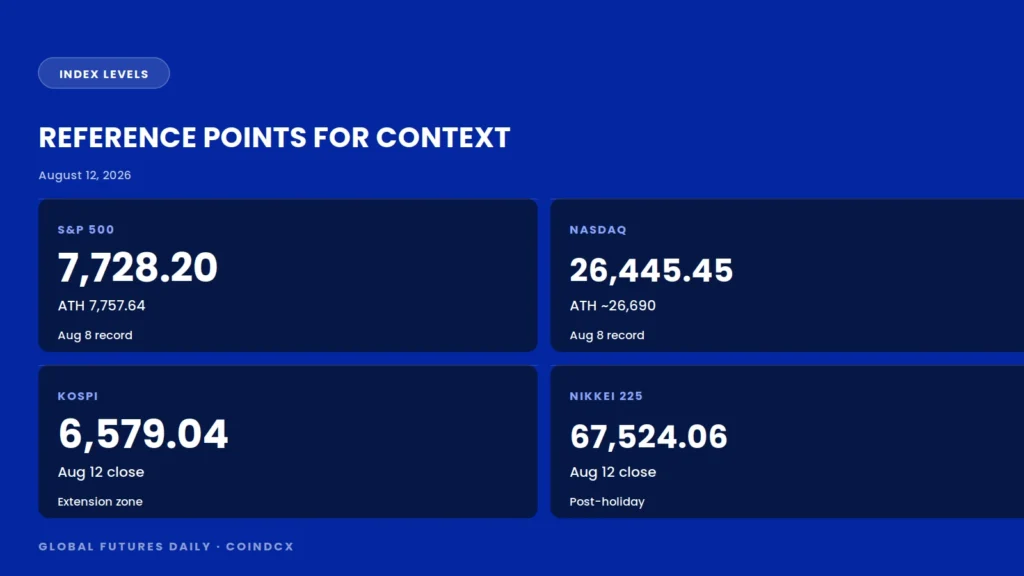
The S&P 500 closed Tuesday at 7,728.20, roughly 30 basis points off Friday 7,757.64 record close. The Nasdaq Composite at 26,445.45 remains below the recent all-time high near 26,690. The Dow at 53,791.85 sits about 560 points below the August 5 record close of 54,349.06. Overseas: Kospi at 6,579.04, Nikkei 225 at 67,524.06, and the Hang Seng around 25,415.
Disclaimer
The information provided in this article is for educational and informational purposes only and does not constitute financial, investment, or trading advice. CoinDCX does not offer securities, stocks, or commodity trading services in India. The mention of any securities or stocks is intended solely for the purpose of educating traders about global market events. Trading and investing in derivatives involve significant risks, including the potential loss of your entire investment. Past performance is not indicative of future results. Any decisions to trade or invest should be made based on your own research, financial situation, and risk tolerance. CoinDCX and its affiliates are not responsible for any losses incurred as a result of using the information provided. Please consult a qualified financial advisor before making any trading or investment decisions.
Frequently Asked Questions
Q1. What did July CPI print at?
Headline CPI came in at 3.4% year-on-year and 0.1% month-on-month, both matching Dow Jones consensus and easing from June 3.5% and -0.4%. Core CPI printed 2.5% year-on-year and 0.2% month-on-month, also in-line and down from June 2.6% and flat monthly read.
Q2. How did the market react to the CPI print?
US futures firmed on the release. S&P 500 futures were up 0.3% and Nasdaq 100 futures were up 0.7% ahead of the US cash open, with the dollar index down 0.1%. The USD softness reflected a modest fade in September hike odds after the in-line print.
Q3. What are Fed rate hike odds after the CPI?
Fed funds futures were pricing a roughly 50 to 51% probability of a September hike into the release, up from around 44% a week ago on the August 1 NFP miss but down from 58% two weeks prior. The in-line print nudged that probability lower without collapsing it, since core services and shelter remain sticky.
Q4. What is Cisco expected to report tonight?
Wall Street consensus calls for $1.17 EPS on $16.83B revenue for fiscal Q4 2026, roughly 18% and 15% year-on-year growth respectively. The company already raised its full-year AI infrastructure order guide to $9 billion from $5 billion at Q3. The swing factor is fiscal 2027 guidance and the pace at which AI orders convert to revenue.
Q5. What is the setup for PPI on Thursday?
Producer prices are the second inflation read of the week. A cool PPI would confirm the CPI trend and pressure September hike odds further. A hot print would revive the stagflation debate that Hammack referenced on Monday. Applied Materials reports fiscal Q3 after the close on Thursday, giving a semiconductor capital equipment read on top of the macro data.