



Crypto market capitalization is one of the most frequently referenced numbers in the crypto space. It is a metric that investors use to measure the size, popularity, and risk aspects of cryptos against each other. Although a simple concept, a market cap may reveal significant aspects of how the entire market is moving towards stability for specific coins and their position in the market.
Key Insights:

1) Market capitalization (market cap) is a measure of a crypto’s total value in circulation.
2) It helps categorize coins into large-cap, mid-cap, and small-cap Cryptos.
3) Market capitalization (market cap) can guide investors in assessing risk, stability, and potential growth.
4) It’s not a perfect metric and should be used in combination with other indicators.
5) Understanding market cap aids in portfolio allocation and market trend analysis
What is Market Cap in Crypto?
Market capitalization or market cap is a key metric in the crypto world that represents the total value of a crypto. It is calculated by multiplying the current price of a coin by its circulating supply, offering a clearer picture of a crypto’s overall size and importance than just looking at its individual price. For instance, if a crypto has 1 million coins worth $10 each, its market cap would be $10 million.
Understanding crypto market cap is essential because it helps investors accurately compare different tokens. A coin with a high price isn’t necessarily more valuable—its total supply matters too. A low-priced coin with a large supply might have a higher market cap, indicating greater market presence and influence. Thus, market cap serves as a better indicator of a crypto’s dominance, strength, and potential stability.
Market cap also helps investors assess risk and growth potential. Large-cap cryptos tend to be more stable and widely used, while small-cap coins often carry higher volatility but may offer greater upside. By evaluating crypto assets through market cap, investors can make more informed decisions about diversification, portfolio balance, and long-term investment strategies.
Why is Market Cap Important in Crypto?
Market cap is not just a number; it tells something beyond the number, such as how and which crypto can be a good investment, what the potential risk is, and what is/are the trend(s) in the market.
By analyzing crypto market cap, investors can make more informed decisions about portfolio allocation, risk management, and long-term investment strategies.
1) Indicator of Size and Stability
One of the most significant reasons market cap in crypto matters is that it indicates the size and stability of a crypto. Coins with a large market cap are typically more established and widely adopted. These coins tend to have stronger networks, higher liquidity, and greater resilience against market volatility. They are less likely to experience extreme price swings and often have broader support from exchanges, investors, and developers.
On the other hand, small-cap coins usually represent newer projects with smaller communities and lower liquidity. While they can grow rapidly if the project succeeds, they are generally much more unstable and susceptible to price manipulation. Evaluating cryptos by market cap helps investors distinguish between mature, stable projects and speculative, high-risk opportunities.
2) Comparing Coins Beyond Just Price
Many beginners focus on the price of a single coin, but this can be misleading. For instance, a coin priced at $500 might seem more valuable than one priced at $50. However, market cap provides a more accurate picture because it accounts for both price per coin and the number of coins in circulation.
A lower-priced crypto with a much larger circulating supply could actually have a higher market capitalization than a higher-priced coin. This indicates which coin holds the largest market share, providing a more meaningful measure of its impact in the crypto ecosystem. By using market cap in crypto, investors can compare coins on a level playing field and avoid being misled by nominal prices alone.
3) Role in Risk Assessment and Volatility
Market cap may be used as a risk indicator:
- Large-cap cryptos are more stable but tend to provide lower percentage gains. They are ideal for investors seeking long-term growth and lower risk.
- Mid-cap cryptos strike a balance between risk and reward, offering moderate growth potential.
- Small-cap cryptos, while highly volatile and riskier, can deliver substantial returns if the project succeeds.
By evaluating the market cap, investors can better understand how much risk they are taking and allocate their portfolio accordingly. This helps in building a diversified investment strategy that balances stability and growth potential.
Also Read: Market Cap Vs Fully Diluted Market Cap
Limitations of Using Crypto Market Cap Alone
Although market capitalization (market cap) is a good indicator, it should not be the only factor considered when making investment decisions. Relying solely on the crypto market cap can be misleading for investors because it doesn’t capture all aspects of a coin’s value, growth potential, or risk. Understanding these limitations is essential for making well-informed investment decisions.
1) Volatility and Manipulation Concerns
The market cap is subject to rapid price changes and thus volatility, making it an unreliable indicator of short-term stability. Small-cap tokens are the most susceptible to manipulation.
One major limitation of using market cap in crypto alone is that it is highly sensitive to price fluctuations. Because market cap is calculated by multiplying the current coin price by the circulating supply, even small price changes can cause significant shifts in market capitalization. This volatility can make the crypto market cap an unreliable indicator of short-term stability, particularly for smaller coins.
Small-cap and low-liquidity tokens are especially vulnerable to manipulation. A relatively small trade can drastically affect the price, creating an artificial increase or decrease in market cap. This makes it risky to evaluate such coins purely based on their market cap in crypto, as it may not reflect the real adoption or long-term potential of the project. Investors should complement market cap data with additional indicators, such as trading volume, developer activity, and community engagement, to form a more comprehensive picture.
2) Misleading Fully Diluted Market Cap
The fully diluted market cap is based on the maximum supply rather than the amount of coins in circulation. This will make the value of an asset seem smaller than it actually is, hence attracting buyers who are unaware of the difference.
Understanding the difference between the circulating market cap and the fully diluted market cap is crucial for assessing cryptos by market cap accurately and avoiding misleading impressions about potential returns or risks.
3) Doesn’t Measure Profitability or Fundamentals
Market capitalization reflects the market’s perception and the current price of the coin. It doesn’t directly show the technology, adoption, or revenue model, all of which are very important for evaluation over time.
A crypto’s high market cap may be driven by speculation, but this does not guarantee long-term success or sustainability. Conversely, projects with strong technology and promising use cases may have a lower market cap simply because they are not yet widely recognized by investors.
Relying solely on market cap without analyzing the project’s fundamentals can lead to poor investment decisions. Investors should consider factors like the project’s roadmap, team experience, tokenomics, and real-world adoption to gain a comprehensive understanding of its potential.
Calculate Market Cap in Crypto
The calculation of crypto market cap is straightforward – simply multiply the current price per coin of the token by its circulating supply.
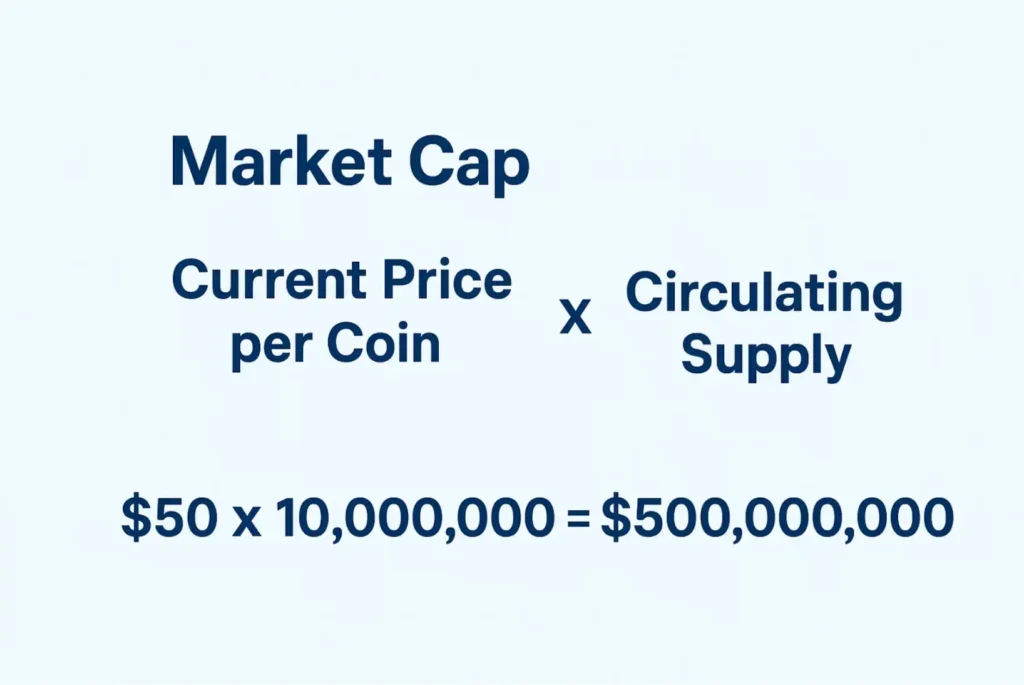
Use our crypto market cap calculator to easily calculate the current market value of tokens.
Categories of Cryptos by Market Cap
Cryptos are often classified based on their market capitalization, which helps investors understand their potential risk and growth prospects.
Large-Cap Cryptos (Over $10B)
The group comprises some of the most prominent names, including Bitcoin and Ethereum. Those cryptos are among the first on the list of market leaders, and as they are more or less fully mature, their level of adoption is high. In general, they exhibit less volatility than other smaller coins.
Mid-Cap Cryptos ($1B – $10B)
Mid-cap tokens typically capitalize on the period of their rise. For one thing, they are less developed and therefore smaller than large-cap cryptos; on the other hand, they can offer a considerably higher return for investors who are willing to take a moderate-risk approach.
Small-Cap Cryptos (Under $1B)
Small-cap tokens represent new projects with significant growth potential. Nevertheless, their value is subject to extreme fluctuations, and a significant amount of risk is involved. Be cautious with your approach, and conduct thorough research before investing in them.
Also Read: Key Differences b/w Market Cap and Circulating Supply
Quick View: Large-Cap vs Mid-Cap vs Small-Cap Crypto
| Category | Market Cap Range | Risk Level | Typical Examples |
| Large-Cap | Over $10B | Low | Bitcoin, Ethereum |
| Mid-Cap | $1B – $10B | Moderate | Chainlink, Polygon |
| Small-Cap | Under $1B | High | New ICOs, niche tokens |
How Market Cap Helps in Investment Portfolio Balancing?
One of the main benefits of understanding market cap in crypto is that it allows investors to structure and diversify their portfolios effectively.
A balanced crypto portfolio typically comprises a diverse mix of market-cap segments, each serving a distinct purpose. The investors’ portfolio can be diversified by combining the following:
- Large-cap coins for stability: These coins typically have a high market capitalization, strong community trust, and established use cases. They act as the stable foundation of a portfolio, providing steady growth with less volatility.
- Mid-cap coins for moderate growth: These cryptos often represent growing projects with expanding user bases. They balance risk and reward, offering moderate potential returns while maintaining reasonable stability.
- Small-cap coins for high risk and reward: These have a smaller market cap in crypto terms but can deliver substantial returns if the project succeeds. However, they are more prone to price swings and market manipulation, so investors should approach them with caution.
By combining these categories, investors can achieve a diversified and well-balanced crypto portfolio that aligns with their goals and risk appetite.
Conclusion
Market capitalization is a key metric for evaluating a crypto project’s value, offering essential insights into its size, stability, and relative ranking. Although it helps to classify coins into different categories based on large, mid, and small capitalization, it should not be used entirely to make investment decisions. By integrating market cap with other metrics, such as trading volume, adoption rate, and project fundamentals, investors gain a more comprehensive understanding of the risk and reward potential.
Understanding market cap and its consequences enables investors to make informed decisions, diversify their portfolios with knowledge, and estimate the general state of the market. These skills are essential in the fast-changing crypto ecosystem.
FAQs
Q1. Is a higher market cap always better?
No. A higher market cap is a sign that a coin is stable, but a lower-cap coin could give you high growth potential. It mainly depends on the risk tolerance and investment strategy. However, this doesn’t always mean they offer the highest returns. Small-cap cryptos, characterized by lower market caps, can sometimes deliver massive growth if the project succeeds. However, they also come with higher risks, such as market manipulation or project failure.
Q2. What is the difference between market cap and trading volume?
Market Cap is the total dollar value of coins in circulation. On the other hand, volume indicates the total amount of crypto that has been traded over a specific period. Market capitalization highlights the size of a crypto, while volume reveals the level of liquidity and activity in the market. Market cap indicates the total value of a crypto, whereas trading volume reflects the market's activity and liquidity. Both metrics are crucial for analyzing the significance of market cap in crypto and assessing the overall health of a project.
Q3. Can a low-cap coin become a large-cap crypto one day?
Yes, many cryptos start as small-cap stocks and grow larger as adoption rises and the project matures, but all this comes with a considerable amount of risk. A low-cap coin can become a large-cap one, but investors should always research thoroughly, understand the project’s use case, and never invest money they can’t afford to lose.
Q4. How often should I check the market cap for investment decisions?
You should regularly track your market cap, but your decisions should be based on long-term trends, fundamentals, and market research, rather than on daily fluctuations. Short-term price movements or market fluctuations don’t always reflect a coin’s real potential. Instead of reacting to daily changes, focus on long-term trends, project fundamentals, and overall market sentiment. Monitoring crypto market cap trends over time helps you understand where the market is heading and which projects are gaining or losing investor confidence. Incorporate market cap in crypto as part of a broader investment strategy that encompasses technology, use case, and team evaluation.
Q5. Does market cap account for all coins ever mined?
Market cap typically considers the number of coins in circulation, rather than the total or maximum number of coins, providing a more accurate indication of the coin's market value. It does not factor in the total or maximum number of coins that could exist in the future. This method gives a realistic view of a crypto’s current market value, making it easier to compare different cryptos by market cap. Using only the circulating supply ensures that the valuation reflects the coins currently influencing the market, rather than those yet to be released.