


Introduction
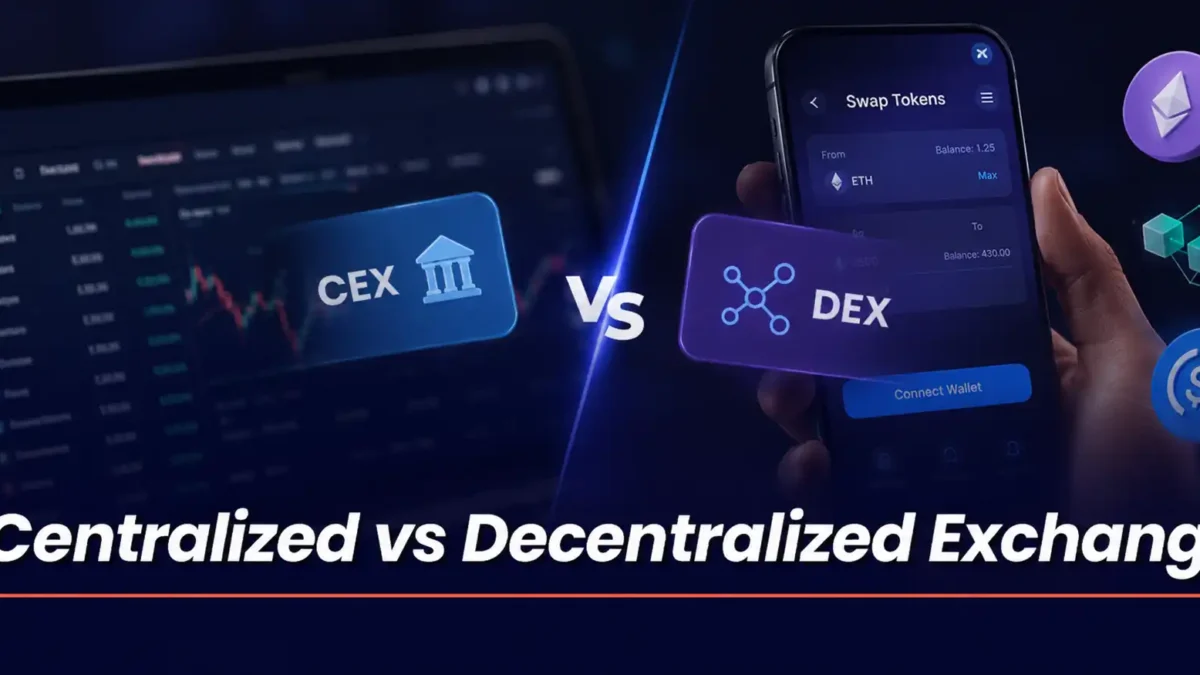
To buy or trade crypto you use an exchange, and there are two very different kinds: centralized exchanges – CEXs and decentralized exchanges – DEXs. They work in fundamentally different ways, and the right choice depends on what you need.
This guide explains what a crypto exchange is, how CEXs and DEXs differ, the trade-offs of each, and what Indian users should look for, including FIU-IND registration and how India’s crypto tax rules apply.
What Is a Crypto Exchange?
In simple terms: A crypto exchange is an online platform where you can buy, sell, and trade cryptos. It is the main gateway most people use to get into and out of crypto, much as you might use an app to buy shares. When people say ‘crypto trading platform’, they usually mean the same thing.
An exchange matches people who want to buy with people who want to sell, and provides the tools to do it, such as price charts, order types, and wallets. The biggest difference between exchanges is whether they are centralized or decentralized, and that shapes everything else: who holds your money, who you can call when something goes wrong, and what protections apply.
What Is a Centralized Exchange – (CEX)?
A centralized exchange is the type most beginners start with. A company runs it and acts as a trusted middleman for your trades.
The company operates the platform, holds your funds, which is called ‘custody’, matches buyers and sellers, provides support, and handles security. It works much like an online stockbroker: convenient, relatively easy to use, and backed by a company you can contact. For Indian users, CEXs based in India let you deposit and withdraw in rupees and handle much of the tax and compliance work.
What Is a Decentralized Exchange (DEX)?
A DEX works very differently. Instead of a company holding your money, it lets you trade directly from your own wallet using automated software, with no middleman.
Trades happen through ‘smart contracts’, self-running programs on a blockchain, and your funds stay in your own self-custody wallet throughout. That gives you more control, privacy, and access to newer tokens. It also brings significant responsibility. There is usually no support if you make a mistake, no way to reverse an error, and no company to recover funds from. DEXs generally do not support rupee deposits, charge network fees on every transaction, and leave the full burden of tax record-keeping with you.
CEX vs DEX: The Key Differences
Neither type is simply better than the other, because they suit different needs and levels of experience.
A CEX is run by a company that holds your funds. It is easier to use, offers support, and in India supports rupees and helps with tax, but you have to trust that company. A DEX lets you trade directly from your own wallet with full control and no middleman, and it offers no support, places full responsibility on you, and carries a higher risk of scam tokens. Many beginners start with a reputable CEX and explore DEXs later, once they understand self-custody.
FIU-IND Registration and Crypto Tax Rules in India
For users in India there are specific points beyond the CEX-versus-DEX choice. Getting them right protects both your money and your legal standing.
On tax, India treats crypto as a Virtual Digital Asset (VDA). Gains are taxed at a flat 30 percent, plus a 4 percent cess and any applicable surcharge, regardless of your income slab or holding period, and losses cannot be set off or carried forward. A 1 percent TDS applies to transfers above the relevant thresholds, deducted at source and claimed as credit against your final bill. A compliant Indian CEX handles much of this for you, including deducting TDS and providing transaction reports, whereas on a DEX the entire burden falls on you. Consult a qualified chartered accountant for your own situation.
How to Choose a Crypto Exchange in India
There is no single best exchange for everyone. Knowing what to look for is more useful than any ranking, because it lets you judge any platform yourself.
FIU-IND Registration
Confirm the platform is registered with FIU-IND before anything else. This is the single most important check for an Indian user, and it determines whether the platform is operating lawfully here. Verify it through official sources rather than taking the platform’s word for it.
Security Track Record
Look for strong security practices and a history of protecting user funds. Ask how long the platform has operated and how it handled past incidents, because how a company behaves after a problem tells you more than its marketing does.
INR Support and Ease of Use
Straightforward rupee deposits and withdrawals matter a great deal for most Indian users, as does a clear interface. This is especially true for beginners, where a confusing app leads directly to costly mistakes. Check that withdrawals work as smoothly as deposits.
Tax and Compliance Help
A compliant Indian exchange that deducts TDS and provides transaction reports makes staying on the right side of the rules considerably easier. Without that, you are reconstructing a year of trades yourself at filing time.
Fees and Costs
Compare trading fees and other charges, noting that platform fees also attract GST in India, and check withdrawal fees as well as trading ones. Never let low fees outweigh safety and registration, because the cheapest platform is worthless if you cannot get your money out.
Custody and Transparency
A CEX holds your funds on your behalf, so favour platforms that are open about how they secure and hold customer assets. Transparency about custody is one of the few things you can actually assess from the outside.
Which Crypto Exchange Should You Use?
For most people in India, especially beginners, a reputable, FIU-IND registered centralized exchange is the most practical and compliant starting point, because of its ease of use, rupee support, and help with tax. As you gain experience you may explore decentralized options, but only once you properly understand self-custody and its risks. CoinDCX is one example of an FIU-IND registered Indian exchange. Whatever you choose, crypto is volatile and high-risk, so protect your seed phrase, be wary of anyone promising guaranteed returns, and never invest more than you can afford to lose.
FAQs
Q1. What is a crypto exchange?
A centralized exchange is run by a company that holds your funds, matches trades, and provides support. It is generally easier for beginners and, in India, supports rupee deposits and withdrawals. The trade-off is that you are trusting that company with your crypto.
Q2. What is the difference between a centralized and a decentralized exchange?
A decentralized exchange runs on blockchain smart contracts with no company in the middle. You trade directly from your own wallet and keep control of your funds throughout. It is more complex, usually has no rupee support, offers no customer support, and carries a higher risk of scam tokens.
Q3. Which is safer, a CEX or a DEX?
The biggest difference is custody, meaning who holds your crypto. On a CEX the company holds it for you. On a DEX your funds stay in your own wallet. That single difference drives everything else: ease of use, support, rupee access, and how much responsibility falls on you.
Q4. What is FIU registration, and why does it matter in India?
Check FIU-IND registration first, because it is a legal requirement for platforms serving Indian users. Then look at the security track record, rupee support and ease of use, tax and compliance help, fees, and how transparent the platform is about custody.
Q5. How is crypto taxed in India, and does the exchange type matter?
India treats crypto as a Virtual Digital Asset. Gains are taxed at a flat 30 percent plus a 4 percent cess and any applicable surcharge, losses cannot be set off or carried forward, and a 1 percent TDS applies on transfers. A compliant Indian exchange deducts TDS and provides transaction reports, which makes filing far easier.
Q6. What is the best crypto exchange in India?
For most beginners in India, a reputable FIU-IND registered centralized exchange is the most practical starting point, because of its ease of use, rupee support, and tax help. Decentralized exchanges suit more experienced users who understand self-custody and its risks.
Crypto exchanges come in two main forms: centralized exchanges, run by a company that holds your funds and (in India) supports rupees and tax handling, and decentralized exchanges, which give you full control from your own wallet but also full responsibility and higher scam risk. Neither is simply 'best'; the right choice depends on you. For Indian users, the essentials are clear: use an FIU-IND registered platform, verify it yourself, understand the tax rules, and protect your seed phrase. Keep learning with CoinDCX's education guides, and never invest more than you can afford to lose.