

What is Curve Finance?
Curve Finance is a decentralized exchange built specifically for trading assets that should hold the same value, stablecoins like USDC, USDT, and DAI, and pegged assets like stETH and wBTC. It was launched in January 2020 by Michael Egorov, a Russian physicist and cryptographer, and has grown into one of the most important pieces of infrastructure in the DeFi ecosystem.
What makes Curve different from general DEXs like Uniswap is the math underneath. Curve uses a specialized bonding curve algorithm called StableSwap that concentrates liquidity around a 1:1 price ratio. The result is dramatically lower slippage and fees for large stablecoin trades, often 10x to 100x better than what you’d get elsewhere.
By 2026, Curve’s model has proven its staying power. Total trading volume grew from around $119 billion in 2024 to $126 billion in 2025, and Curve now captures roughly 44% of all DEX fee revenue on Ethereum, up from just 1.6% a year prior. It runs across Ethereum mainnet, Arbitrum, Optimism, Polygon, and several newer EVM chains.
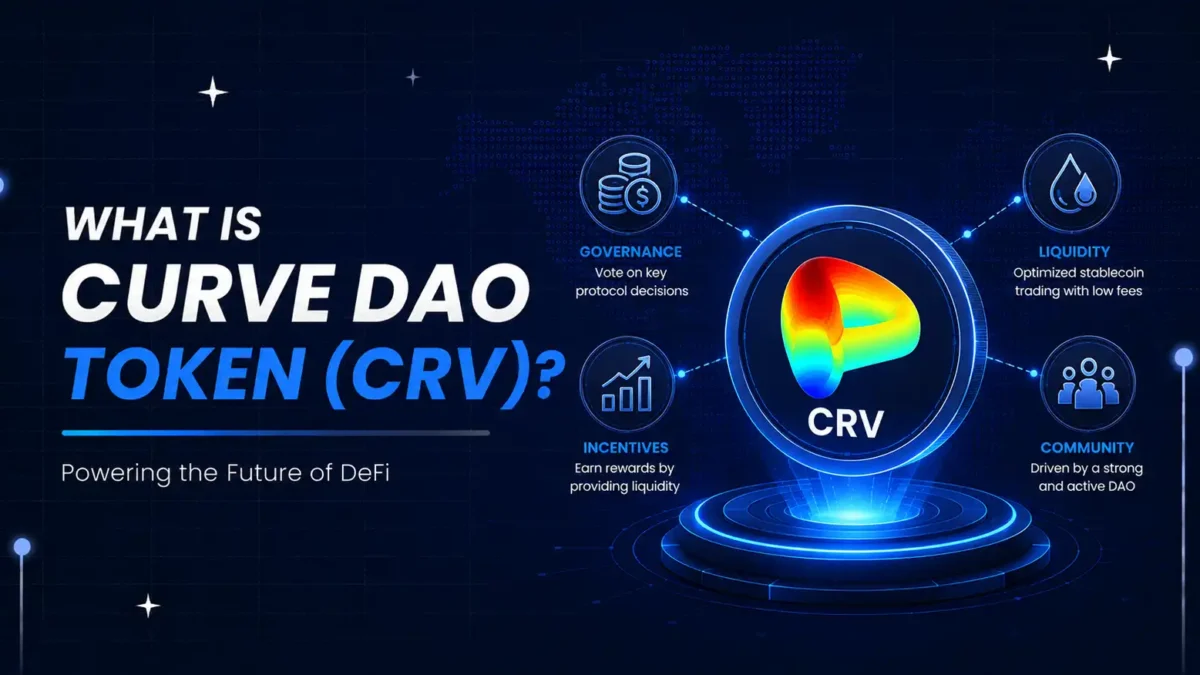
What is Curve DAO Token?
Curve DAO Token or CRV is the governance and utility token of Curve Finance. It was launched in August 2020 alongside Curve’s decentralized autonomous organization, giving the community formal control over how the protocol operates.
CRV isn’t just a governance token you hold and forget. It’s designed to be actively used, locked, voted with, and earned through providing liquidity. The token’s value comes from its deep connection to protocol activity: the more Curve is used, the more fees flow to CRV holders who have locked their tokens.
Think of CRV as both a vote and a yield instrument inside one of DeFi’s most essential protocols.
Infographic: CRV at a Glance
| Full Name | Curve DAO Token |
| Ticker | CRV |
| Launched | August 2020 |
| Creator | Michael Egorov |
| Blockchain | Ethereum, also on Arbitrum, Optimism, Polygon, and more |
| Max Supply | 3.03 billion CRV |
| Circulating Supply | ~1.47 billion CRV |
| TVL | ~$2.1–$2.6 billion |
| Use Cases | Governance voting, liquidity rewards, fee sharing, yield boosting |
Read more: Buy CRV in India
How Does CRV Work?
CRV has three primary functions in the Curve ecosystem, and they’re all interconnected.
Governance: CRV holders participate in protocol decisions, from which liquidity pools receive CRV reward emissions, to fee structures, to major protocol upgrades. However, raw CRV gives you limited voting power. To vote with full weight, you need to lock your CRV and convert it to veCRV.
Liquidity Mining Rewards: When you deposit tokens into a Curve liquidity pool, you earn a share of the trading fees generated by that pool. On top of that, you earn CRV token rewards, which are distributed proportionally based on how much liquidity you provide and how long you’ve been in the pool. The more veCRV you hold, the higher your CRV reward boost — up to 2.5x the base rate.
Fee Sharing: Fifty percent of all protocol fees generated across Curve, from every stablecoin swap, every lending transaction, is distributed to veCRV holders. This is the “real yield” component that makes CRV holders passive beneficiaries of the entire Curve ecosystem’s growth. Given that Curve now processes hundreds of millions of dollars in weekly volume, this fee stream is meaningful.
What is veCRV? The Vote-Locking System Explained
veCRV or vote-escrowed CRV, is what you receive when you lock your CRV tokens in the Curve protocol. It’s not a tradeable token, you cannot transfer or sell veCRV. It represents your locked position and decays linearly back to zero as your lock period expires.
Here’s how the locking math works:
| Lock Duration | veCRV Received (per 1 CRV) | Max LP Boost |
| 1 week | ~0.005 veCRV | Very low |
| 6 months | ~0.12 veCRV | Moderate |
| 1 year | ~0.25 veCRV | Moderate |
| 2 years | ~0.50 veCRV | High |
| 4 years, maximum | 1.00 veCRV | 2.5x |
The longer you lock, the more veCRV you receive and the higher your governance weight and yield boost. This design is deliberate, it rewards long-term believers over short-term speculators, and it reduces sell pressure on CRV by incentivizing holders to lock tokens out of circulation.
veCRV also entitles you to:
- 50% of all Curve protocol fees, distributed weekly in 3CRV
- Gauge weight voting rights, directing where CRV emissions flow
- LP reward boost up to 2.5x on your liquidity positions
The four-year lock period is a serious commitment. Most DeFi users who don’t want to lock their own CRV use protocols like Convex Finance, which pools veCRV voting power and passes through boosted yields, you deposit CRV into Convex and receive cvxCRV, which earns boosted rewards without direct locking.
Trade CRO in INR on 
Deposit and withdraw in INR (₹).
No Conversion to Crypto Required.

What is Curve Wars And Why They Matter
Curve Wars is the name given to the ongoing battle between DeFi protocols competing to accumulate veCRV voting power, and it’s one of the most fascinating economic games in crypto. Here’s why it happens.
CRV emissions are allocated to liquidity pools based on weekly gauge weight votes. The more veCRV a protocol controls, the more it can direct CRV rewards toward its own pools. More rewards attract more liquidity. More liquidity means better prices and lower fees for that protocol’s users.
So protocols that rely on Curve pools for deep liquidity are constantly trying to accumulate veCRV. They do this by offering bribes, building meta-governance protocols and direct CRV buying.
The Curve Wars have created an entirely new market for the so-called vote markets and bribe protocols like Votium and Hidden Hand. For ordinary CRV holders with veCRV, this is a bonus income stream, you can effectively sell your votes to the highest bidder while still earning base protocol fees.
Understanding the Curve Wars is important because it explains a lot of the sustained demand for CRV tokens even during bear markets.
What is crvUSD?
crvUSD is Curve’s native decentralized stablecoin, launched in 2023. Unlike traditional stablecoins, crvUSD uses an innovative liquidation mechanism called LLAMMA or Lending-Liquidating AMM Algorith, that softens liquidations by gradually converting collateral rather than triggering sharp cliff-style liquidations.
In practice, this means crvUSD borrowers are less exposed to sudden, catastrophic liquidation events, the system slowly adjusts as collateral prices fall, giving borrowers more time to manage their positions.
By 2026, crvUSD has become one of the most actively traded stablecoins on Curve itself, with two crvUSD pools ranking in Curve’s top 10 by volume. The crvUSD minted supply has grown consistently, and it now serves as collateral and liquidity backbone across multiple Curve products.
For CRV holders specifically, crvUSD matters because: a portion of borrow interest paid by crvUSD borrowers flows into protocol revenue, which is distributed to veCRV holders.
Curve in 2026 — Yield Basis, Llamalend V2, and What’s New
Llamalend V2
Curve’s lending market, known as LlamaLend (or Llamalend), underwent a major upgrade in 2026. Version 2 expanded eligible collateral types, introduced LP tokens and fixed-yield assets as collateral, and added administrative fees that flow directly into DAO treasury revenue. This makes Curve a meaningful competitor in decentralized lending, not just trading.
Yield Basis Protocol
Yield Basis is built on top of Curve’s infrastructure and is designed to solve one of DeFi’s oldest problems: earning meaningful yield on Bitcoin without sacrificing too much to impermanent loss. By using crvUSD as the base liquidity layer, Yield Basis launched three Bitcoin-focused pools (WBTC, cbBTC, tBTC) each capped at $10 million initially.
For CRV holders, the relevance is direct. Between 35% and 65% of Yield Basis yields flow back to veCRV holders. This means holding and locking CRV now gives exposure to Bitcoin DeFi yield in addition to stablecoin fees, a significant expansion of what veCRV earns. The integration has already produced results. By December 2025, Yield Basis pools were generating some of the highest fee growth on the platform, and the YB/crvUSD pool jumped into a top ranking position within weeks of launch.
CRV Emissions Cut
In August 2025, Curve reduced its annual CRV inflation rate to 5.02%, cutting approximately 22 million tokens per year in sell pressure. This was an important tokenomics improvement, less constant selling from new emissions means the existing token supply becomes more valuable over time.
Curve-Lite Expansion
Curve has been deploying a lightweight version of its DEX (“Curve-Lite”) across newer EVM chains. After launching on Monad and OP Stack chains in 2025, Curve is targeting deployments on Scroll, zkSync, and Polygon CDK chains in 2026, expanding CRV utility and emissions-driven demand across more ecosystems.
DAO Treasury
In June 2025, the DAO voted to allocate 10% of all protocol revenue to a dedicated treasury — a governance first for Curve. This gives the protocol a financial reserve for audits, development, and long-term stability, rather than distributing all fees immediately to stakeholders.
CRV Tokenomics — Supply, Distribution, and Inflation
Understanding CRV’s supply structure helps explain its price dynamics, especially during a bear market.
- Total supply: 3.03 billion CRV (hard cap, never changes)
- Circulating supply: ~1.47 billion CRV (as of March 2026)
- Annual inflation rate: ~5.02% (reduced from higher levels in August 2025)
Distribution breakdown:
- 62% — Community liquidity providers (distributed as mining rewards over ~200 years)
- 30% — Shareholders and team (2-year vesting schedule)
- 5% — Community reserve
- 3% — Employees
The long-tail emission schedule is intentional, it keeps liquidity incentives running for decades. But the August 2025 emissions cut means the rate at which new CRV enters circulation has slowed significantly, reducing constant sell pressure from miners liquidating rewards.
As more CRV gets locked into veCRV (some estimates suggest 40–50% of circulating supply is locked), the effective tradeable float shrinks further. This dynamic is one of the reasons CRV proponents argue the token is structurally better-positioned than most DeFi governance tokens.
Staking vs Locking CRV — What’s the Difference?
| Staking CRV | Locking CRV (veCRV) | |
| Reward type | Protocol trading fees | Boosted LP rewards + protocol fees + bribe income |
| Lock period | Flexible (no commitment) | 1 week to 4 years |
| Governance rights | None or limited | Full voting power |
| Yield level | Lower | Higher (up to 2.5x boost) |
| Liquidity | Liquid / withdrawable | Locked — cannot transfer or sell |
| Best for | Passive, low-commitment yield | Active DeFi participants, long-term holders |
Most experienced DeFi users lock CRV for 1–4 years to maximize both their yield and their governance influence. If you don’t want to commit to a lock period, using a protocol like Convex Finance is a common middle-ground, you deposit CRV and receive boosted yields without personally locking.
Conclusion: Is CRV Right for You?
If you’re active in DeFi and want to earn more from liquidity provisioning or participate in DAO governance, CRV could be a valuable asset. Its blend of rewards, influence, and ecosystem utility makes it more than just a governance token, it’s a core part of DeFi infrastructure in 2026.
FAQ
1. Is Curve DAO Token a good investment?
CRV offers utility in governance and yield farming but remains volatile. It's ideal for active DeFi users rather than passive investors.
2. Where can I buy CRV?
Yes. You can buy CRV in India using INR on CoinDCX. The process takes a few minutes, create an account, complete KYC, deposit INR via UPI or Net Banking, and buy CRV directly. You can check the details on this link https://coindcx.com/how-to-buy/curve/
3. What makes Curve unique in DeFi?
Curve’s stablecoin swap model and vote-locking mechanism allow efficient trading and unique governance dynamics.
4. How does veCRV work?
The veCRV works by locking CRV to get veCRV, which boosts rewards and gives voting rights. The longer you lock, the more veCRV you get.
5. Can I use CRV on Layer-2 chains?
Yes, Curve operates on Arbitrum, Optimism, and Polygon with bridging options available.
How much is CRV worth today?
CRV is currently trading at approximately $0.24 (as of March 2026). For the latest live price in INR, check our buy page at CoinDCX.
What is the Yield Basis protocol?
Yield Basis is a protocol built on top of Curve, approved by the Curve DAO in September 2025 with a $60 million crvUSD backing. It enables Bitcoin holders to earn sustainable DeFi yields (via WBTC, cbBTC, and tBTC pools) while mitigating impermanent loss. Between 35% and 65% of Yield Basis yields flow back to veCRV holders.
How is Curve different from Uniswap?
Uniswap is a general-purpose DEX designed for all token pairs. Curve is specialized, its AMM algorithm is optimized for assets that should trade near the same price (stablecoins, liquid staking tokens). This gives Curve dramatically lower slippage and fees on those pairs, but makes it less suitable for volatile trading pairs.