


In the ever-evolving world of cryptos, two names stand out: Bitcoin and Pi Network. Bitcoin, the pioneer of digital assets, has dominated the market for over a decade. On the other hand, Pi Network, a relatively new player, has gained immense popularity and a massive user base in a short span of time. In this article, we will delve into the intriguing comparison between these two crypto projects. We’ll explore their fundamental concepts, highlight their similarities and differences, examine key features, and provide the latest updates on both Bitcoin and Pi Network. So, let’s dive into the world of these prominent cryptos and discover what sets them apart and makes them significant in the current crypto landscape.
Key Insights:

1) Bitcoin’s groundbreaking features include a limited supply of 21 million coins, a decentralized nature, and pseudonymous transactions.

2) Pi Network employs a unique consensus mechanism called “Proof of Mining, ” allowing users to mine Pi coins directly from their smartphones.

3) Pi Network emphasizes accessibility, inclusivity, and user engagement, aiming to bring crypto to the masses by making mining available to anyone with a smartphone.
What is Bitcoin?
Bitcoin, often referred to as the “king of cryptos,” is a decentralized digital asset that was introduced in 2009 by an anonymous person or group known as Satoshi Nakamoto. It operates on a blockchain technology, a distributed ledger that records all transactions made with Bitcoin.
At its core, Bitcoin is designed to be a peer-to-peer electronic cash system, enabling individuals to make secure, direct transactions without the need for intermediaries such as banks or governments. Transactions are verified by network nodes through cryptography and added to the blockchain, ensuring transparency and immutability.
Bitcoin’s groundbreaking feature is its limited supply. Unlike traditional fiat currencies, which can be printed by central banks, Bitcoin has a maximum supply cap of 21 million coins. This scarcity has contributed to its store of value narrative and has often been compared to digital gold.
Bitcoin’s decentralized nature and cryptographic security make it resistant to censorship and manipulation. It has gained widespread adoption as a means of payment, an investment asset, and a hedge against inflation. Bitcoin has also paved the way for developing thousands of other cryptos, collectively known as altcoins, and has become the benchmark against which other digital assets are measured.
Overall, Bitcoin represents a paradigm shift in the world of finance, offering individuals greater control over their wealth and challenging traditional financial systems. Its impact on the global economy and its continued evolution make it a captivating and influential force in crypto.
Key Features of Bitcoin
- Decentralized: Bitcoin operates on a decentralized network, meaning no central authority governs or controls it.
- Blockchain Technology: Bitcoin utilizes blockchain technology to record and verify transactions transparently and immutable.
- Limited Supply: Bitcoin has a maximum supply of 21 million coins, making it a deflationary asset and potentially valuable due to scarcity.
- Pseudonymous Transactions: Bitcoin transactions are pseudonymous, meaning they are linked to unique cryptographic addresses rather than personal identities.
- Security: Bitcoin employs robust cryptographic techniques to ensure the security and integrity of transactions and users’ funds.
Also Read: Bitcoin vs Ethereum
What is Pi Network?
Pi Network is a relatively newer crypto project that aims to create a decentralized digital currency that can be mined on mobile devices. A team of Stanford graduates named Nicolas Kokkalis and Chengdiao Fan created it, and it offers a unique approach to mining by leveraging users’ daily activities on their mobile devices. Pi Network aims to provide an accessible and user-friendly platform for individuals to participate in the crypto economy. Unlike Bitcoin, Pi Network is still in its early stages and is currently in the testing phase.
Pi Network is a crypto project that was created with the objective of redefining the way individuals mine and participate in the crypto world. Pi Network introduces a novel consensus mechanism called “Proof of Mining” that allows users to mine Pi coins directly from their mobile devices. What sets Pi Network apart is its focus on accessibility and inclusivity, aiming to bring crypto to the masses by making mining accessible to anyone with a smartphone.
The project emphasizes user engagement, encouraging individuals to contribute to the network’s growth by simply engaging in their daily activities. By leveraging the power of social networks and user trust, Pi Network seeks to create a truly decentralized and user-friendly digital currency ecosystem. As a result, Pi Network has gained significant attention and a rapidly growing community of users. While still in its early stages, Pi Network has the potential to revolutionize the way individuals engage with and benefit from cryptos.
Read More: What is PI Network & How It Works
Key Features of Pi Network
- Mobile Mining: Pi Network allows users to mine Pi coins directly from their mobile devices without the need for expensive mining equipment or high energy consumption. This approach enables a more accessible and sustainable mining process, making it possible for anyone with a smartphone to participate in the network.
- User-Friendly Interface: Pi Network focuses on creating a user-friendly experience, allowing individuals to easily navigate the app and engage with the platform. The intuitive interface and simplified mining process make it accessible to crypto beginners and those without technical expertise
- Security and Privacy: Pi Network strongly emphasizes security and privacy. It employs advanced cryptographic algorithms and protects user data by not storing personal information on the blockchain. This commitment to privacy ensures that user information remains secure and confidential.
- Social Connection: Pi Network leverages the power of social networks by incorporating a referral system that rewards users for inviting friends and family to join the network. This social approach encourages community growth and creates a network effect, fostering widespread adoption and participation.
- Decentralization and Governance: Pi Network is designed to be decentralized, allowing its community members to participate actively in decision-making through the consensus mechanism. Users can propose and vote on changes, ensuring a democratic and community-driven governance model.
Also Read: Pi Network vs Ethereum
Comparing Bitcoin vs. Pi Network Key Details
| Bitcoin | Pi Network | |
| Launch Date | January 3, 2009 | March 14, 2019 |
| Founder | Satoshi Nakamoto (pseudonym) | Nicolas Kokkalis and Chengdiao Fan |
| Native Token | Bitcoin (BTC) | Pi Network (PI) |
| Market Cap | $699,753,921,712 | N/A |
| Token Type | Native | Utility |
| Circulating Supply | 19,542,800 BTC | ~0 (in the testing phase) |
| Max Supply | 21 million BTC | Unknown (circulating supply) |
| Consensus Method | Proof of Work (PoW) | Proof of Mining |
Also Read: Difference Between Proof-of-Work and Proof-of-Stake
Key Differences between Bitcoin vs. Pi Network
Here are the key differences between Bitcoin and Pi Network:
| Bitcoin | Pi Network |
| Bitcoin is minable only after completing a mathematical puzzle in computer. | PI tokens are minable on smartphones, with no need for heavy mining equipment. |
| Bitcoin is an established crypto asset that is available for trading and usage. | PI is still in its testing phase; thus, no token can be traded. |
| BTC’s supply is capped at 21 million. | Unknown, as PI tokens are in the testing phase. |
| Bitcoin relies on Proof of Work, where miners solve complex mathematical puzzles to validate transactions. | Pi Network uses the Stellar Consensus Protocol based on a federated Byzantine agreement. |
Bitcoin (BTC) vs Pi Network (PI) Technical Analysis
Peeking a glance at the current market cycle, Bitcoin has witnessed a notable shift in momentum. After recording a strong rally earlier, BTC price is now moving through a corrective and consolidation phase, trading around the $87,000–$88,000 region. The broader sentiment has turned cautious, with Bitcoin struggling to reclaim key moving averages as selling pressure limits upside attempts toward the $90,000–$92,000 zone.
Even though the Pi Network continues to attract attention within crypto communities, the token remains under technical pressure. PI price is currently hovering near the $0.20 mark, reflecting a prolonged consolidation near its lows. As the token remains largely speculative and lacks broader exchange participation, price action suggests stabilization rather than recovery, with sentiment staying neutral to bearish in the absence of strong catalysts.
Bitcoin Price Projection 2026
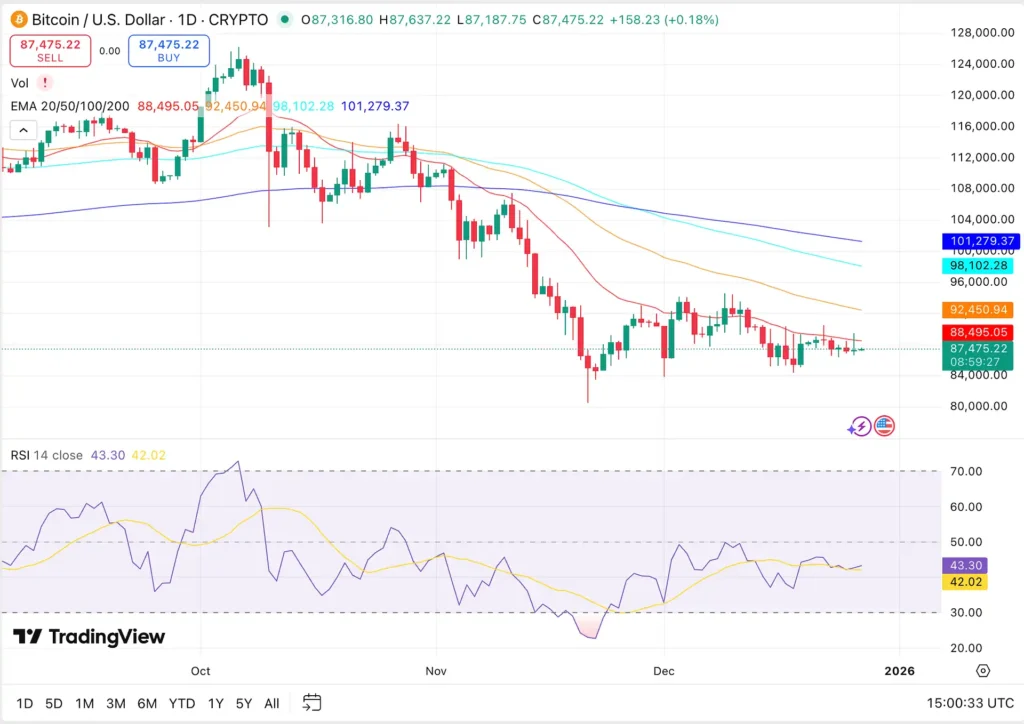
With the Bitcoin halving event now well absorbed by the market, historical market patterns appear to be playing out gradually. Bitcoin’s price has been moving through a consolidation phase after its previous rally, maintaining stability above the $85,000 level. Currently valued around $87,000, the expectation is for the BTC price to attempt a move toward the $100,000–$110,000 range as broader market confidence improves through 2026.
Beyond the post-halving cycle, continued institutional participation and long-term adoption have supported Bitcoin’s macro outlook. However, as of the time of writing, the BTC price reflects a cautious trend, with momentum indicators remaining subdued. The projection indicates that Bitcoin may witness temporary pullbacks toward the $80,000–$85,000 zone in the short term, followed by gradual recovery. If bullish momentum strengthens, BTC could conclude 2026 trading comfortably above the $95,000 mark.
Read More: BTC Price Prediction
Pi Network Price Projection 2026
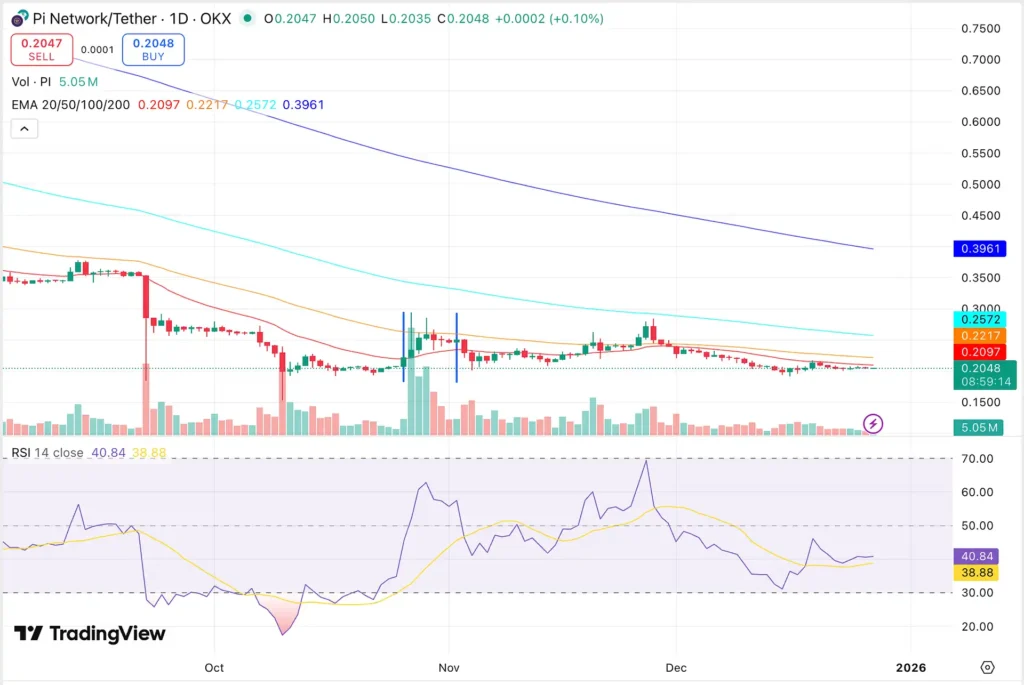
Currently trading near $0.20, Pi Network continues to rely on a strong base around the $0.18–$0.20 support zone. The price could attempt to revisit higher resistance levels near $0.30, potentially initiating a gradual recovery toward the $0.40 region. Nevertheless, persistent selling pressure and limited liquidity may restrict sustained upside movement.
As a result, bearish pressure may continue to influence price action, compelling PI to conclude most of the 2026 trading period within a broader consolidation range of $0.22 to $0.35, unless significant ecosystem or adoption-driven catalysts emerge.
Read More: Pi Network Price Prediction
Should you Buy Bitcoin or Pi Network?
Well, this is a rather tricky question – because out of the two coins on this list – only one has been actively traded, namely Bitcoin, while on the other hand, Pi Network is still in its testing phases and hasn’t been listed yet. From a purely technical point of view, Bitcoin has been performing extremely well in 2023, having gained over 80% since the beginning of the year. Pi Network on the other hand has been gaining popularity across the space, but hasn’t touched the real market yet and thus, it is impossible to discern what value the real world will assign to it.
Since the migration of Pi Network’s mainnet began on August 3, 2022, the project has been dedicated to various endeavors such as technological advancements, developing a KYC solution, establishing the Pi platform and ecosystem, and more. However, the specific date for the final phase 4 launch of Pi Network is currently undisclosed.
How to Buy Bitcoin or PI in India?
Investing in Bitcoin today is extremely simple, fast, and secure with the CoinDCX App. All you have to do is register on the platform.
- To register, follow the below-mentioned steps:
- Download the CoinDCX App.
- Register by entering your details.
- Complete KYC and verify your mobile number and email.
- Once your profile is validated, add funds to your wallet.
- Search for BTC or the PI Network and open the page.
- Enter the amount you want to invest.
- Swipe or tap Buy to complete your purchase.