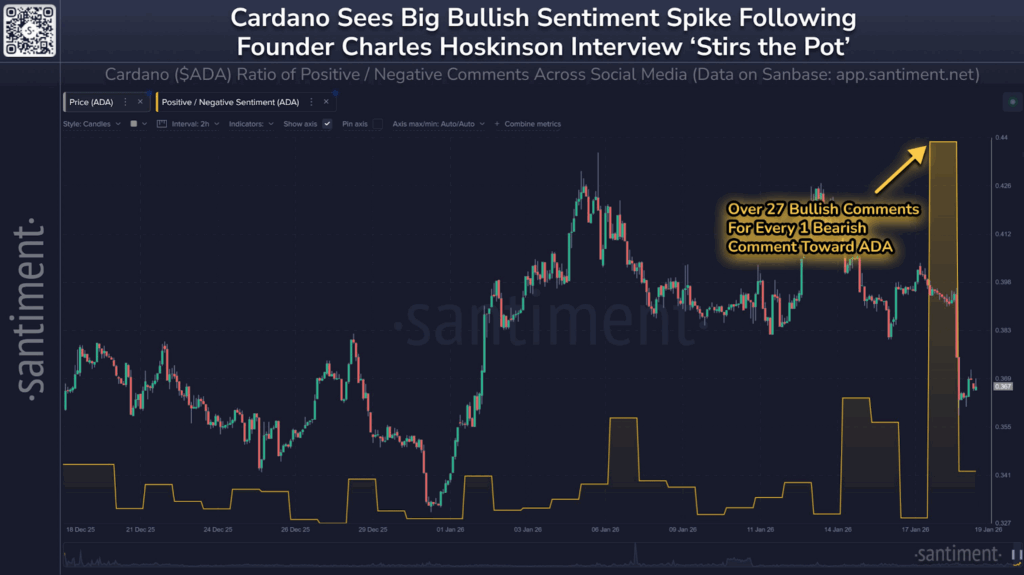
Cardano saw a sharp rise in bullish market sentiment followed by a swift price decline after a widely circulated public interview featuring founder Charles Hoskinson. The episode illustrates how rapidly changing narratives and social media momentum can influence short-term price action, even for established blockchain networks.
Following the viral interview, market data and social sentiment indicators initially reflected a wave of optimism. Yet, this optimism came too late to the market price, which went down; thus, this pattern repeats in a common crypto market trend where extreme sentiment is likely to drive volatility rather than extended upside.
Source: X
Interview Comments Drive Debate and Online Engagement
The interview attracted public attention as Hoskinson unraveled the most debated issues, for example, expressing his disapproval of the proposed U.S. crypto market structure legislation named the CLARITY Act. In addition, he criticized the Ripple CEO, Brad Garlinghouse, and also expressed his worries regarding the long-term impact of artificial intelligence, warning that a lack of proper governance may result in bigger global risks.
The comments stirred mixed feelings among the crypto community. On the one hand, supporters of Cardano saw the talk as a sincere and refreshing take on regulatory and industry challenges, praising Hoskinson for tackling issues they say rarely get the spotlight. On the other hand, the opponents considered the comments to be unnecessarily aggressive and a distraction from Cardano’s technical development and ecosystem progress.
Consequently, the debate increased Cardano’s recognition on social media, leading sentiment indicators to rise sharply over a short period. From the analysts’ perspective, sentiment fluctuations driven by celebrities or prominent influencers are on the rise, especially when interviews delve into divisive or emotionally charged topics.
Trade ADA in INR on 
Deposit and withdraw in INR (₹).
No Conversion to Crypto Required.

Sentiment Peaks and Short-Term Price Dynamics
Despite the rise in optimism, Cardano’s price retreated soon after sentiment reached elevated levels. Market observers suggest the move was largely driven by short-term traders taking advantage of inflated expectations, a pattern commonly seen when retail enthusiasm intensifies.
Social analytics data indicate that a rapid wave of bullish commentary contributed to short-lived fear of missing out, attracting late-stage buyers as earlier participants began locking in gains. This sequence often leads to short-term reversals, highlighting how markets can move counter to prevailing sentiment.
Analysts point out that sentiment indicators mainly show the behavior of the crowd and are not trustworthy forecasts. Optimistic sentiment can certainly drive the market higher, but overly optimistic conditions may lead to very crowded positions, which are quite likely to face corrections. Those who are really invested in the long run should look at the fundamental factors of the project, such as how much the network is being used, the progress in development, and the changes in governance as the most relevant indicators.
Read more: Cardano Price Prediction
Conclusion
The Cardano saga is a great example of how far sentiments and narratives have gone in influencing digital asset markets. Even though many people were attracted to and discussed the interview with Charles Hoskinson, the price movement afterward suggests that increased exposure does not always mean the price will go up right away.
As crypto markets continue to mature, participants are increasingly emphasizing the balance between sentiment analysis and fundamental evaluation. Cardano’s longer-term outlook is likely to be shaped more by sustained technological delivery, ecosystem expansion, and regulatory clarity than by short-term bursts of enthusiasm. In the near term, however, the event serves as a clear example of how quickly expectations can shift, and how markets often respond when optimism accelerates too rapidly.