Check out the tokens that keep your anonymity paramount!
In 2026, privacy tokens continue to balance privacy, compliance, and real-world utility. In this article, we take a September 2026-focused look at the top privacy coins to watch ranked by market capitalization and relevance, highlighting how they differ, what risks they carry, and why they continue to matter in the broader crypto ecosystem. This update also reflects a genuine reshuffle since our last look at this list: Zcash has pulled well clear of Monero at the top on the back of a sustained rally, and two tokens from the prior update, Secret Network and Oasis Network, have fallen far enough by market cap that they no longer place in the top five. Dash and Midnight take their spots instead.
| Token | Privacy Type | Default Privacy | Tech Used | Smart Contracts | Regulatory Risk | Best For |
|---|---|---|---|---|---|---|
| Zcash (ZEC) | Transaction-level | Optional | zk-SNARKs | No | Medium | Flexible privacy |
| Monero (XMR) | Transaction-level | Yes | RingCT, Stealth Addresses | No | High | Maximum anonymity |
| Dash (DASH) | Transaction-level | Optional (PrivateSend) | CoinJoin-style mixing | No | Medium | Fast private payments |
| Midnight (NIGHT) | Data & contracts | Optional (selective disclosure) | Zero-knowledge proofs | Yes | Low–Medium | Compliant private DeFi |
| Horizen (ZEN) | Transaction + infra | Optional | zk-SNARKs | Limited | Medium | Modular privacy |
Trade Crypto in INR on 
Deposit and withdraw in INR (₹).
No Conversion to Crypto Required.

Top Privacy Tokens by Market Cap [2026]
1) Zcash (ZEC)
Zcash was launched in 2016 to deliver cryptographic financial confidentiality using zero-knowledge proofs known as zk-SNARKs. The protocol allows users to choose between transparent addresses that function like standard Bitcoin transactions and shielded addresses that completely conceal sender, receiver, and transaction amounts. Growing institutional engagement and exchange-traded product proposals have supported its market capitalization, establishing it as the largest privacy asset by market valuation.
Source: TradingView
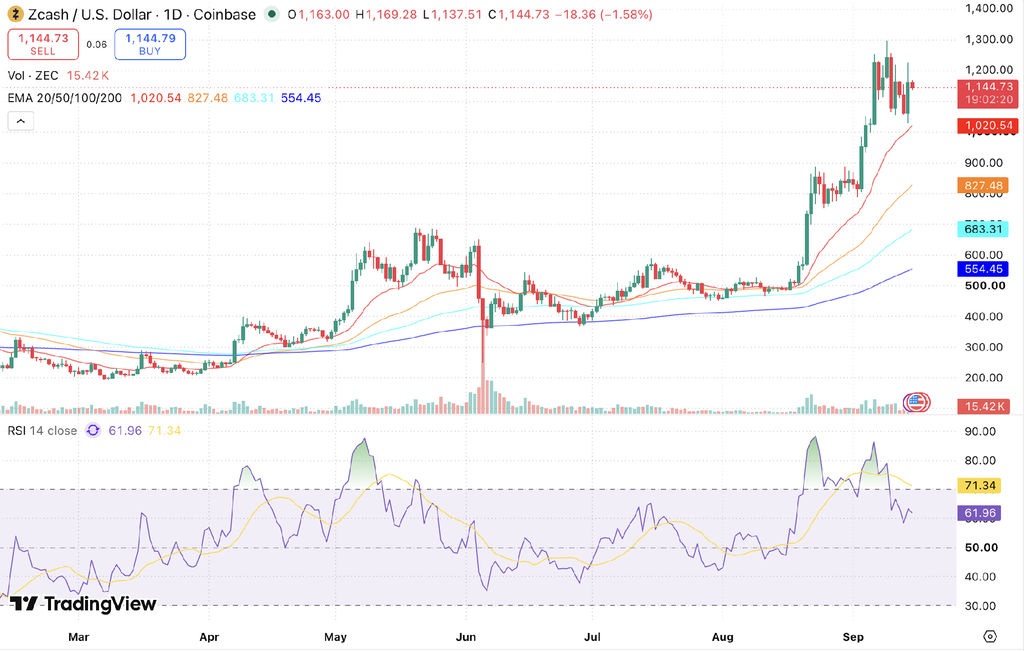
Technical Insight: ZEC trades above its multi-month exponential moving averages at $1,020.54, $827.48, $683.31, and $554.45 after pulling back from highs above $1,300 to $1,144.73. The 14-day Relative Strength Index (RSI) sits at 61.96, beneath its signal line of 71.34, indicating that the pullback represents a healthy cooling of overbought conditions rather than a macro trend reversal. The 20-day EMA at $1,020.54 functions as the primary short-term support level on deeper market retracements.
| Metric | Value |
| Current Price | $1,144.73 |
| Market Capitalization | $19.31B |
| Circulating Supply | 16.87M ZEC |
| Max Supply | 21M ZEC |
| 24h Volume | $1.3B |
| 2026 YTD Change | Approx. +2,730%* |
2) Monero (XMR)
Monero was established in April 2014 to address the privacy limitations of transparent blockchain ledgers. The network obscures transaction data using Ring Confidential Transactions (RingCT), stealth addresses, and ring signatures to ensure that transaction values, sending addresses, and receiving destinations remain untraceable. Unlike platforms with optional shielding, every transaction executed on Monero is shielded automatically at the protocol layer, making it the benchmark for default-on transaction privacy.
Source: TradingView
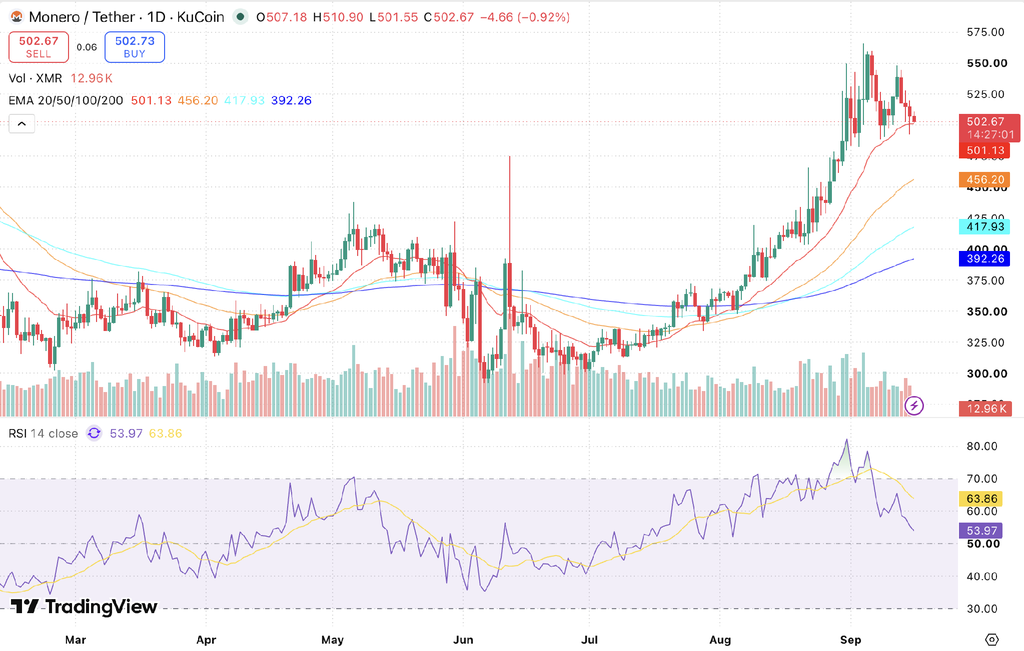
Technical Insight: XMR trades near its 20-day EMA at $501.13, holding above its 50-day, 100-day, and 200-day EMAs at $456.20, $417.93, and $392.26. The 14-day RSI stands at 53.97, reflecting market consolidation following its September breakout above $550. The 20-day EMA serves as immediate support, with a breakdown opening the 50-day EMA near $456 as the next structural support zone.
| Metric | Value |
| Current Price | $502.67 |
| Market Capitalization | $9.45B |
| Circulating Supply | 18.8M XMR |
| Max Supply | – (tail emission, no hard cap) |
| 24h Volume | $115.01M |
| 2026 YTD Change | Approx. +44.7%* |
3) Dash (DASH)
Dash was launched in 2014 as Darkcoin before rebranding in 2015, operating as an early digital token designed around optional transaction privacy. Its PrivateSend mechanism utilizes an automated CoinJoin mixing process coordinated through an incentivized network of Masternodes to obscure fund trails. Dash also integrates InstantSend technology to achieve rapid transaction finality, combining payment speed with decentralized governance.
Source: TradingView
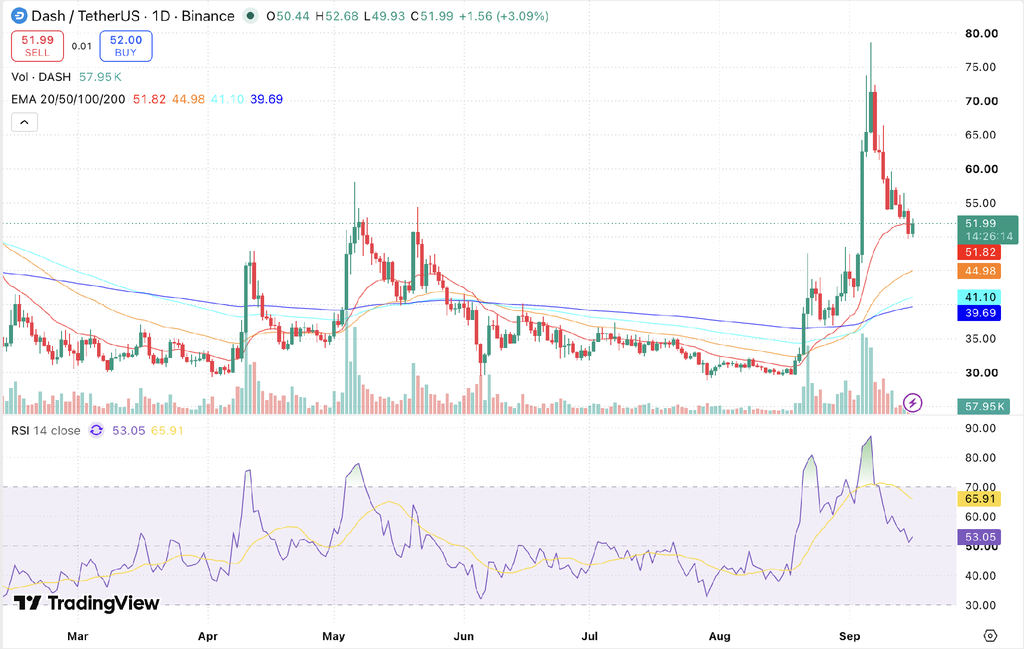
Technical Insight: DASH trades near its 20-day EMA at $51.82, remaining comfortably above its 50-day, 100-day, and 200-day EMAs at $44.98, $41.10, and $39.69. The price touched highs near $78 in early September before retracing toward the low-$50 range, bringing the 14-day RSI down to 53.05. Maintaining the 20-day EMA keeps the recent breakout structure intact, while losing this level exposes the mid-$40 support range.
| Metric | Value |
| Current Price | $51.99 |
| Market Capitalization | $669M |
| Circulating Supply | 12.83M DASH |
| Max Supply | Approx. 18.9M DASH |
| 24h Volume | $95.19M |
| 2026 YTD Change | n/a – reliable Jan 2026 baseline not available* |
4) Midnight (NIGHT)
Midnight is a data-protection blockchain developed by IOG to allow developers to deploy decentralized applications with selective data disclosure. Built on zero-knowledge cryptography, the network enables users and institutions to prove the validity of their data without revealing the underlying information. This architecture positions Midnight as infrastructure for auditable, privacy-preserving decentralized finance and enterprise operations.
Source: TradingView
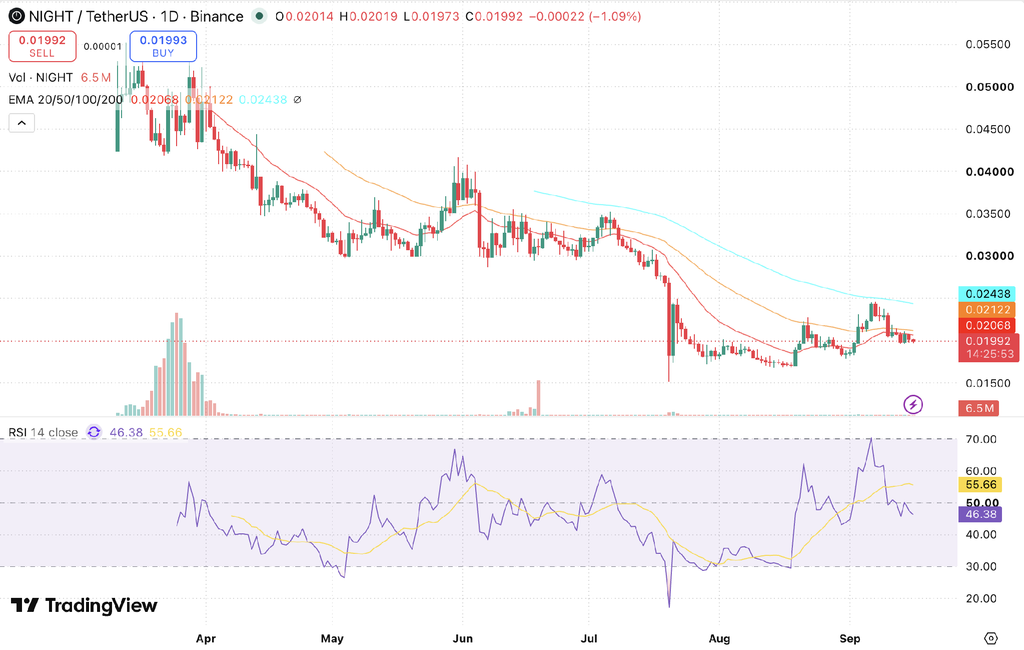
Technical Insight: Because Midnight listed in 2026, its trading chart has limited historical data and currently lacks a 200-day EMA baseline. The token trades below its 20-day, 50-day, and 100-day EMAs at $0.02068, $0.02122, and $0.02438, with a neutral 14-day RSI of 46.38. Technical signals should be treated as provisional until the market establishes a longer historical price record.
| Metric | Value |
| Current Price | $0.01992 |
| Market Capitalization | $330.32M |
| Circulating Supply | 16.6B NIGHT |
| Max Supply | – (not yet established) |
| 24h Volume | $10.19M |
| 2026 YTD Change | n/a – token listed after 1 Jan 2026 |
5) Horizen (ZEN)
Horizen operates as a hybrid privacy network that emphasizes zero-knowledge cryptographic verification and customizable sidechains. The project completed a technical migration to Base, Coinbase’s Ethereum Layer 2 network, transitioning the ZEN token to an ERC-20 contract via a 1:1 token swap. This transition integrated Horizen directly into the broader Ethereum ecosystem, improving liquidity and decentralized application interoperability.
Source: TradingView
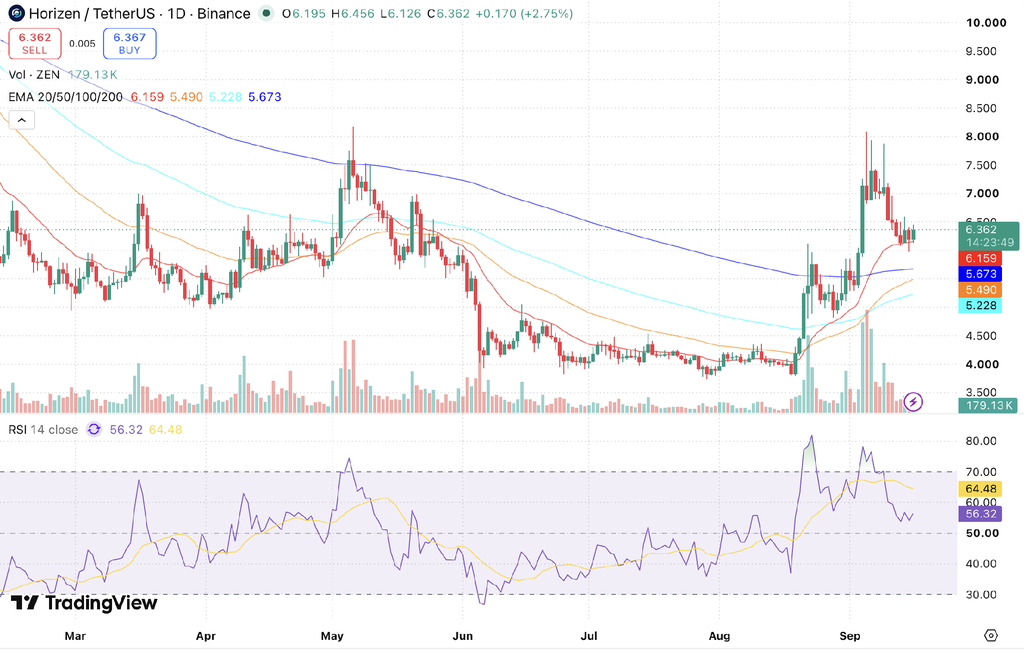
Technical Insight: ZEN trades above its moving averages at $6.159 (20-day EMA), $5.490 (50-day EMA), $5.228 (100-day EMA), and $5.673 (200-day EMA) after recovering from August lows near $3.50. The 14-day RSI stands at 56.32, indicating price consolidation near $6.36. The current moving average configuration shows the 100-day average sitting below the 200-day average, reflecting the market’s recovery from earlier cycle drawdowns.
| Metric | Value |
| Current Price | $6.362 |
| Market Capitalization | $116.6M |
| Circulating Supply | 18.33M ZEN |
| Max Supply | 21M ZEN |
| 24h Volume | $14.7M |
| 2026 YTD Change | Approx. –31.1%* |
So, how can you invest in these privacy tokens?
Today, investing in privacy coins is extremely simple with the CoinDCX App! Just download the CoinDCX crypto investing app, enter the details required, and wait for your profile to get verified. Once done, fund your wallet, and you can now invest in any privacy token of your choice!
Conclusion
Privacy tokens occupy a unique and often controversial position in the crypto ecosystem. While they address a legitimate need for financial confidentiality and data protection, they also operate in an environment shaped by regulatory caution and evolving compliance standards.
This update marks a real shift in the sector’s leaderboard rather than a simple refresh. Zcash’s rally, backed by genuine institutional interest including a Grayscale ETF push, has pulled it well clear of Monero at the top, a reversal of the ordering implied when this list was last compiled. Dash’s re-entry and Midnight’s arrival also show the category expanding beyond the “untraceable payments” framing of a few years ago to include newer, compliance-aware approaches to confidentiality.
Disclaimer: That said, privacy tokens remain higher-risk assets compared to many other crypto categories. Regulatory developments, exchange support, and jurisdiction-specific rules can significantly impact liquidity and accessibility. Investors should carefully evaluate not just price potential, but also technology design, legal risks, and long-term viability before gaining exposure.
FAQ
Q1. Why are privacy tokens important?
Privacy tokens are important in the world of crypto because they attempt to solve the problem of financial privacy by safeguarding one's financials from malicious prying eyes, sophisticated surveillance, and cybercriminals.
Q2. Isn't Bitcoin already private?
No, Bitcoin is a crypto that runs on an open public ledger, meaning transactions happening on the blockchain are viewable by anybody and everybody.
Q3. What are privacy tokens and are they legal?
Privacy tokens are a category of cryptos that use blockchain technology to offer advanced features to keep user data and transaction details hidden from prying eyes. While the legality of cryptos is in question, it is one of the most scrutinized sectors of the crypto industry, thanks to claims of money laundering, terrorism financing, and tax evasion happening over these platforms.
Q4. What is the best privacy coin in 2026?
There is no single “best” privacy coin, as it depends on the use case. Monero (XMR) is widely regarded as the most private crypto asset due to its default-on anonymity. Zcash (ZEC) offers optional privacy with zero-knowledge proofs and has led this list by market cap since a sustained 2026 rally. Dash offers optional CoinJoin-style privacy with fast payments, while newer networks like Midnight focus on privacy-preserving smart contracts and compliant data protection. Each serves a different privacy need.
Q5. Are privacy tokens risky investments?
Yes, privacy tokens generally carry higher regulatory and market risk than many other crypto assets. They may face exchange delistings, reduced liquidity, or sudden policy changes. While they offer strong technological innovation, investors should approach them with careful risk management and thorough research.
Q6. Can privacy coins be traced?
Traceability depends entirely on the underlying cryptographic design and how the token is used. Mandatory privacy protocols like Monero are exceptionally difficult to trace on-chain, whereas optional privacy tokens like Zcash can be audited easily if users execute unshielded transparent transactions.
Additional Read:
1. Crypto Legal Status in India
2. Top 10 Cryptos To Invest In