


Dogecoin began as a fun internet joke. Its Shiba Inu dog logo and lighthearted style made it stand out from other serious-looking crypto tokens. But over time, this “meme coin” turned into something much bigger. Today, Dogecoin is one of the most popular and widely traded crypto coins, supported by a loyal global community.
Even though it’s famous now, Dogecoin is still known for its fast and unpredictable price movements. Its value can rise or fall within hours — sometimes even minutes. For beginners, that can be both exciting and a bit scary. This high volatility, combined with its popularity, often leaves people confused about their investment decisions in Dogecoin.
So, is Dogecoin really a good investment in 2025? Let’s look at Dogecoin’s price history, technical analysis, pros and cons, and decide if it’s worth investing in.
Key Takeaways:
- From meme to market player: Dogecoin started as a joke in 2013 but has since grown into a major digital asset with strong community support and global recognition.
- High liquidity, high volatility: It’s easy to buy and sell Dogecoin on major exchanges, but its price often moves sharply due to hype, trends, and social media buzz.
- Community over technology: Dogecoin thrives on its loyal fanbase and cultural influence but lacks scarcity and advanced use cases compared to coins like Bitcoin or Ethereum.
- Better for beginners than core investors: Dogecoin can be a fun way to explore crypto markets, but its speculative nature makes it too risky to serve as the foundation of a long-term portfolio.
Dogecoin Price History
Dogecoin was launched in 2013 by Billy Markus and Jackson Palmer as a meme-inspired take on the speculative craze in crypto. But despite originating as a joke, its price history shows periods of complex market dynamics.
Price Evolution & Major Moves
- 2013 (Launch): Dogecoin price surged from around ~$0.0002 to ~$0.0023 within the first week of its launch before crashing nearly 80% as speculative momentum overheated.
- 2014–2016: During this period, DOGE traded within very low ranges — typically between ~$0.0001 and ~$0.0005 — with minimal growth.
- 2017–Early 2018: This was one of the best periods for the first memecoin, as the broader crypto bull market pushed Dogecoin’s price above $0.008 by early 2018, followed by a steep crash during the subsequent market downturn.
- 2019–2020: Throughout this period, prices remained relatively flat, oscillating within the low-thousandths range without major movement.
- 2021: This year marked the famous meme rally driven by viral social media trends and celebrity endorsements (notably Elon Musk). DOGE first crossed $0.10 in April and soared near $0.45 in May before declining sharply later that year.
- 2022: Dogecoin continued its downtrend amid the broader crypto bear market, trading far below its all-time highs.
- 2023–2025: Signs of resurgence have emerged, with periods of volatile upward movement, though long-term sustainability remains uncertain.
Dogecoin Price Ranges Over Time
Below is a snapshot of DOGE’s typical price ranges in different eras:
| Period | Approx. Low | Approx. High | Notes |
| 2013 | ~$0.0001 | ~$0.0023 | Launch, early spike then crash |
| 2014–2016 | ~$0.0001 | ~$0.0005 | Long period of very low trading |
| 2017–2018 | ~$0.0002 | ~$0.01 | Bull run peak, followed by a crash |
| 2019–2020 | ~$0.0018 | ~$0.0050 | Flat, narrow trading range |
| 2021 | ~$0.0057 | ~$0.45 | Meme-driven surge, Elon Musk effect |
| 2022–2023 | ~$0.07 | ~$0.20 | Bear market, modest recoveries |
| 2024–2025 | ~$0.09 | ~$0.30+ | Renewed volatility, uncertain trend |
What Insights Dogecoin Price History Gives?
Dogecoin’s price history reveals that its major moves are largely sentiment-driven rather than fundamentals-based. Each surge — from 2013 to 2021 — coincided with viral attention or broader crypto bull markets, followed by sharp corrections. This pattern highlights that Dogecoin performs best during speculative or hype phases but struggles to maintain long-term momentum. For traders, this means DOGE can offer short-term trading opportunities during market upswings, but it remains a high-risk asset for long-term holding without clear utility growth.
Dogecoin Technical Analysis & Market Performance
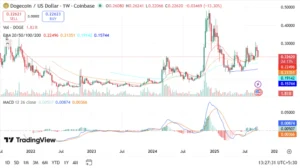
Dogecoin Price Graph – Source: Trading View
- Long-Term Growth: Dogecoin has grown from an initial offering price of about $0.0002 in 2013 to around $0.22 today, delivering more than 40,000% lifetime gains and proving its ability to retain value far beyond its meme status.
- Market Capitalization Strength: With a market capitalization of around $34 billion, Dogecoin is a consistent top 10 cryptocurrency with zero inflation. This can be interpreted as a clear sign of strong liquidity and investor commitment.
- Liquidity & Trading Activity: Daily trading volumes commonly exceed $4 billion, and the volume-to-market-cap ratio is close to 12%, indicating that DOGE is significantly more liquid and actively traded than many altcoins of similar size.
- Community-Backed Stability: Unlike most meme coins, Dogecoin has maintained global adoption with a circulating supply of over 151 billion DOGE and one of the largest and most active crypto communities supporting it.
- Resilient Market Positioning: Despite extreme volatility, Dogecoin remains a fixture during major bull and bear cycles. Its ability to recover and retain exchange listings demonstrates strong endurance compared to other speculative assets.
Read more: Dogecoin price prediction
How Does Dogecoin Compare to Other Major Crypto?
Dogecoin’s biggest strength lies in its culture and popularity, while its main weaknesses are its unlimited supply and limited technical depth.
| Feature | Dogecoin | Bitcoin | Ethereum |
| Supply | Unlimited | 21 million | Limited, adjustable |
| Use | Payments, memes | Digital gold | Apps, smart contracts |
| Volatility | Very high | High | High |
| Community | Meme-driven | Investor-focused | Developer-focused |
| Cultural Presence | Extremely high | High | High in tech & finance |
Key Insights
- Unlimited supply makes DOGE inflationary, unlike Bitcoin’s fixed cap.
- Utility remains limited to payments, while ETH powers apps and DeFi.
- Dogecoin’s volatility is sharper and often meme-driven.
- Its community thrives on culture, compared to BTC’s investors and ETH’s developers.
- DOGE leads in pop culture visibility but lags in blockchain innovation.
Why People Invest in Dogecoin?
Let us look at the various reasons people consider investing in Dogecoin:
- Community Support: Dogecoin’s biggest strength is its devoted fan base. They create memes, hype the token, and keep it in the spotlight.
- Easy to Trade: It is listed on nearly every major platform, and its high liquidity makes it easy to buy and sell Dogecoin.
- Recognition: Dogecoin is widely recognized, and some companies even accept it as a form of payment. This gives the brand tangible value.
- Affordable Entry: The price per token is low, making it attractive for beginners who want to experiment without incurring significant costs.
Risks of Investing in Dogecoin
Let us also have a look at the risk associated with investing in Dogecoin:
- Unlimited Supply: Dogecoin has no limit on the number of coins that can exist. About 10,000 new coins are added every minute. Over time, this can limit price growth.
- High Volatility: Dogecoin prices swing dramatically, and tweets, trends, or hype can trigger significant fluctuations.
- Limited Use: Dogecoin is primarily used for payments and tipping. It lacks the advanced features found in some other digital assets.
- Reliance on Hype: Much of its value depends on community excitement. If interest fades, so could the price.
- Competition: Thousands of other tokens offer stronger technology or more practical applications, while Dogecoin relies mainly on its popularity.
Dogecoin in Today’s Market
Today, Dogecoin operates in a more mature environment. It benefits from strong recognition, but its long-term future depends on continued enthusiasm.
- Institutional Attention: Some companies are testing it for payments.
- Retail Popularity: Fans on social media keep it alive.
- Competition: Newer tokens have better technology, but few have Dogecoin’s fame.
Should Beginners Invest in Dogecoin?
Dogecoin can be an exciting, short-term investment in 2025 due to its strong community, liquidity, and pop culture presence. However, its unlimited supply, high volatility, and limited utility make it too risky to rely on as a core long-term investment.
Dogecoin Current Market Snapshot (September 2025)
| Metric | Value |
| Price per Token | ~$0.265–$0.270 USD |
| 24-Hour Trading Volume | ~$4.0–$4.3 billion USD |
| Market Capitalization | ~$39–$40 billion USD |
| Circulating Supply | ~150.97 billion DOGE |
| Price Change Last 7 Days | Up ~10% |
| Support Level | ~$0.24–$0.25 |
| Resistance Level | ~$0.28–$0.30 |
Key Points:
- Dogecoin is currently stabilizing around $0.26.
- Liquidity remains strong, making it easy to buy or sell.
- Its market capitalization keeps it among the top digital assets.
- The trend shows mild upward momentum, provided support levels hold.
Conclusion
Dogecoin is more than a meme but less than a technological powerhouse, with strengths in community, liquidity, brand recognition, and low entry cost, and weaknesses in volatility, unlimited supply, limited use, and hype-driven value.
For beginners, investment in Dogecoin can be a way to learn how markets work. For experienced investors, it is speculative and should not dominate a portfolio. Dogecoin has survived ups and downs, proving its resilience. Its future depends on the community and continued interest. The bottom line is that Dogecoin is unpredictable. If you enjoy excitement and community-driven energy, it can be part of your portfolio. If you prefer stability and strong fundamentals, approach with caution. Even as a joke, Dogecoin has left its mark. In today’s markets, even a meme can move billions.
FAQs
Q1. Is Dogecoin safe to invest in?
Dogecoin is popular but very volatile. Prices can rise or fall quickly, so it carries risk. Only invest what you can afford to lose.
Q2. How to invest in Dogecoin?
You can buy Dogecoin on major exchanges, store it in a wallet, and track its price regularly. Start small and learn as you go.
Q3. Can Dogecoin be used for payments?
Yes, some merchants and platforms accept Dogecoin for payments, but it’s not as widely used as traditional money.
Q4. Will Dogecoin’s price keep rising?
No one can predict for sure. Dogecoin often moves with market trends and community hype, so it’s best to stay cautious.
Q5. Why is Dogecoin called a “meme coin”?
Dogecoin was created as a joke in 2013 using the Shiba Inu meme. Its lighthearted origin earned it the “meme coin” label, though today it’s widely traded and recognized.