

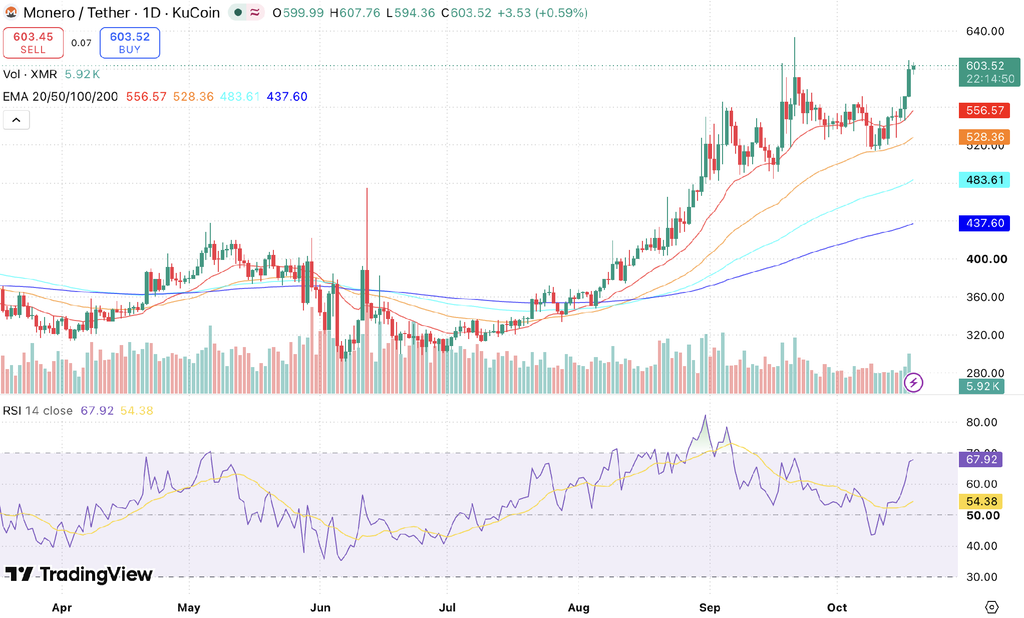
Monero climbed back above the $600 threshold on 19 October 2026, trading at $602 after gaining 2.6% over the trailing 24 hours and extending an 8.1% breakout advance from 18 October. The recovery pushed XMR to a circulating market capitalization of $11.3 billion, securing its position as the largest privacy-focused blockchain asset by market value. While this Monero (XMR) price surge restored spot pricing to levels unseen since late September, the move unfolded without an unexpected project announcement, with derivatives turnover outpacing physical spot volume across secondary exchanges.
New to Monero? Read what Monero is and how to buy it in India.
Catalyst Behind the Monero Price Rally
The recent price increase occurred in the absence of a major network roadmap disclosure or operational change from Monero core contributors. The project’s most recent software release, Monero v0.18.5.4, published on 16 October 2026, was a routine point maintenance release focused on minor bug fixes and node daemon stability rather than a consensus hard fork.
In the public domain, market commentary focused on technical analysis from veteran trader Peter Brandt, who highlighted XMR as his preferred chart setup among monitored large-cap digital assets in a 6 October analysis. Spot prices subsequently reversed an early-month pullback, climbing from $516 on 11 October back across the $600 psychological resistance shelf.
Monero vs Zcash Price Performance
Monero’s 8.1% single-session gain on 18 October diverged sharply from its primary sector peer Zcash (ZEC), which slipped 3.7% over the same trading window according to CoinGecko data.
Over the past 30 days, XMR is up about 4% while ZEC is down about 27%. ZEC’s slide included a sharp sell-off on October 15, when forced closures of leveraged bets deepened its fall before a brief rebound the next day.
How Futures and EU Rules Affect XMR Traders
Futures, which let traders bet on XMR’s price with borrowed money, have outpaced direct buying and selling during the move. XMR futures recorded $271 million in trading over the 24 hours to midday October 18, according to TokenPost, and open futures positions stood at $261 million. CoinMarketCap tracked about $186 million in spot trading, the direct buying and selling of XMR, over the latest 24 hours. A rally carried by borrowed money can reverse quickly if those positions are forced to close.
From July 10, 2027, an EU anti-money-laundering rule will bar crypto service providers from handling privacy coins such as XMR. The rule applies to service providers, so people holding XMR in their own wallets are not covered. XMR remains about 25% below its all-time high of $798.91, set on January 14, 2026.
Looking for a longer-term XMR price analysis? Read our Monero price prediction.
Where XMR Stands Back Above $600
XMR is trading above $600 again with no Monero-specific news behind the move, and futures trading has outpaced direct buying and selling. Zcash has moved the other way over the past month, and the EU rule taking effect in July 2027 is the next fixed date affecting where XMR can be traded.
Disclaimer: Crypto products and NFTs are unregulated and can be highly risky. There may be no regulatory recourse for any loss from such transactions. The information provided here is for general informational purposes only and does not constitute investment advice. Please do your own research before making any investment decisions.


