


Zcash rebounded 8.5% over the trailing 24 hours to trade at $1,235 on 16 October 2026, recovering most of its losses from a sharp leveraged liquidation event on 15 October. The bounce lifted ZEC to a circulating market capitalization of $20.8 billion, cementing a 4% gain over the past seven days. While the Zcash (ZEC) crypto rebound materialized without an unexpected project announcement, secondary market structure remains tightly wound as traders position ahead of an official review on 20 October to schedule the mainnet activation of the Network Upgrade 7 (NU7).
New to Zcash? See how to buy Zcash (ZEC) in India.
Reasons of October 15 the Zcash (ZEC) Liquidation
The steep decline on 15 October saw ZEC slide 13% over 24 hours to test an intraday trough of $1,087, accelerated by cascading margin liquidations across derivatives platforms. Futures let traders bet on a price with borrowed money, and exchanges close those bets automatically when losses use up the money set aside to cover them. About $20 million of ZEC futures positions were closed this way, and $17.8 million of that, or 89%, came from traders betting on a rise, according to CoinGlass data.
The drop came after a long climb. ZEC rose from under $500 in mid-August to above $1,600 in late September, then slid through early October.
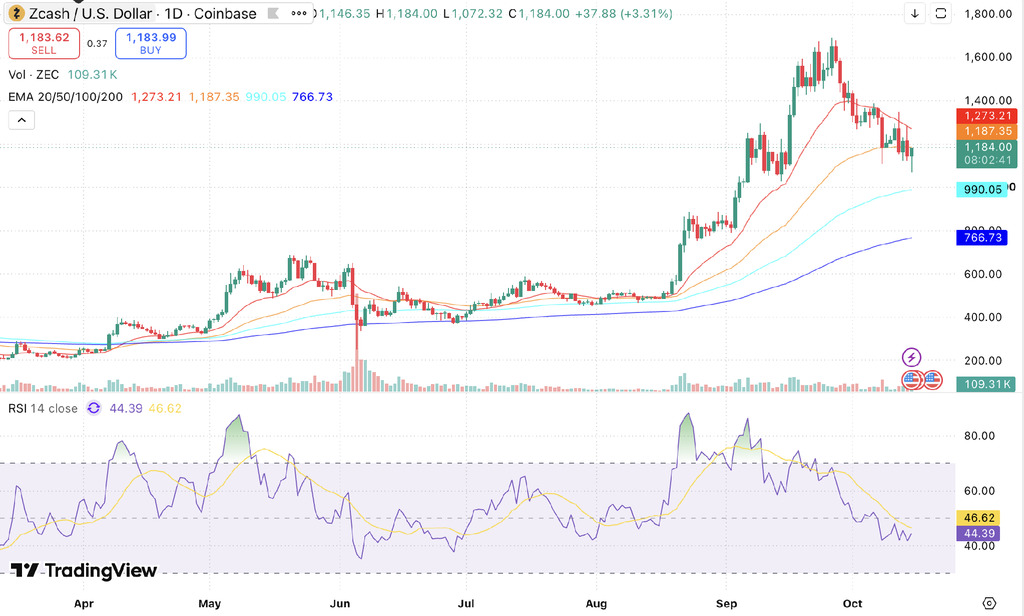
ZEC has since recovered most of its October 15 loss. Zcash’s developers have made no announcement linked to the rebound.
Zcash’s NU7 Upgrade and Sprout Retirement
NU7, Zcash’s next network upgrade, went live on the test network on October 4. Developers will review its performance on October 20 and then set a date for the main network, with November 5 as the target. NU7 cuts the time between blocks, the batches in which transactions are recorded, from 75 seconds to 25 seconds.
That second change affects anyone holding ZEC in Sprout, Zcash’s oldest type of private address. Once NU7 activates on mainnet, funds left in Sprout addresses will no longer be spendable under standard consensus rules, and developers have promised no recovery mechanism. Holders with older shielded balances must migrate their assets to modern address types (such as Sapling or Orchard) before mainnet activation.
ZEC Futures and Fund Flows Traders Should Watch
Open ZEC futures positions total about $2.2 billion, according to CoinGlass, roughly a tenth of ZEC’s market cap. Those open positions are worth more than a full day of ZEC trading volume, which stood at about $1.5 billion over the past 24 hours. With that much borrowed money still in play, a sharp move in either direction could trigger more forced closures.
SoSoValue data shows investors steadily pulling money out of ZCSH, Grayscale’s US spot Zcash fund, which holds ZEC directly. The fund recorded net outflows of $93.56 million in the week to October 3 and $30.72 million the following week. Another $5.19 million left on October 13, bringing the total to nearly $130 million in three weeks.
The October 20 NU7 review is the next scheduled event for ZEC, since it will set the main network date. ZEC remains about 79% below its all-time high of $5,941.80 from October 2016.
Looking for the latest Zcash price analysis? Read our Zcash price prediction.
Where ZEC Stands After Its 8.5% Rebound
ZEC has recovered most of its October 15 loss without any Zcash-specific news, while about $2.2 billion in futures positions remain open. The October 20 review will set NU7’s main network date, and Sprout holders have until that upgrade to move their coins.
Disclaimer: Crypto products and NFTs are unregulated and can be highly risky. There may be no regulatory recourse for any loss from such transactions. The information provided here is for general informational purposes only and does not constitute investment advice. Please do your own research before making any investment decisions.


