



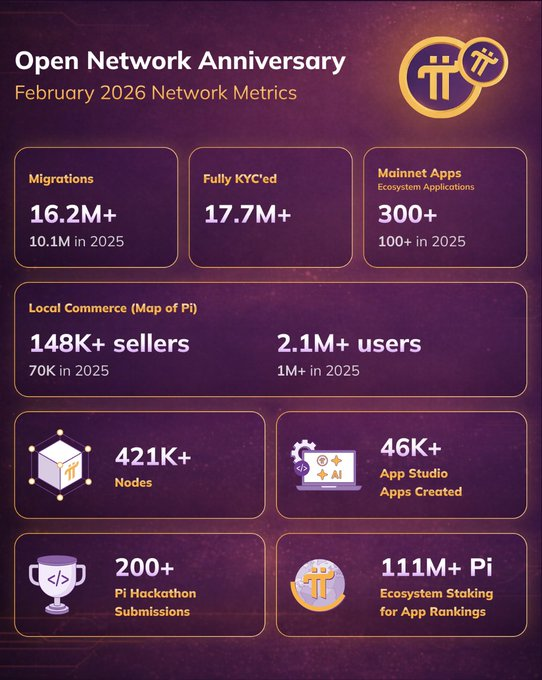
One year after the launch of Pi Network’s Open Network, the February 2026 Network Metrics offer a clear snapshot of how the ecosystem has evolved. The numbers reflect structured expansion across user verification, Mainnet migrations, developer activity, and local commerce. Rather than short bursts of activity, the data shows consistent progress throughout the year.
The growth has not been confined to one area. Infrastructure, application deployment, commerce participation, and staking activity have all progressed in tandem. This balanced development has strengthened the network’s overall foundation.
Source: Pi Network
Migrations, KYC, and Mainnet Apps Show Operational Depth
Mainnet readiness remains central to ecosystem maturity. As of February 2026, Migrations have crossed 16.2M+, including 10.1M completed during 2025. This reflects steady onboarding into the live network environment. At the same time, fully KYC’ed accounts have surpassed 17.7M+. Verified participation supports compliance standards and builds trust across the ecosystem. A strong KYC base ensures that the network grows on a verified and accountable foundation.
Application deployment has also expanded. The ecosystem now includes 300+ Mainnet Apps, with more than 100 added in 2025 alone. This signals that development is translating into real, accessible products. Applications are moving beyond testing phases into active use.
Together, these three metrics show alignment between infrastructure, verification, and utility. Growth in one area is supported by measurable progress in the others.
Also Read: PI coin Price Prediction
Trade Pi in INR on 
Deposit and withdraw in INR (₹).
No Conversion to Crypto Required.

Local Commerce and Node Participation Strengthen the Core
Network expansion is also visible in commercial activity. Local Commerce (Map of Pi) now reports 148K+ sellers and 2.1M+ users. A significant share of this growth occurred during 2025. This indicates rising participation at the marketplace level.
An expanding seller base reflects business confidence, while user growth shows increasing engagement. Commerce activity adds practical value to the ecosystem and supports real transactions within the network.
Technical participation has grown alongside commercial adoption. The network is supported by 421K+ Nodes. A broad node base strengthens decentralization and enhances operational stability. Reliable infrastructure is essential for sustained growth.
The connection between marketplace activity and node participation highlights ecosystem balance. Commercial expansion is supported by a stable and distributed technical layer.
Read more: Pi Network Mainnet Update 2026
Developer Momentum and Ecosystem Staking
Developer engagement remains a defining feature of the past year. The data shows 46K+ App Studio Apps Created, indicating active experimentation and innovation. App Studio continues to serve as an entry point for new builders.
In addition, 200+ Pi Hackathon Submissions demonstrate continued community-driven development. Hackathons often introduce new ideas that later scale into full applications. Consistent participation suggests long-term developer commitment.
Ecosystem Staking for App Rankings has reached 111M+ Pi. Staking adds a structured mechanism for evaluating and ranking applications. It encourages accountability and rewards quality development within the ecosystem.
These metrics show that user participation and developer contribution are advancing together. The growth is not isolated; it reflects coordinated involvement across multiple layers.
Conclusion
The February 2026 Network Metrics provide a comprehensive view of Open Network’s first year. With 16.2M+ Migrations, 17.7M+ fully KYC’ed users, 300+ Mainnet Apps, 148K+ sellers, 2.1M+ commerce users, 421K+ Nodes, 46K+ App Studio Apps Created, 200+ Pi Hackathon Submissions, and 111M+ Pi in Ecosystem Staking, the ecosystem has expanded across infrastructure, commerce, and development.
The anniversary data reflects steady progress rather than isolated milestones. It demonstrates structured growth supported by users, developers, businesses, and validators worldwide. After one year, the network shows operational scale and a broadened base of participation.


