


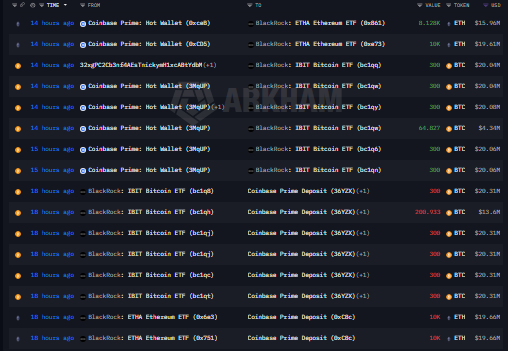
BlackRock has begun seeding its upcoming Ethereum staking ETF with an initial $100,000 capital allocation, marking another major step in institutional crypto adoption. A BlackRock affiliate purchased 4,000 seed shares of the trust, which will be used to acquire Ethereum (ETH) for the fund. On-chain data linked to BlackRock wallets shows growing ETH holdings, aligning with disclosures around its ETF strategy.
According to the filing, the fund estimates an average annual ether staking yield of 3%, using early 2026 benchmark references. This signals that the product will not only provide ETH exposure but also incorporate staking rewards as part of its return structure.
Source: Arkham Intelligence
The product is structured under BlackRock’s iShares Ethereum Trust framework and is expected to integrate staking as a core feature rather than functioning purely as a spot price tracker. This differentiates it from traditional crypto ETFs that focus solely on price exposure.
Read more: What is Crypto Staking?
ETH Accumulation Visible on Chain
Blockchain tracking platforms, like Arkham Intelligence, show notable Ethereum balances connected to BlackRock’s digital asset portfolio. The holdings sit alongside large BTC allocations tied to its existing ETF products. This confirms that ETH accumulation is already underway rather than remaining at a planning stage.
The portfolio breakdown highlights substantial ETH value under management. While BlackRock maintains strong exposure to Bitcoin, the expansion into Ethereum staking shows a broader digital asset strategy. The firm is not simply diversifying; it is integrating yield generation into its ETF model.
That distinction is important. Traditional crypto ETFs focus on price movement. A staking ETF introduces a structured income component through Ethereum’s proof-of-stake mechanism.

Source: Arkham Intelligence
While exact ETH purchase totals have not been publicly itemized, blockchain trackers estimate that the seed capital allocation translates into an initial multi-million-dollar Ethereum exposure as accumulation continues. Analysts expect holdings to scale significantly as the ETF approaches broader launch phases.
How the 3% Staking Yield Works
Ethereum operates on a proof-of-stake system, where validators lock ETH to help secure the network. In return, they earn staking rewards. The ETF filing estimates a 3% annual staking yield, based on early 2026 benchmark data.
The yield estimate reflects network conditions and validator participation rates. It is not framed as a speculative target but as a benchmark-based projection. That approach adds credibility to the product structure.
For institutional investors, this model removes the need to manage validators directly. The ETF provides regulated access to Ethereum staking rewards within a familiar investment vehicle. Custody, compliance, and operational oversight remain under the fund’s framework.
Trade ETH in INR on 
Deposit and withdraw in INR (₹).
No Conversion to Crypto Required.

Expanding Institutional Participation
At the same time, Harvard University disclosed a new position in BlackRock’s iShares Ethereum Trust, purchasing approximately 3.87 million shares valued at roughly $86.8 million. The move signals that institutional appetite for regulated Ethereum exposure is expanding beyond asset managers into major endowments.
Strategic Impact on the ETF Market
BlackRock’s move into an Ethereum staking ETF expands its presence beyond Bitcoin-focused products. With strong BTC exposure already established, adding ETH staking strengthens its position across the two largest crypto assets. The structure also responds to growing demand for yield-generating digital products. Investors are increasingly looking for assets that combine price appreciation with income potential. Ethereum staking allows both within one framework.
By integrating staking rewards into an ETF, BlackRock bridges traditional finance and blockchain-based yield systems. It also reinforces institutional confidence in Ethereum’s long-term stability and infrastructure. The filing also suggests that a significant portion of the fund’s ETH holdings, potentially between 70% and 95%, may be allocated toward staking, allowing the ETF to generate yield while maintaining exposure to Ethereum’s price movements.
Read more: Ethereum Price Prediction
Conclusion
BlackRock’s Ethereum accumulation for its staking ETF represents a clear shift toward structured, income-generating crypto investment products. The projected 3% annual staking yield, based on early 2026 benchmarks, places the fund within measurable parameters rather than speculative expectations.
As institutional capital continues to enter the digital asset space, Ethereum’s role within diversified portfolios is expanding. BlackRock’s latest move signals that staking-based ETFs may become a key part of the next phase of regulated crypto investment.


