

Introduction
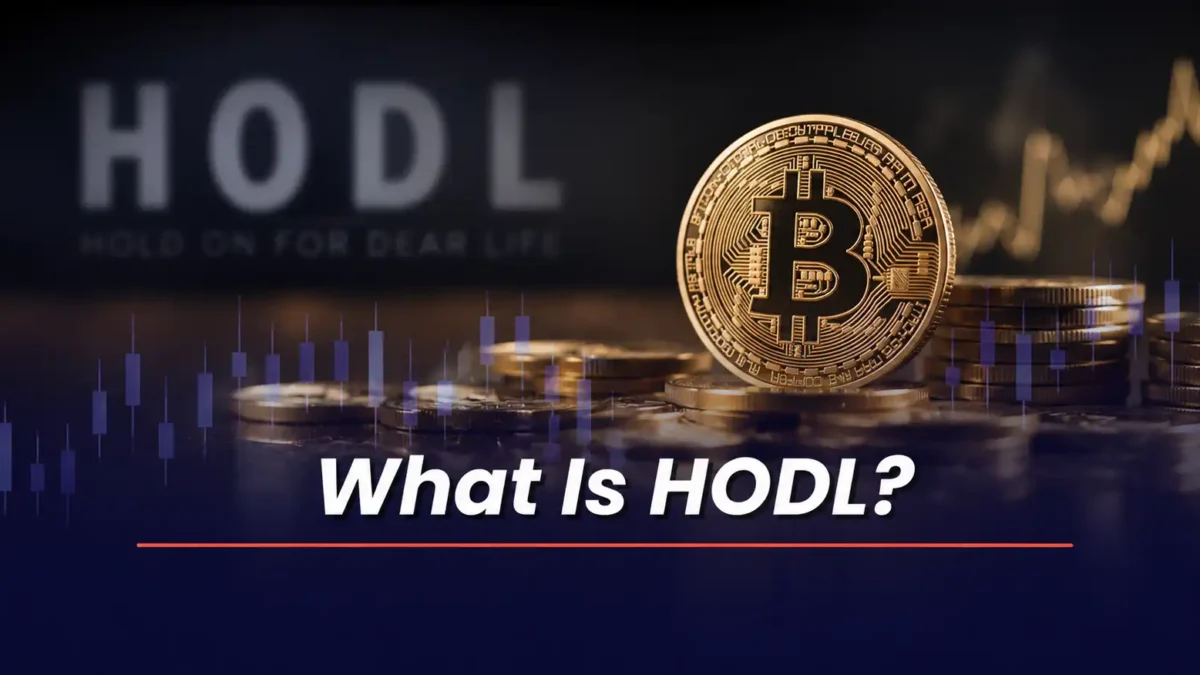
Spend any time in crypto communities and you will see HODL everywhere, usually in capitals when prices are crashing. It looks like a typo because it began as one, and behind the meme sits a real and widely followed approach to crypto investing.
You will learn the meaning of HODL, the story of how the word was born, the thinking behind the strategy, its benefits, and its real risks and limits.
What Does HODL Mean in Crypto?
HODL means to hold on to your crypto for the long term rather than selling in response to short-term price movements, and someone who does this is called a HODLer. Instead of buying and selling frequently to chase quick profits, you acquire an asset you believe in and hold it through the ups and downs, sometimes for years.
HODL is as much a mindset as a method, and it stands in contrast to active trading, where people try to buy low and sell high over short periods. A HODLer accepts that crypto prices are extremely volatile in the short term and deliberately chooses not to react to every swing.
Where Did the Word HODL Come From?
The origin explains why the spelling is wrong on purpose. In December 2013, during a sharp drop in Bitcoin’s price, a user on a popular Bitcoin forum wrote a now-legendary post titled I AM HODLING.
The user admitted they had been drinking and had simply misspelled holding. Their point was that they were not a skilled trader, so rather than trying to sell at the right moment and probably getting it wrong, they would hold their Bitcoin regardless. The crypto community loved it, and the typo spread quickly.
Why People Choose to HODL
The HODL strategy rests on a few underlying beliefs, worth understanding whether or not you ultimately agree with them.
The first is that timing the market is extremely hard. Even professional traders struggle to buy at the bottom and sell at the top consistently, and ordinary investors who try often buy high in excitement and sell low in panic. HODLing sidesteps this by not trying to time anything. The second is that some crypto may grow in value over long periods despite severe crashes, so holding through the dips gives that growth a chance. The third is psychological: by committing to hold in advance, a HODLer aims to avoid panic-selling at the worst possible moment.
The Benefits of HODLing
Used sensibly, HODLing has practical advantages, which is a large part of why it appeals to beginners.
Less Stress
You are not watching price charts all day or reacting to every swing, which makes investing far less emotionally draining. That matters more than it sounds, because stress is what drives most poor decisions. A plan you can actually live with is worth more than an optimal one you abandon.
Fewer Mistakes From Emotion
Deciding in advance to hold reduces the risk of panic-selling in a crash or over-buying in a rally. The decision is made when you are calm rather than when the market is moving. Most investors lose more to their own reactions than to the asset itself.
Lower Fees and Fewer Taxable Events
Every trade can incur fees, and frequent trading creates more taxable events to track and pay. Holding reduces that churn considerably. In India, where each disposal is a taxable transfer and losses cannot be set off, that difference is not trivial.
No Need to Time the Market
You avoid the difficult and often losing game of guessing the perfect moments to buy and sell. Nobody does this reliably over time, including professionals. Removing the need to try removes a large source of error.
Simplicity
It is a strategy a complete beginner can understand and follow without advanced trading skills or tools. There is nothing to monitor daily and no technique to master. That simplicity is its main practical strength.
The Risks and Limits of HODLing
This is the part hype-filled posts leave out, and the most important section, because HODLing is neither magic nor a guarantee of profit.
HODLing does not remove risk: The biggest misunderstanding is the belief that holding somehow makes crypto safe. It does not. If you hold a coin whose price keeps falling, you are simply holding a losing position. Some cryptos have fallen and never recovered, and many have gone to zero, so a HODLer in those cases loses regardless of how long they wait.
There are other limits. HODLing ties up money in an asset you cannot easily use elsewhere. It demands real emotional discipline, because watching holdings fall by half or more without selling is hard. And it only works if the asset you chose is worth holding, which returns the question to research: HODLing a weak or fraudulent project simply means holding it all the way down.
Is HODLing a Good Crypto Investment Strategy in 2026?
Whether HODLing suits you depends on what you choose to hold, and it is not a decision anyone should make on your behalf. It can suit people who have researched an asset, believe in it for the long term, and can afford to leave that money untouched for years. It tends not to suit money you might need soon, or assets you do not properly understand.
A few principles help. Only HODL money you can afford to lose and to lock away. Do your own research before holding anything, because the strategy is only as good as the asset. Remember that holding does not remove risk, and never let HODL culture pressure you into keeping a position you no longer believe in. In India, crypto is a Virtual Digital Asset, so gains are taxed at a flat 30 percent plus a 4 percent cess and any applicable surcharge, with no set-off for losses and a 1 percent TDS deducted on transfers. Use only FIU-IND registered platforms and never invest more than you can afford to lose.
FAQs
Q1. What does HODL mean in crypto?
To HODL means holding on to your crypto for the long term rather than selling in response to short-term price movements. Someone who does this is called a 'HODLer'. It contrasts with active trading, where people try to buy low and sell high over short periods.
Q2. Where did the word HODL come from?
HODL comes from a post on a Bitcoin forum in December 2013, during a sharp price drop, titled 'I AM HODLING'. The user had been drinking and simply misspelled 'holding'. Their point was that rather than trying and failing to time the market, they would hold through the volatility. The community embraced the typo.
Q3. Does HODL stand for 'Hold On for Dear Life'?
Not originally. 'Hold On for Dear Life' is a backronym, a phrase invented later to fit the letters H-O-D-L. The word itself came from a 2013 forum post in which a user misspelled 'holding'. The phrase captures the spirit of holding through volatility, but it is not the true origin.
Q4. Is HODL a good strategy?
The main benefits of HODL are less stress, fewer mistakes driven by emotion, lower fees and fewer taxable events, no need to time the market, and simplicity a beginner can follow. It is a plan you can live with, which matters more than an optimal one you abandon.
Q5. Can you lose money HODLing?
No. Holding does not make crypto safe. If you hold a coin whose price keeps falling, you are holding a losing position, and some cryptos have fallen and never recovered. HODLing also ties up money and demands emotional discipline, and it only works if the asset you chose is worth holding.
Q6. Is HODLing the same as investing in Bitcoin long term?
Yes, "HOLDing" (often called "HODLing") is a form of long-term investing, but it carries a distinct cultural mindset focused on extreme price swings, community identity, and a refusal to sell regardless of market crashes. However, research what you own, hold only what you can afford to lock away, and decide for yourself. Keep learning with CoinDCX's education guides, use only FIU-IND registered platforms, and never invest more than you can afford to lose.