

Introduction
‘Fungible’ sounds like a technical word, and the idea behind it is one of the simplest in money and crypto. Most people first met the term through cryptos and NFTs. You will learn what fungible means, an easy way to remember it, what non-fungible tokens are as the contrast, the meaning explained for Hindi speakers, and why fungibility matters for anything used as money.
What Does Fungible Mean?
Define fungible: Something is ‘fungible’ when each of its units is identical and interchangeable with any other unit of the same kind. If you can swap one unit for another and end up with exactly the same value, it is fungible. It does not matter which specific unit you hold, because they are all equal.
Money is the clearest example of fungibility. Any 100-rupee note is worth exactly the same as any other 100-rupee note. If you lend a friend a 100-rupee note and they hand back a different one, you have lost nothing, because the two are interchangeable. That quality, being swappable unit for unit with no change in value, is fungibility.
What Is Fungibility in Crypto?
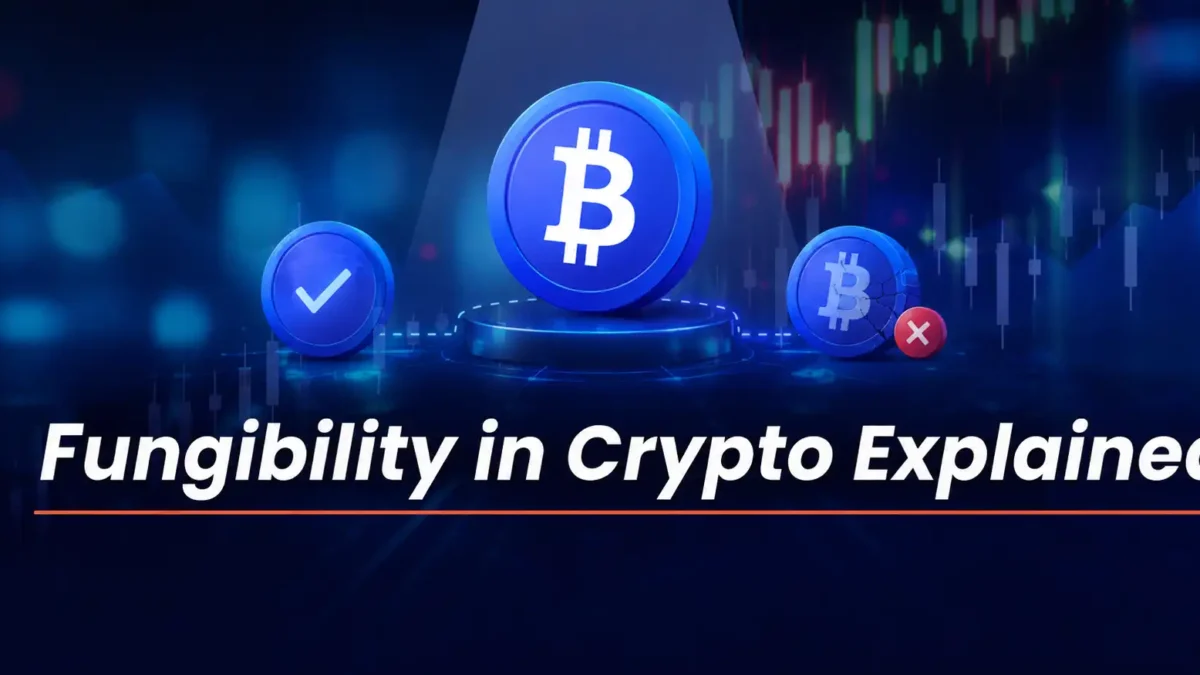
Most cryptos are fungible, meaning each coin or token of a given type is identical in value to another of the same type. One Bitcoin is worth the same as another Bitcoin, and one unit of Ethereum the same as another.
This is why fungible cryptos can work like money. Because the units are interchangeable, they are easy to trade, spend, and value. Fungible tokens are the everyday building blocks of crypto, used for payments, trading, and saving. If every coin carried a slightly different value, using crypto as money would be close to impossible.
One qualification is worth knowing. At the protocol level every bitcoin is identical, but because every transaction is recorded publicly, a coin’s history can be traced. Some exchanges and businesses screen incoming coins and may refuse or freeze those linked to theft or sanctioned addresses. In that practical sense, fungibility is not absolute.
What Are Non-Fungible Tokens (NFTs)?
Something is non-fungible when it is unique and cannot be swapped one for one with another item, because each one differs.
A non-fungible token is a unique digital item recorded on a blockchain, with its own distinct identity. Because each NFT is one of a kind, one NFT is not automatically equal to another the way one rupee equals another. The comparison that makes it click is this: a 100-rupee note is fungible, so any note will do, while an original painting is non-fungible, because there is only one. NFTs often represent ownership of unique items such as digital art, collectibles, or in-game assets.
Why Fungibility Matters for Money
Fungibility is what allows anything to function as money. For something to work as a medium of exchange, meaning a way to pay, and as a store of value, meaning a way to hold wealth, its units have to be interchangeable and equal.
Imagine if every 100-rupee note were worth a different amount depending on its serial number. Trade would slow to a crawl, because you would have to check the worth of each note before accepting it. Fungibility removes that problem: since every unit is equal, you can accept, spend, and value money instantly. The same logic applies to fungible cryptos.
How Fungible and Non-Fungible Crypto Are Taxed in India
Understanding fungibility helps you tell apart crypto used like money, meaning fungible coins, and crypto used to represent unique assets, meaning non-fungible tokens. Both carry risk. Fungible or not, crypto and NFTs are volatile, high-risk, and unregulated, and NFT prices in particular are highly speculative. In India, crypto is treated as a Virtual Digital Asset (VDA), so gains are taxed at a flat 30 percent, plus a 4 percent cess and any applicable surcharge, with no set-off for losses. A 1 percent TDS applies on transfers, deducted at source and claimed as credit against your final bill. Use only FIU-IND registered platforms and never share your seed phrase.
Also read: How to Buy NFT, Beginner’s Guide to NFT Investing
Frequently Asked Questions
Q1. What is the meaning of fungible?
Fungible means each unit of something is identical and interchangeable with any other unit of the same kind, so one unit is always worth exactly the same as another. Money is the classic example, since any 100-rupee note is worth the same as any other. In crypto, one Bitcoin equals any other Bitcoin.
Q2. How do you define fungible with an example?
Currency is the simplest example. If you lend someone a 100-rupee note and they return a different one, you have lost nothing, because the notes are interchangeable and equal in value. Bitcoin works the same way. The opposite, non-fungible, means unique and not interchangeable, like an original painting.
Q3. What are non-fungible tokens (NFTs)?
NFTs are unique digital items recorded on a blockchain, each with its own distinct identity. Unlike fungible tokens such as Bitcoin, which are identical and interchangeable, NFTs are one of a kind, so one is not simply equal to another. They often represent ownership of digital art, collectibles, or in-game items.
Q4. Why does fungibility matter in crypto?
Fungibility is what lets a crypto work like money. When every unit is identical and interchangeable, the coin is easy to trade, spend, and value, exactly like cash. If each coin carried a different value, using it as money would be close to impossible. This is why most cryptos, including Bitcoin and Ethereum, are designed to be fungible.
Q5. Is Bitcoin fungible?
Yes, generally. One Bitcoin is worth the same as any other and they can be swapped one for one with no loss of value. There is a qualification: every transaction is recorded publicly, so a coin's history can be traced, and some exchanges screen incoming coins and may refuse or freeze those linked to theft or sanctioned addresses.