

In 2026, earning digital assets through crypto games has become an exciting way to generate income. In these games, players complete tasks and receive rewards in the form of tokens or NFTs. However, as the industry grows quickly, players often face challenges in choosing reliable games. They worry about quality, scams, and withdrawal issues. In this article, we will look at some of the best genuine crypto earning games that can help you build a passive income.
Key Takeaways
- The best play-to-earn crypto games include Axie Infinity, The Sandbox, and Decentraland based on their supported tokens and reward systems.
- In crypto earning games, players make money through battles, quests, asset trading, land ownership, and staking mechanisms.
- Token value depends on supply design, user growth, and overall ecosystem demand.
- Earnings in these blockchain games are not fixed and remain exposed to market volatility.
- Token inflation and weak economic models can reduce long-term reward value.
- Regulatory and tax rules in India apply to crypto-based gaming rewards.
- Security risks, including smart contract vulnerabilities in some crypto games, should not be ignored.
- Sustainable P2E platforms focus on balanced tokenomics and active communities.
What Are Play-to-Earn (P2E) Games?
Play-to-Earn games are blockchain-based games that reward users with digital assets. These rewards include crypto tokens or NFTs stored on-chain. Players can earn through battles, quests, tournaments, staking systems, or marketplace trades, and other activities on these play-to-earn games. The reward structure on these crypto gaming platforms depends on each game’s token design and economic model, which also decides the players’ earning amounts.
List of the Best Play-to-Earn Crypto Games
Below is a comparison of leading P2E crypto games in May 2026.
| Game Name | Supported Blockchain | Primary Token | Token Price | Market Cap | Core Earning Model |
| Axie Infinity | Ethereum / Ronin | AXS, SLP | $1.41 | $198M | Battles, breeding |
| The Sandbox | Ethereum | SAND | $0.07 | $209M | Land creation, events |
| Decentraland | Ethereum | MANA | $0.08 | $173M | Virtual land, experiences |
| Gods Unchained | Ethereum | GODS | $0.03 | $14.39M | Card battles |
| Illuvium | Ethereum | ILV | $4.4 | $32.9M | RPG exploration |
| CryptoKitties | Ethereum | None fixed | — | — | NFT breeding |
| Shiba Shootout | Ethereum (planned) | SHIBASHOOT | $0.0187(Presale Price) | Not Yet Listed | Arcade rewards |
| Splinterlands | Hive | SPS | $0.004 | $6.14M | Card tournaments |
| Alien Worlds | WAX | TLM | $0.001 | $12M | Mining, staking |
| Star Atlas | Solana | ATLAS | $0.0001739 | $4.32M | Space missions |
The table above is sourced from CoinMarketCap and reflects data as of May 18, 2026. Prices and market caps fluctuate continuously — always verify current figures before making any investment decision.
1. Axie Infinity
Source: TradingView
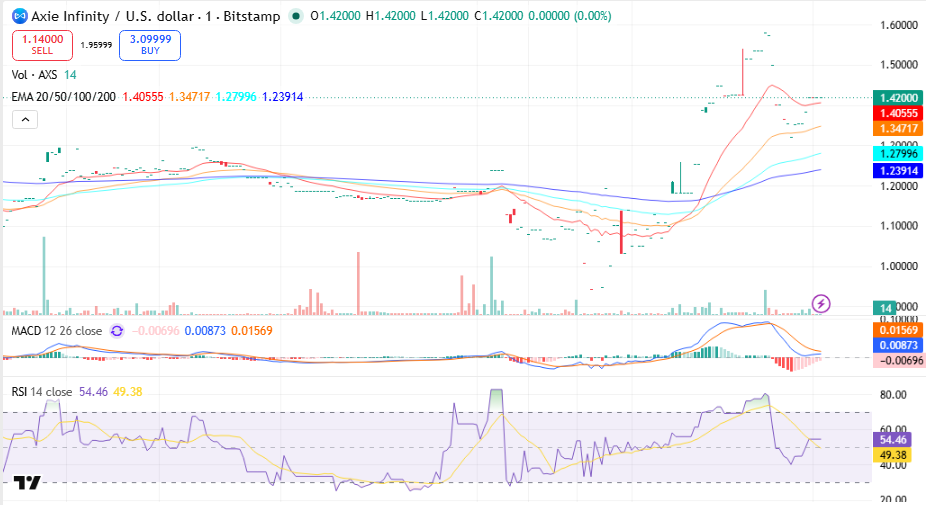
Axie Infinity is one of the games that brought global attention to blockchain gaming. In this game, players have to collect creatures called Axies, which exist as NFTs and are used in battles and breeding. The ecosystem uses SLP and AXS tokens, with rewards mainly earned through gameplay and daily tasks. However, like every game, the earnings depend on performance and token prices, which can fluctuate.
Technical Insights: The Axie Infinity (AXS/USD) chart shows a strong recent bullish breakout above $1.40, supported by rising volume. EMA indicators are in bullish alignment (short-term EMA above long-term EMA), suggesting upward momentum. MACD is slightly bearish but flattening, indicating potential consolidation. RSI at 54.46 shows neutral momentum with room to rise. Overall, the trend is bullish with short-term consolidation risk.
| Metric | Value |
| Current Price | $1.14 |
| Market Capitalization | $198.04M |
| Circulating Supply | 173.38M AXS |
| Max Supply | — |
| 24h Volume | $19.82M |
| 2026 YTD Change | -60.7% |
Read also: Axie Infinity Price Prediction
2. The Sandbox
Source: TradingView
The Sandbox is a P2E virtual world where players buy LAND NFTs and create games, experiences, or digital spaces. The platform runs on the SAND token, used for transactions and governance. Creators can monetise their land through events, assets, or experiences, while the value of land often depends on location and ecosystem growth.
Technical Insights: The Sandbox (SAND/USD) is in a short-term downtrend, trading below all major EMAs, indicating bearish momentum. MACD is slightly bullish but near the zero line, suggesting weak reversal potential. RSI at 44.56 shows oversold conditions easing, hinting at a possible minor bounce. Overall, the chart reflects continued bearish pressure with potential short-term consolidation.
| Metric | Value |
| Current Price | $0.07115 |
| Market Capitalization | $209.03M |
| Circulating Supply | 2.93B SAND |
| Max Supply | – |
| 24h Volume | $32.61M |
| 2026 YTD Change | -79.8% |
Read also: Sandbox Price Prediction
3. Decentraland
Source: TradingView
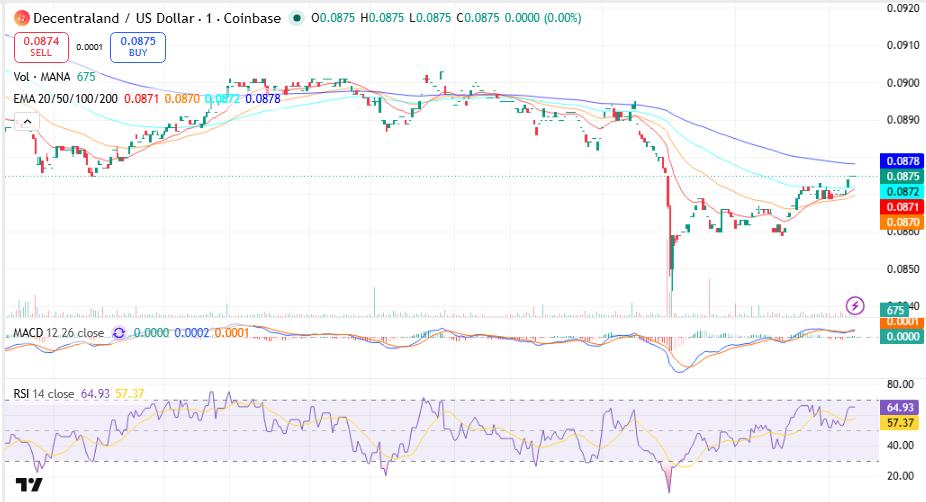
Decentraland is a social metaverse where users explore virtual spaces and attend events. Land parcels exist as tradable NFTs, and transactions are powered by the MANA token. Landowners can build venues or host experiences to generate income, although demand for virtual land tends to fluctuate with user activity.
Technical Insights: Decentraland (MANA/USD) shows early signs of recovery after a sharp drop, with price now above the 20- and 50-period EMAs but still below the 100- and 200-period EMAs, indicating mixed momentum. MACD is turning slightly bullish, supporting short-term upside. RSI at 64.93 signals strengthening buying pressure. Overall, the chart suggests a cautious bullish reversal with resistance ahead.
| Metric | Value |
| Current Price | $0.08738 |
| Market Capitalization | $173.53M |
| Circulating Supply | 1.98B MANA |
| Max Supply | – |
| 24h Volume | $16.95M |
| 2026 YTD Change | -73.25% |
Read also: Decentraland Price Prediction
4. Gods Unchained
Source: TradingView
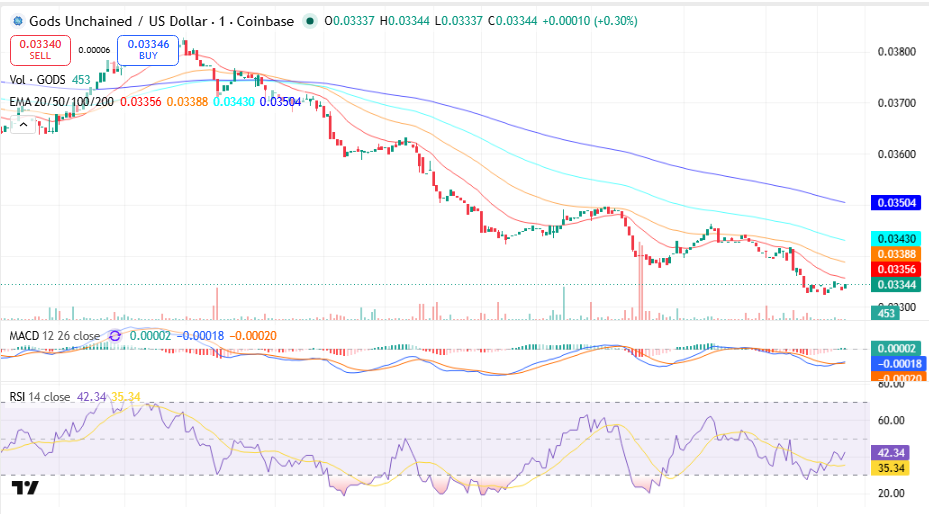
Gods Unchained is a strategy-based trading card game where each card is an NFT that players fully own. Competitive matches reward players with GODS tokens, especially in ranked gameplay. Rare cards may also gain value in the marketplace, making both skill and card rarity important.
Technical Insights: Gods Unchained (GODS/USD) is in a clear downtrend, trading below all major EMAs, indicating strong bearish momentum. MACD is slightly bullish but near zero, suggesting weak short-term recovery potential. RSI at 42.34 shows mild oversold conditions with room for a minor bounce. Overall, the chart signals continued bearish pressure with a potential short-term consolidation.
| Metric | Value |
| Current Price | $0.03351 |
| Market Capitalization | $14.39M |
| Circulating Supply | 429.51M GODS |
| Max Supply | 500M GODS |
| 24h Volume | $532K |
| 2026 YTD Change | -80.7% |
5. Illuvium
Source: TradingView
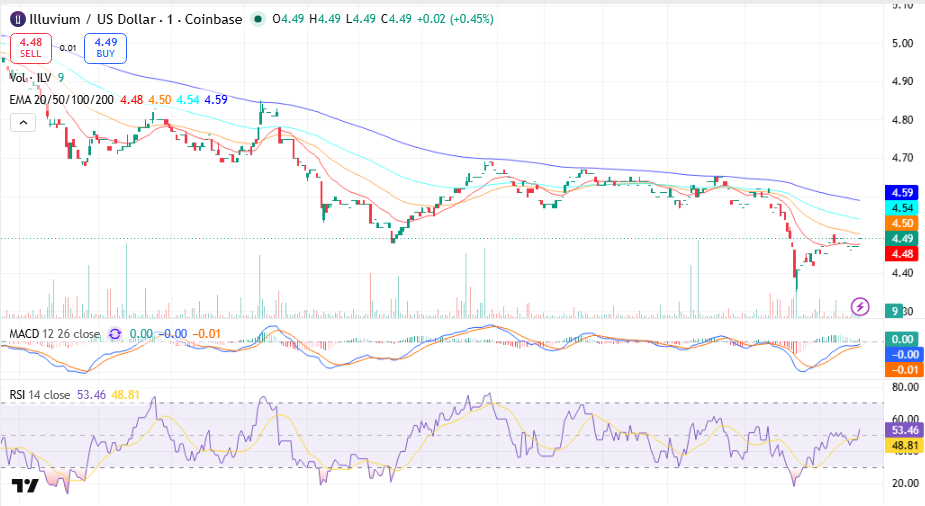
Illuvium combines exploration with creature collection, where players capture Illuvials that exist as NFTs. The ecosystem uses ILV tokens for governance and staking. In this game, players may earn through tournaments, gameplay rewards, or trading assets, although the project continues to evolve as new features are introduced.
Technical Insights: The Illuvium (ILV) chart shows a short-term downtrend, with price below the 50, 100, and 200 EMA, signaling bearish pressure. The recent bounce near $4.44 shows minor support. MACD is slightly bullish, hinting at a potential recovery. RSI at 53 suggests neutral momentum with room to rise. Watch $4.50–$4.54 resistance; a break above may signal a short-term reversal.
| Metric | Value |
| Current Price | $4.49 |
| Market Capitalization | $32.96M |
| Circulating Supply | 7.33M ILV |
| Max Supply | – |
| 24h Volume | $6.78M |
| 2026 YTD Change | -67.04% |
6. CryptoKitties
CryptoKitties was one of the earliest NFT-based blockchain games. Players breed and collect digital cats with unique traits, and rare combinations can increase resale value. Instead of a reward token, earnings mainly come from trading or selling these NFT cats in the marketplace.
7. Shiba Shootout
Shiba Shootout is an arcade-style blockchain game focused on fast-paced competition. In this game, players may earn ecosystem tokens or NFT rewards through gameplay. As the project is still under development, its reward systems and token model may continue to evolve.
8. Splinterlands
Source: TradingView
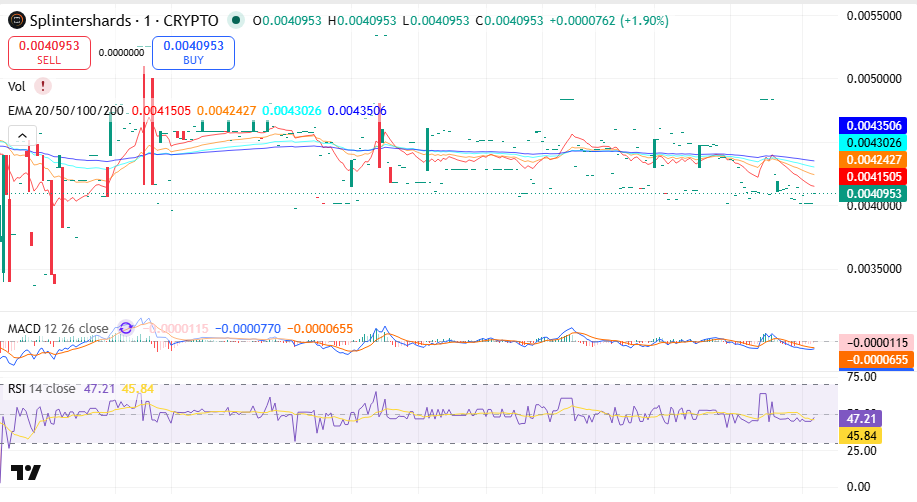
Splinterlands is a strategy card game built on the Hive blockchain. Players in this game are required to build decks using NFT cards and compete in ranked matches or tournaments. The platform rewards active players with SPS tokens, while rare cards may also generate value in the secondary market.
Technical Insights: The Splintershards (SPS) chart shows a consolidating market, with price hovering near $0.0040953 and slightly below the 20, 50, 100, and 200 EMAs, indicating weak bearish bias. MACD is near zero, signaling neutral momentum. RSI at 47 suggests neither overbought nor oversold conditions. Watch $0.00415 resistance and $0.0040 support for potential breakout or further sideways movement.
| Metric | Value |
| Current Price | $0.004044 |
| Market Capitalization | $6.14M |
| Circulating Supply | 1.51B SPS |
| Max Supply | 3B SPS |
| 24h Volume | $2.49K |
| 2026 YTD Change | -63.99% |
9. Alien Worlds
Source: TradingView
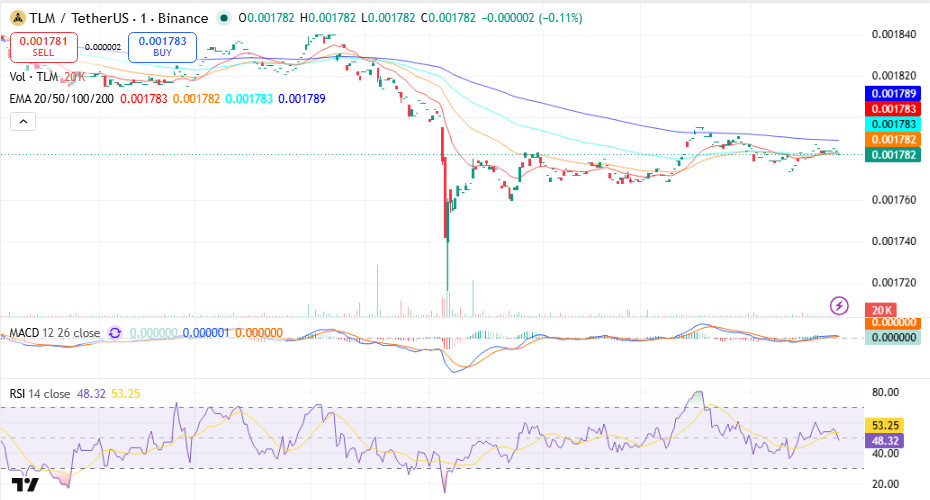
Alien Worlds centres around mining Trillium (TLM) tokens on different virtual planets. Players use NFT tools and land to improve mining efficiency. Staking tokens can also allow participation in governance, although rewards depend on asset strength and market demand.
Technical Insights: The TLM/USDT chart shows a short-term downtrend with price below the 100 and 200 EMAs, but above the 20 and 50 EMAs, indicating minor consolidation. MACD is flat near zero, suggesting neutral momentum. RSI at 48–53 signals indecision. Key levels to watch: support near 0.00176 and resistance around 0.001783–0.001789 for potential breakout or continuation.
| Metric | Value |
| Current Price | $0.001781 |
| Market Capitalization | $12.04M |
| Circulating Supply | 6.76B TLM |
| Max Supply | 10B TLM |
| 24h Volume | $3.61M |
| 2026 YTD Change | 69.21% |
10. Star Atlas
Source: TradingView
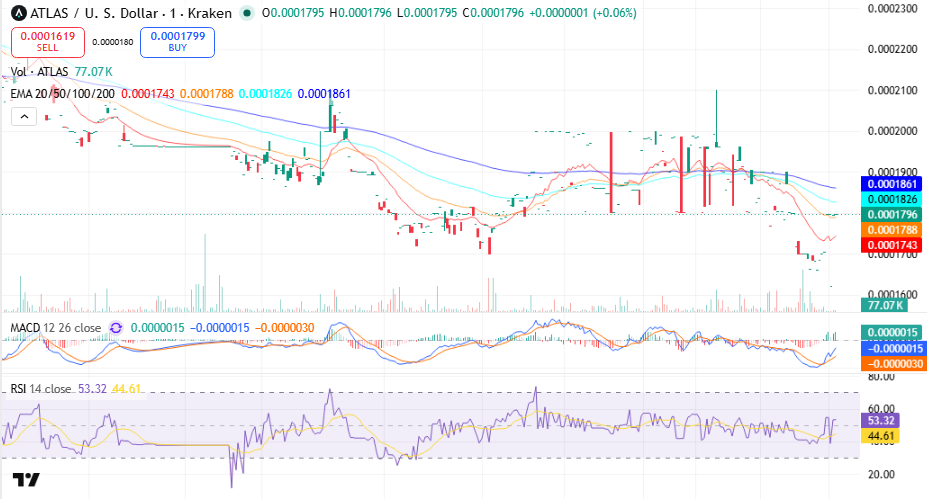
Star Atlas is a space-themed blockchain game where players control ships and explore a digital universe. Ships and land exist as NFTs that can be traded or used in missions. The ecosystem uses ATLAS tokens, and rewards may come from missions, resource collection, or asset trading.
Technical Insights: The ATLAS/USD chart shows a clear short-term downtrend, with price below the 50, 100, and 200 EMAs, indicating strong bearish pressure. Recent bounce near $0.0001743 suggests minor support. MACD shows a slight bullish crossover, hinting at potential short-term recovery. RSI at 53 indicates neutral momentum. Watch $0.0001788–$0.0001826 resistance for reversal confirmation.
| Metric | Value |
| Current Price | $0.0001739 |
| Market Capitalization | $4.32M |
| Circulating Supply | 24.84B ATLAS |
| Max Supply | – |
| 24h Volume | $61.24K |
| 2026 YTD Change | -87.11% |
How Players Make Money from P2E Games
- Token rewards: Players earn crypto tokens through gameplay victories or quests.
- NFT trading: Rare in-game items may sell in secondary markets.
- Land ownership and rentals: Virtual property may generate digital income streams.
Evaluating Earning Potential Realistically
Many new users search for the best play to earn crypto games with high returns. However, earning potential varies widely. It depends on three main factors:
- Token price stability.
- Active player base size.
- Game economy balance.
High token emission rates may reduce reward value. Reduced user growth may affect marketplace liquidity. Beginners should avoid assumptions of fixed returns.
Monitoring gaming tokens on platforms such as CoinDCX allows users to track price movements and historical volatility. Educational material on tokenomics can clarify how supply impacts value. Understanding these fundamentals strengthens long-term decision making.
Risks of Play-to-Earn Games
Play-to-Earn gaming introduces new economic opportunities, but it also carries structural and financial risks that users should understand before participating. Since these ecosystems combine gaming mechanics with crypto tokens and NFTs, their sustainability depends on multiple interconnected factors.
1. Token Inflation and Supply Imbalance
Many P2E games distribute native tokens as gameplay rewards, which increases circulating supply over time. If token issuance grows faster than real demand within the ecosystem, inflation can reduce the value of earned rewards. This imbalance often occurs when new user growth slows but token emissions continue at high rates. Without strong token utility or burn mechanisms, excess supply may weaken long-term price stability. Players should examine tokenomics carefully, including maximum supply, emission schedules, and reward distribution models.
2. Market Volatility and Price Fluctuations
Gaming tokens operate within the broader crypto market, which is known for price volatility. Token values can rise sharply during periods of hype or rapid adoption, but they can also decline quickly during market downturns. Since rewards are usually paid in native tokens, earnings are directly exposed to price swings. Even active players may see reduced value if token prices fall. Monitoring market conditions and historical price patterns helps set realistic expectations.
3. Sustainability of the Game Economy
The long-term success of Play-to-Earn games depends on active user participation and balanced economic design. Many early P2E models relied heavily on new users entering the ecosystem to sustain reward pools. If user growth slows or engagement declines, demand for in-game assets may decrease. This can affect NFT resale value and token liquidity. Sustainable platforms usually focus on strong gameplay, balanced reward systems, and long-term community engagement rather than short-term incentives.
4. Regulatory and Compliance Uncertainty
Crypto regulations continue to evolve across different countries, including India. Changes in taxation rules, digital asset classifications, or trading policies may affect gaming tokens and NFT transactions. Regulatory announcements can influence token prices and platform operations. Users should stay informed about legal developments that could impact participation or earnings. Reviewing official updates and understanding tax implications reduces compliance risks.
5. Smart Contract and Security Risks
Play-to-Earn games rely on blockchain-based smart contracts to manage transactions, rewards, and NFT ownership. While many projects conduct third-party audits, audits do not guarantee complete security. Vulnerabilities, coding errors, or exploits may still occur. Security breaches can affect token value or user assets. Players should research project transparency, audit history, and developer credibility before engaging with any platform.
6. Liquidity and Exit Risk
NFTs and gaming tokens depend on active buyers and sellers within marketplaces. During periods of low demand, users may find it difficult to sell assets at expected prices. Limited liquidity can delay exits or force sales at discounted values. This risk increases in smaller or early-stage projects. Evaluating trading volume and marketplace activity offers insight into potential liquidity constraints.
Understanding these risks allows players to approach Play-to-Earn gaming with greater awareness. Careful research, realistic expectations, and attention to token design and market conditions can reduce exposure to avoidable challenges.
Regulatory and Tax Considerations in India
India currently taxes virtual digital assets under specific provisions. Gains from crypto transfers may attract tax liabilities. P2E rewards converted to fiat could fall under these rules. Regulatory clarity continues to evolve. Players should stay informed about updates. Reviewing official government notifications remains advisable.
CoinDCX provides educational resources explaining taxation frameworks in simple language. Staying informed helps users maintain compliance.
How to Start with Play-to-Earn Games
Beginners should follow structured steps:
- Create a secure crypto wallet.
- Research the game’s official documentation.
- Understand token utility and supply.
- Evaluate entry cost requirements.
- Track token price trends responsibly.
Many games require NFT purchases before participation. Some offer free-to-play models with limited rewards. Entry barriers vary widely.
Security should remain a priority. Use strong authentication and avoid unofficial links. Protect private keys at all times.
Read also: What are Public & Private Keys in Crypto
A Balanced View on the Best Play to Earn Crypto Games
The best play to earn crypto games in 2026 offer new digital ownership models. Players earn tokens and NFTs through structured gameplay. However, these rewards are not guaranteed income sources. Market demand and token design shape outcomes significantly.
Approaching P2E gaming with research and realistic expectations is essential. Educational platforms such as CoinDCX support users through structured learning resources and market tracking tools. Understanding risks and sustainability factors improves overall decision quality.
Blockchain gaming represents innovation within digital assets. Participation should remain informed and balanced.
FAQs
Q1. Are P2E crypto games free to start?
Some Play-to-Earn games allow free entry so players can try the gameplay without investing upfront. However, these versions often limit rewards or features. To unlock full participation and better earning potential, players may need to purchase NFTs such as characters, cards, or land.
Q2. Which P2E crypto game pays the most?
P2E payouts are not consistent for any game and hence, there is no single game that consistently offers the highest payouts. Earnings vary depending on token prices, player competition, and overall platform activity. Instead of focusing only on short-term rewards, players should evaluate token supply, reward distribution, and long-term sustainability.
Q3. Is Play-to-Earn crypto games legal in India?
Blockchain gaming is not banned in India, but cryptos operate within an evolving regulatory environment that continues to develop. Government authorities have introduced taxation rules for virtual digital assets, and future policy updates may further clarify compliance requirements. Participation in P2E games is generally allowed, yet users remain responsible for adhering to applicable financial and tax regulations.
Q4. Are P2E earnings taxed?
In India, gains arising from the transfer or sale of crypto tokens and NFTs may fall under virtual digital asset taxation provisions. A flat tax rate currently applies to certain crypto gains, and the ability to offset losses against other income may be restricted under prevailing rules. Even rewards earned through gameplay could become taxable once converted or transferred.
Q5. Can beginners play P2E games?
Yes, most Play-to-Earn platforms provide tutorials, demo modes, or community guides to help new users get started. However, beginners should first understand how wallets, NFTs, and in-game marketplaces work. Learning these basics can reduce mistakes and improve the overall experience.
Q6. Are Play-to-Earn games still profitable?
Profitability in P2E games depends on factors such as token demand, user adoption, and the balance of reward distribution. Some projects generate strong returns during growth phases, while others struggle with token inflation. Because earnings are tied to market conditions, players should evaluate risks carefully before participating.