![Top Metaverse Tokens by Market Cap [September 2022]](https://coindcx.com/blog/wp-content/uploads/2022/09/09-13-Top-Metaverse-Tokens.jpg)

The world of metaverse tokens continues to evolve in 2026. Once associated mainly with virtual land and play-to-earn games, the sector now covers Web3 gaming, digital ownership, AI-powered virtual agents and decentralised computing infrastructure.
Although the initial metaverse hype has cooled, projects such as Render, Virtuals Protocol, The Sandbox, Axie Infinity and Decentraland continue developing products for immersive applications and virtual economies. This article covers the top metaverse coins by market capitalization, their current market position and the primary role of each token.
What Are Metaverse Tokens?
Metaverse tokens are crypto assets connected to virtual worlds, blockchain games and digital economies. Depending on the project, they may be used to purchase virtual assets, reward players, govern platforms or pay for services such as decentralised computing. Some tokens support complete virtual worlds, while others provide the infrastructure behind gaming and immersive applications.
Best Metaverse Crypto Coins by Market Cap in 2026
Here’s a comprehensive list of the top metaverse crypto coins that have the potential to explode in 2026. These metaverse tokens are shortlisted based on their high market cap and strong growth potential.
| Rank | Token | Price | Market cap | 24h volume | 24h change |
|---|---|---|---|---|---|
| 1 | Render (RENDER) | $1.54 | $804.06M | $14.18M | +1.63% |
| 2 | Virtuals Protocol (VIRTUAL) | $0.5875 | $386.27M | $48.07M | +3.74% |
| 3 | Stacks (STX) | $0.1729 | $313.80M | $5.79M | +0.99% |
| 4 | FLOKI (FLOKI) | $0.00002261 | $216.38M | $11.99M | +2.87% |
| 5 | Axie Infinity (AXS) | $0.9957 | $173.14M | $11.15M | +1.30% |
| 6 | ApeCoin (APE) | $0.1554 | $155.44M | $10.24M | +1.20% |
| 7 | The Sandbox (SAND) | $0.04820 | $141.62M | $11.52M | +2.91% |
| 8 | Decentraland (MANA) | $0.06989 | $138.80M | $8.09M | +3.30% |
| 9 | WEMIX (WEMIX) | $0.2510 | $124.96M | $1.23M | +4.31% |
| 10 | MultiversX (EGLD) | $3.00 | $91.13M | $10.95M | +3.12% |
Table is last updated on 13 July 2026 from Source: Coinmarketcap.com Prices and rankings may fluctuate
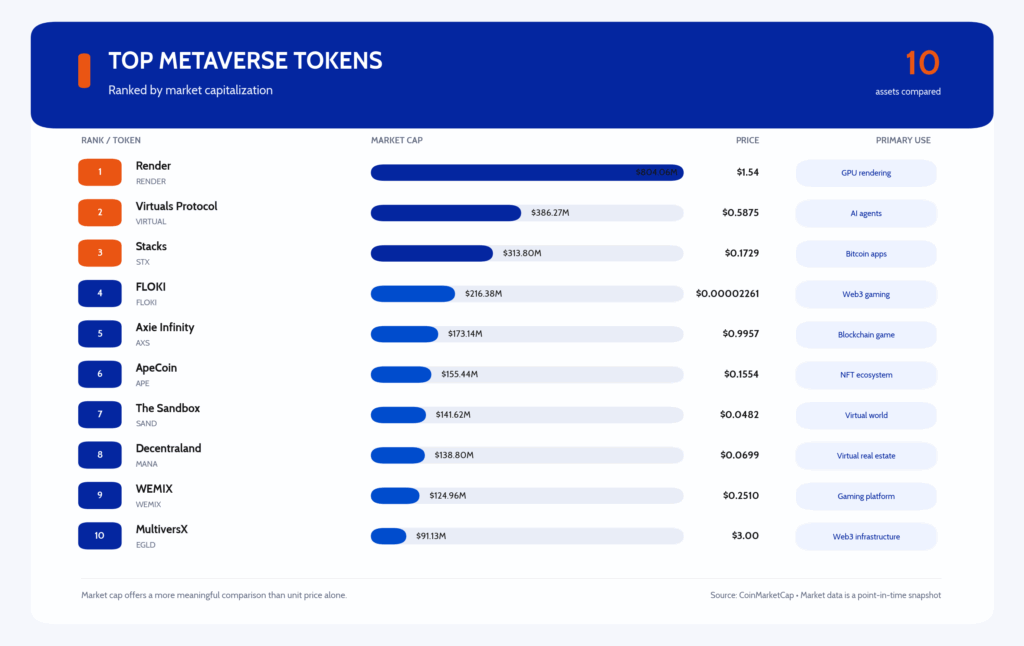
Note: Prices and market-cap rankings are based on CoinMarketCap data checked on the article’s last-updated date and may change with market conditions.
Overview of the Best Metaverse Coins in 2026
Let’s look at the overview of these popular metaverse coins that have strong potential to grow in 2026. Here, you’ll find an in-depth overview and technical insights to help you make informed decisions.
1) Render (RENDER)
Render Network is a decentralised GPU-rendering platform that connects creators requiring computing power with GPU operators who have available capacity. Its infrastructure can be used for 3D graphics, visual effects and other rendering-intensive digital content. Render is not a virtual world itself. Its metaverse relevance comes from providing the computing resources needed to create high-quality virtual environments, animations and immersive experiences. The RENDER token supports transactions between creators and GPU providers across the network.
Key use case: Decentralised GPU rendering for creators and graphics-intensive applications.
What to watch: Creator adoption, demand for GPU resources and competition from centralised and decentralised computing platforms.
Read more: RENDER Price Prediction
2) Virtuals Protocol (VIRTUAL)
Virtuals Protocol is an on-chain ecosystem designed for autonomous AI agents. These agents can provide services, create products and conduct transactions with people or other agents. Its metaverse connection comes from the use of interactive AI agents in gaming, entertainment, virtual worlds and social applications. The protocol’s Agent Commerce Protocol is intended to support verifiable transactions and agreements between autonomous agents, while VIRTUAL plays a central role in agent creation and ecosystem liquidity.
Key use case: Creating and operating tokenised AI agents across digital applications.
What to watch: The number of useful consumer applications, agent-generated activity and whether demand extends beyond speculative token launches.
Read more: VIRTUAL Price Prediction
3) Stacks (STX)
Stacks is a Bitcoin layer that enables smart contracts and decentralised applications while using Bitcoin as its underlying settlement layer. Its ecosystem includes sBTC, a programmable Bitcoin asset designed to let BTC participate in decentralised applications. Stacks is broader than a conventional metaverse project. Its inclusion reflects the role blockchain infrastructure can play in supporting digital assets, games, NFTs and virtual economies. Its 2026 roadmap is primarily focused on self-custodial Bitcoin applications, payments and Bitcoin-based yield rather than a dedicated virtual world.
Key use case: Smart contracts and decentralised applications secured by Bitcoin.
What to watch: sBTC adoption, developer activity and demand for applications built on the Bitcoin ecosystem.
Read more: What is Stacks?
4) FLOKI (FLOKI)
FLOKI began as a meme coin but has expanded into gaming, decentralised finance and crypto education. Its main metaverse product is Valhalla, an NFT-based game in which FLOKI functions as an ecosystem utility token.
The project’s large community and recognisable branding give it greater visibility than many smaller gaming tokens. However, FLOKI’s price can still be influenced heavily by meme-coin sentiment and social-media activity, even when those movements are unrelated to Valhalla adoption.
Key use case: Utility token for the Valhalla gaming ecosystem and other FLOKI products.
What to watch: Valhalla player activity, in-game demand for FLOKI and development across the wider ecosystem.
Read more: Floki Price Predictions
5) The Sandbox (SAND)
The Sandbox is a creator-focused virtual world where users can build games, digital assets and interactive experiences. Its Game Maker and asset-building tools allow creators to develop content without requiring extensive coding knowledge. The project’s current direction extends beyond its original voxel-based virtual world. The Sandbox Studio is being developed as an AI-assisted game-creation environment, with plans to help creators distribute games across the web, mobile and other platforms. SAND remains connected to transactions and participation within the broader Sandbox ecosystem.
Key use case: Building, publishing and monetising user-generated games and virtual experiences.
What to watch: Adoption of The Sandbox Studio, creator activity, game releases and practical demand for virtual LAND and SAND.
Read more: SAND Price Predictions
6) ApeCoin (APE)
ApeCoin is the official ecosystem token associated with Bored Ape Yacht Club, Otherside and ApeChain. It is used across a combination of NFT, gaming, governance and digital-culture applications. Its strongest metaverse connection comes from Otherside, while ApeChain broadens its relevance to gaming and consumer-facing blockchain applications. ApeCoin therefore offers wider ecosystem exposure than a token linked to only one game, although its demand remains closely connected to activity across the Bored Ape and Yuga-related ecosystem.
Key use case: Ecosystem utility and governance across ApeChain, Otherside and affiliated applications.
What to watch: Otherside development, ApeChain activity and demand for APE beyond NFT-market speculation.
Read more: What is ApeCoin (APE)?
7) Axie Infinity (AXS)
Axie Infinity is a blockchain gaming ecosystem built around collectible digital creatures known as Axies. Players can collect, trade and use Axies across different games and experiences. The ecosystem has been expanding beyond its original battle game through Atia’s Legacy, an MMO-style game set in the Axie universe. In July 2026, its third playtest introduced real-time player-versus-player combat, new competition formats and rewards involving bAXS, a non-transferable token linked to AXS ecosystem activities.
Key use case: Governance, rewards and participation within the Axie gaming ecosystem.
What to watch: Atia’s Legacy adoption, active players, game releases and the sustainability of the in-game economy.
Read more: AXS Price Predictions
8) Decentraland (MANA)
Decentraland is a community-driven virtual world built around social experiences, digital spaces, events and user-created content. MANA is used to buy, sell and create within the ecosystem and also contributes to the platform’s decentralised governance structure. A major 2026 development has been Decentraland’s expansion to mobile devices. The project has repositioned the platform as a more accessible social environment where users can join events and virtual spaces without relying only on a desktop client.
Key use case: Virtual-world transactions, digital experiences and community governance.
What to watch: Mobile adoption, recurring users, event participation and creator activity.
Also Read: Decentraland Price Predictions
9) WEMIX (WEMIX)
WEMIX is a blockchain ecosystem centred on gaming, decentralised applications, staking and digital assets. WEMIX PLAY serves as its gaming platform, connecting users with blockchain-enabled games and related ecosystem services. Unlike a token tied to one virtual world, WEMIX supports a broader portfolio of games and applications. One recent market-access development was WEMIX’s official Kraken listing in July 2026. The ecosystem also transitioned some of its platform services from WEMIX$ to USDC.e earlier in the year.
Key use case: Payments, staking and ecosystem activity across blockchain games and WEMIX applications.
What to watch: New game launches, user activity on WEMIX PLAY and demand for WEMIX across the platform.
Read more: What is WEMIX (WEMIX)?
10) MultiversX (EGLD)
MultiversX is a scalable blockchain network designed to support applications across gaming, payments, NFTs and other Web3 sectors. It uses sharding and a Secure Proof-of-Stake model to process transactions while EGLD is used for network fees, staking and governance. Like Stacks, MultiversX is infrastructure rather than a dedicated metaverse world. Its relevance comes from providing the underlying network on which developers can build games, digital-asset platforms and interactive applications.
Key use case: Scalable blockchain infrastructure for gaming, digital assets and Web3 applications.
What to watch: Developer adoption, gaming projects, network usage and demand for EGLD in staking and transaction fees.
Explore our article on the Top Meme Coins by Market Cap to diversify your portfolio.
Conclusion
Metaverse tokens seem to have lost their traction to a large extent in recent times, as the change in market sentiments has failed to revive a strong ascending trend. However, the demand for these tokens is expected to rise soon, which could bring back the lost glory.
FAQs
1. What are metaverse crypto coins?
Metaverse coins are digital assets used in virtual worlds for gaming, land ownership, NFTs, and social experiences.
2. Which are the top metaverse coins in 2026?
Based on the current CoinMarketCap category ranking, leading metaverse tokens include RENDER, VIRTUAL, STX, FLOKI, AXS, APE, SAND, MANA, WEMIX and EGLD. Rankings may change as token prices and circulating supplies fluctuate.
3. Are metaverse tokens a good investment in 2026?
Whether metaverse tokens are a good investment in 2026 depends on their long-term potential and adoption. While the sector shows promise, prices remain highly volatile in the short term.
4. Why are metaverse coins currently down?
The current downtrend in metaverse coins is largely driven by bearish market sentiment, lower demand, and fading hype across the sector.
5. Which metaverse coin has the highest growth potential?
Metaverse coins with the highest growth potential are typically those with strong ecosystems, such as SAND, MANA, and APE.
6. What is the difference between metaverse and gaming tokens?
Metaverse tokens may support broader virtual worlds, digital land, social experiences and infrastructure. Gaming tokens are usually linked to a game or gaming ecosystem. The categories frequently overlap.