


The decentralized cloud computing asset iExec RLC crypto surged from $0.37 on 3 October to $0.8944 on 6 October 2026 without any new enterprise partnership, exchange listing, or technical roadmap milestone behind the advance. While the weekly climb reached 122% to touch a temporary spike high of $0.79, secondary market metrics flash an immediate liquidity warning: 24-hour trading turnover expanded to 238% of the project’s entire $65.7 million market capitalization.
RLC is the token of iExec, a confidential computing marketplace running since 2017 that lets applications rent secure processing power. Nothing in that business changed this weekend, which is exactly what makes the move worth examining.
First time looking at this token? Read what iExec RLC is and how it works on CoinDCX.
RLC Token Rally Arrived With No Fundamental Catalyst
No fundamental protocol updates or commercial business developments accompanied the sudden RLC price surge. Project tracking feeds and official governance portals on 5 and 6 October recorded zero new commercial integrations, exchange listings, or protocol changes for iExec. The platform’s core product, a confidential computing marketplace running since 2017 that allows decentralized applications to rent off-chain compute resources, operated without modification over the weekend.
Consequently, the RLC token rally represents a momentum-driven liquidity rotation rather than value discovery based on network revenue. When price advances lack a fundamental anchor, market levels hold only as long as speculative trading flows persist.
238% Volume-to-Market-Cap Ratio Flashes a Speculative Warning
Daily trading volume reached $153 million against a $65.7 million market value, creating an extreme volume-to-market-cap ratio of 238%. This metric indicates that the entire token float changed hands more than two and a half times within 24 hours.
For an asset ranked 349th by market capitalization, a ratio this high reflects rapid intraday churn driven by algorithmic momentum traders and perpetual futures leverage rather than patient spot accumulation. While high RLC volume provides exit liquidity during upward wicks, turnover of this magnitude is historically short-lived. Once trading activity normalizes, spot prices typically retrace.
On the supply side, all 86.99 million tokens are already in active circulation. Because the hard cap matches the circulating float, holders face zero risk from venture capital vesting cliffs or future token unlocks.
Want the mechanics behind ratios like these? Learn how tokenomics works in crypto project evaluation on CoinDCX.
Three RLC Levels Worth Watching
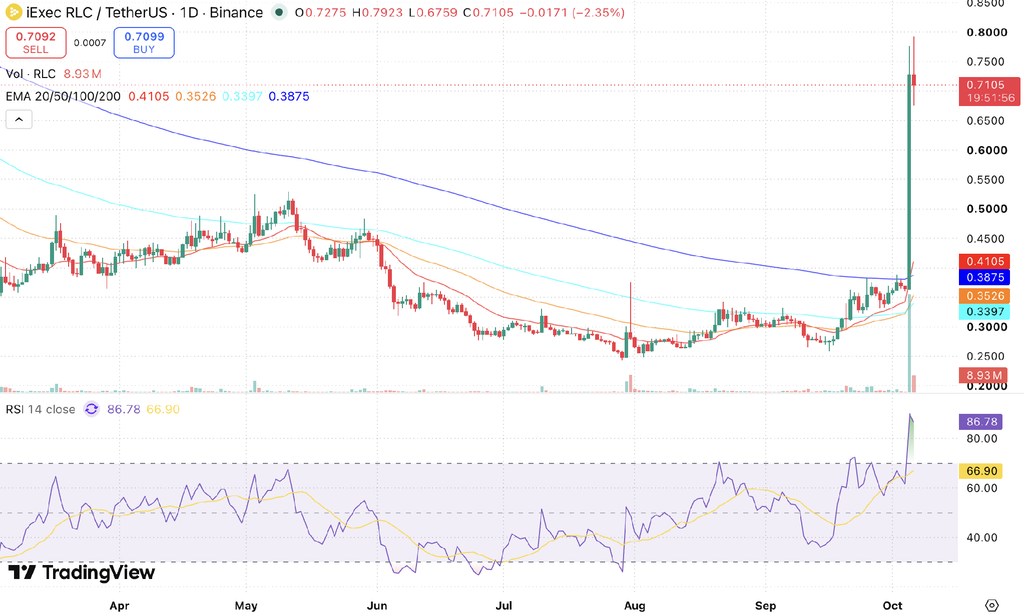
Source: TradingView
The $0.60 level marks the initial support band where the price briefly consolidated during the ascent, while the $0.40 to $0.45 range represents the primary base where the breakout started. Overhead, the $0.79 wick serves as immediate technical resistance. With the daily Relative Strength Index (RSI) at 86.80, the asset sits deep in technically overbought territory, increasing the likelihood of sharp pullbacks.
Tracking which AI and compute tokens lead this cycle? Browse the top AI crypto coins by market cap on CoinDCX.
How Traders Should Treat RLC After a 122% Week
Traders must treat the current market structure as a high-volatility momentum swing rather than a stable accumulation trend. Because small-cap digital assets that double within 72 hours frequently retrace a large portion of their gains once derivatives volume subsides, risk management depends heavily on position sizing. Managing exposure to absorb potential 40% to 50% drawdowns is essential when navigating unanchored speculative spikes.
Disclaimer: Crypto products and NFTs are unregulated and can be highly risky. There may be no regulatory recourse for any loss from such transactions. The information provided here is for general informational purposes only and does not constitute investment advice. Please do your own research before making any investment decisions.