QNT traded near $258.72, marking an approximate 300% gain over a seven-day window, after The Clearing House selected Quant Network as the core technology partner for its On-Chain Money Initiative. Because The Clearing House clears and settles more than $2 trillion daily across wire, ACH, check image, and real-time payment systems, market commentary quickly conflated this aggregate clearing volume with programmatic demand for the token. While the mandate represents a significant commercial milestone for Quant as an enterprise software provider, whether this corporate agreement drives direct economic value to the QNT token is a distinct technical and contractual question.
What Quant Supplies and When It Goes Live
On 24 September, The Clearing House said Quant will supply the interoperability, orchestration and transaction-management layer for clearing and settling tokenized deposit transactions on the On-Chain Money Initiative, first announced in June. The network will connect to RTP and CHIPS, the two systems banks already use for real-time payments and large-value dollar clearing. Participating institutions are expected to access it in the first half of 2027.
The timeline puts a live network about eighteen months away at the earliest. The scope limits Quant to software that sits between bank ledgers and the existing rails. The $2 trillion figure describes what The Clearing House already moves, not volume that will route through Quant.
Corporate Software vs. Token Utility
Quant Network Ltd is a privately held enterprise technology corporation incorporated in the United Kingdom. It licenses proprietary software directly to institutional clients and maintains no public equity listing. By contrast, QNT is a fixed-supply digital token initially issued to facilitate licensing access, gateway verification, and transaction signing within the Quant Overledger operating system.
Neither the joint press release issued by The Clearing House nor the accompanying technical documentation mentions the QNT token.
- No fee routed through the token is disclosed
- No settlement mechanism involving the token is described
- No schedule for either has been published.
A bank that licenses Overledger pays Quant. Whether any of that payment touches the token is something neither party has spelled out. That gap is the thing to hold on to. The contract is a genuine commercial win for the business. The token is trading as though the win flows straight through to it, and that link has not been documented.
Thin Liquidity Amplified the Move
12.07 million tokens circulate out of a 14.88 million maximum, and market capitalization sits at $3.12 billion against a fully diluted valuation of $3.85 billion. The liquidity-to-market-cap ratio is 0.06%, which works out to roughly $1.9 million of order book depth supporting a $3 billion asset.
Thin books move fast in both directions. Twenty-four hour volume of $1.21 billion against that $3.12 billion capitalization is a turnover ratio of 38.63%, so more than a third of the asset changed hands in a single day. A week ago, the same token traded at $65.18.
Severe Moving Average Extension
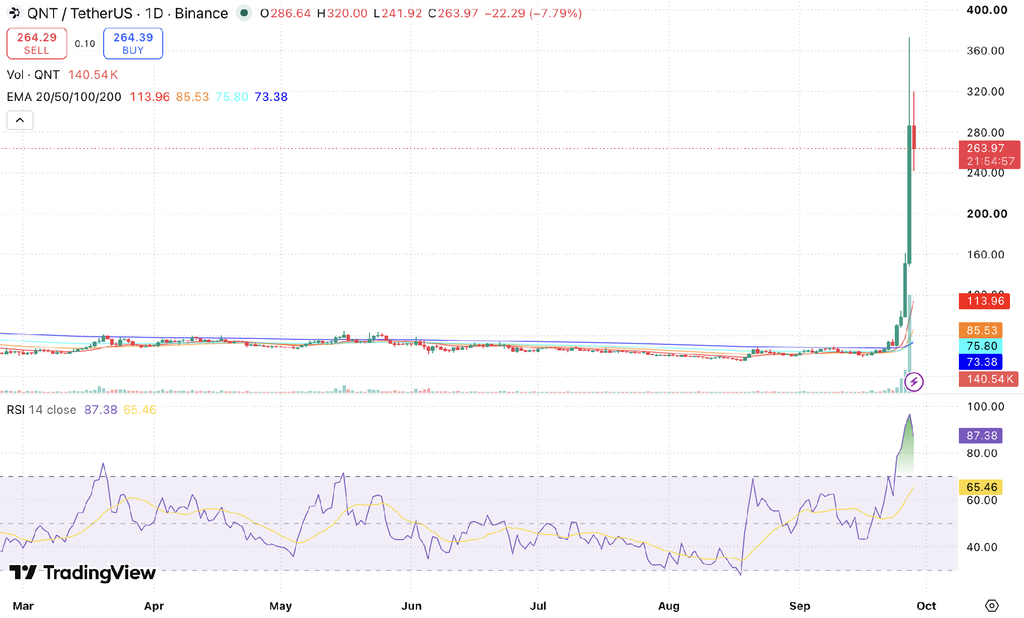
QNT daily chart with EMA 20/50/100/200 and RSI 14. Source: TradingView.
QNT has traded between $241.92 and $320.00 on the current daily session and is down 7.79%. That range is 32% of the low, and the last price sits about 19% below the session high.
The 20-day EMA is at $113.96 and the 200-day at $73.38, putting price 2.3 times the first and 3.5 times the second. RSI 14 reads 87.38 against a signal line of 65.46. QNT spent March through mid-September between roughly $70 and $120, so almost no volume has ever traded between $120 and current levels. Candles printed through empty territory tend to retrace through it just as quickly when bids thin out.
Read more: Quant (QNT) Price Prediction
Concurrent UK Commercial Banking Pilot
The US announcement followed another institutional milestone in the United Kingdom. On the same day, UK Finance confirmed that seven commercial banks, including Barclays, HSBC UK, Lloyds Banking Group, NatWest, Nationwide, Santander and Monzo, completed live interbank customer transactions using tokenized sterling deposits.
Transactions involving mortgage refinancing and consumer marketplace purchases settled over the Great British Tokenised Deposit (GBTD) shared infrastructure developed by Quant, conducted under the observation of the Bank of England and the Financial Conduct Authority (FCA). While confirming that Quant’s software functions in regulated interbank environments, this institutional deployment also operated without native token dependency.
Key Catalysts to Monitor Going Forward
Evaluating whether the Quant Clearing House deal will translate into sustained fundamental support depends on several upcoming milestones:
- Tokenomics disclosures: Any formal documentation clarifying whether Overledger enterprise licensing or interbank transaction validation incorporates mandatory programmatic QNT locking or fee burning.
- Institutional participant rosters: Announcements from specific commercial banks joining the On-Chain Money Initiative pilot ahead of the 2027 launch window.
- Secondary market structure: Whether spot markets establish a durable higher support shelf above the $120 to $150 prior consolidation zone during subsequent retracements.
Disclaimer: Crypto products and NFTs are unregulated and can be highly risky. There may be no regulatory recourse for any loss from such transactions. The information provided here is for general informational purposes only and does not constitute investment advice. Please do your own research before making any investment decisions.
FAQs
What did The Clearing House and Quant announce?
The Clearing House selected Quant on 24 September 2026 to provide the interoperability and transaction-management infrastructure for its On-Chain Money Initiative. The platform will connect tokenised deposits issued by commercial banks to existing US settlement systems, including RTP and CHIPS, with institutional availability scheduled for the first half of 2027.
Does the deal create demand for the QNT token?
The deal creates no documented demand for the QNT token. Neither The Clearing House nor Quant mentions QNT in the announcement, and no fee or settlement mechanism routing through the token has been disclosed. Quant sells software to banks, and payment for that software is company revenue unless a link to the token is stated separately.
Can you buy shares in Quant Network?
No. Quant Network Ltd is an unlisted private limited company registered in the UK. The QNT token is a cryptographic software utility asset, not an equity share, and confers no corporate ownership, dividend rights, or voting governance in Quant Network Ltd.
Why did QNT move so much on the news?
QNT moved so much because its float is small relative to the money that arrived. Only 12.07 million tokens circulate, and a liquidity-to-market-cap ratio of 0.06% means roughly $1.9 million of order book depth was supporting a $3.12 billion asset when the news broke.