



PENDLE reclaimed its $2.152 breakout pivot and traded up 5.58% at $2.35 after launching its inaugural yield market on Robinhood Chain and proposing a permissioned trading venue for institutional participants. The rally is supported by the protocol’s value-accrual model, which allocates up to 80% of protocol revenue toward programmatic PENDLE buybacks. However, both ecosystem catalysts come with practical timelines and market dynamics that traders should evaluate closely.
PENDLE Price Today
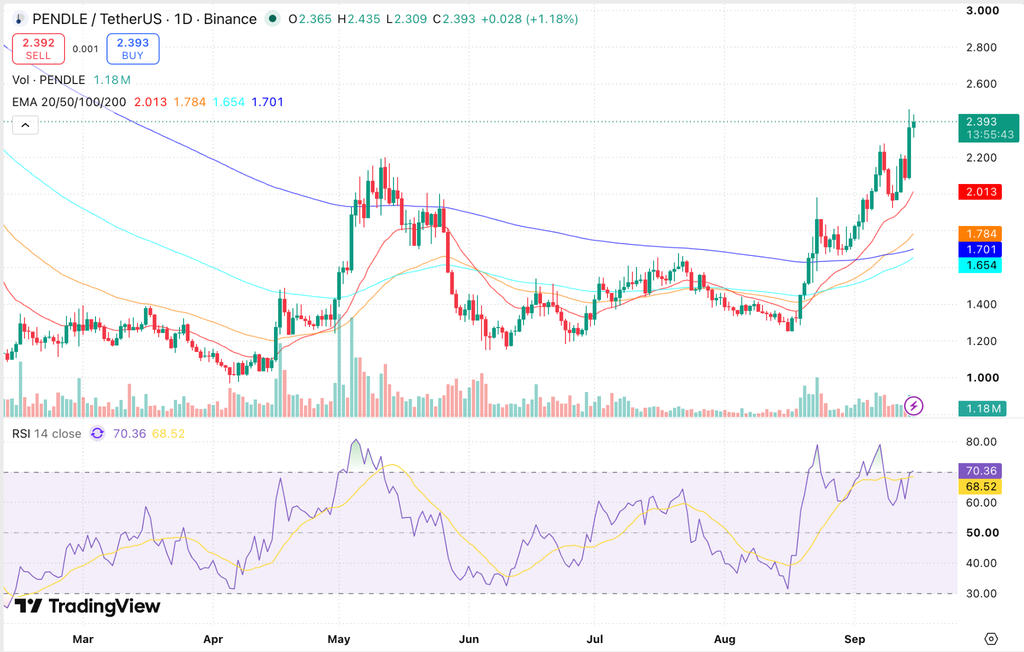
PENDLE traded at $2.393, up 1.18% on the day within a range of $2.309 to $2.435. That is a marked slowdown from the 5.58% session that carried the breakout, and it sits roughly 10% above the $2.152 level that holds the structure together.
Source: TradingView
The moving averages have not caught up. PENDLE trades 19% above its 20-day exponential average at $2.013 and 41% above the 200-day at $1.701, with the 100-day at $1.654 the furthest below. The 14-day RSI reads 70.36 indicating a flattening momentum rather than accelerating.
The Robinhood Chain Market Expires on 17 September
Pendle announced on 4 September that it had gone live on Robinhood Chain, an Ethereum Layer 2 built using Arbitrum technology. Robinhood Chain launched on 1 July and currently secures more than $1.4 billion in total value locked (TVL), compared to Pendle’s $1.23 billion footprint across all supported networks.
The deployment consists of one market. It covers sNET, the staked form of NET from NetNet Capital, and it matures on 17 September, giving the launch a thirteen-day life from announcement to expiry. Pendle has not named the assets for subsequent markets or given a timetable, and several observers read the first market as a test, not a flagship pool.
The Institutional Permissioned Pilot Is Still a Proposal
The proposed Permissioned Markets Pilot aims to provide institutional investors with controlled access to whitelist-gated Principal Token (PT) and Yield Token (YT) pools, designed to fulfill the KYC and AML compliance mandates that typically prevent regulated firms from interacting with open DeFi protocols.
However, the framework has not officially launched. The development team is targeting a deployment within two months as commercial discussions with prospective institutional partners proceed, meaning the institutional narrative driving current market sentiment represents a strategic proposal rather than an active product.
Where the 80% Protocol Revenue Share Goes
Pendle transitioned from its legacy vote-escrow model to liquid sPENDLE in January. Under the current tokenomics architecture, up to 80% of protocol revenue generated from swap and yield fees is routed directly into hourly open-market PENDLE buybacks, which are distributed to active sPENDLE stakers. Concurrently, baseline token emissions were reduced by roughly 30%, and unstaking requires either a standard 14-day cooldown or an optional 5% fee for immediate liquidity.
With approximately 60% of circulating supply locked in staking contracts, the mechanism removes floating tokens from the market while scaling programmatic buy orders directly with protocol volume.
Valuation Considerations and Long-Term Sustainability
Revenue-funded buybacks only work while revenue grows. A widely circulated analysis from May argued that Pendle traded at about 45 times revenue and 90 times earnings while both total value locked and revenue were contracting.
Those figures are four months old, and the protocol has expanded since, onto Robinhood Chain, into commodity funding-rate markets through Boros, and onto Monad in October. Whether that expansion has reversed the trend is the question the next revenue print answers.
What PENDLE Traders Should Watch
The initial sNET yield pool matures on 17 September, making Pendle’s subsequent asset listings on Robinhood Chain the first genuine indicator of whether the integration represents an active liquidity hub or a short-term trial.
Additionally, traders should monitor official updates regarding the Permissioned Markets Pilot for confirmed launch dates and formal institutional custody partners. On the daily chart, $2.152 remains the structural support level required to maintain the breakout, with $2.50 representing the primary technical target above spot.
FAQ
1. Why is the Pendle price surging?
PENDLE surged 5.58% to $2.35 after launching its first yield market on Robinhood Chain and proposing a permissioned venue for institutional access. Volume climbed 47% to around $64.5 million, and the token has held above the $2.152 level that supports the breakout.
2. What did Pendle launch on Robinhood Chain?
Pendle launched an initial yield pool for sNET (staked NET from NetNet Capital), which matures on 17 September 2026. Users can tokenize the asset into Principal Tokens (PT) for fixed yields or Yield Tokens (YT) for leveraged exposure. Subsequent asset additions have not yet been detailed.
3. What is the Pendle Permissioned Markets Pilot?
The Permissioned Markets Pilot is a proposed framework to provide institutions with whitelist-gated access to compliant Principal and Yield Token pools. The feature is targeting a rollout within two months as partner discussions continue.
4. How does PENDLE capture protocol revenue?
Under the sPENDLE model introduced in January 2026, up to 80% of protocol fees fund automated, hourly buybacks of PENDLE that are distributed to active sPENDLE stakers. Unstaking requires a 14-day waiting period or an immediate exit fee of 5%.