


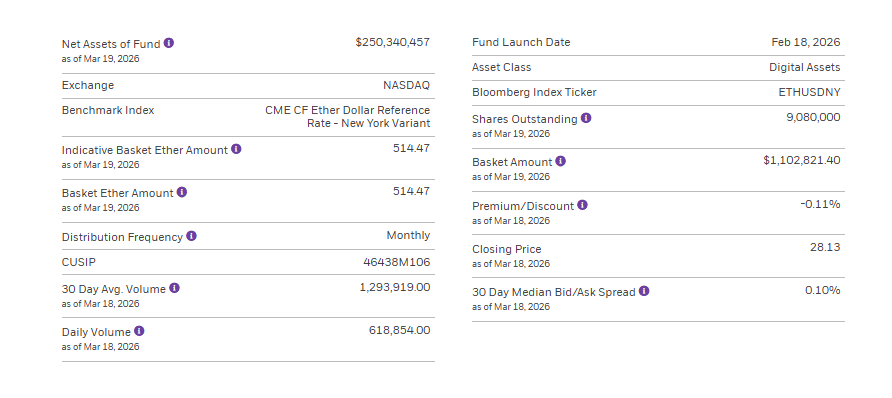
BlackRock has recorded a strong debut for its iShares Staked Ethereum Trust (ETHB), with assets under management crossing $250 million within the first week of launch. The fund, listed on Nasdaq, reflects rising institutional interest in Ethereum exposure combined with staking-based income. Early inflows and consistent trading activity indicate a structured demand for products that go beyond simple price tracking.
The rapid growth in AUM also aligns with broader trends in digital asset investment products, where yield generation is becoming a key differentiator. As institutions refine their allocation strategies, products like ETHB introduce a more utility-driven approach to Ethereum participation.
Strong Early Flows and Market Positioning
The fund launched with over $100 million in seed capital and has since attracted an additional $146 million in inflows. This places ETHB among the fastest-growing Ethereum-based investment products in its initial phase. Its listing on Nasdaq has also ensured accessibility and visibility among institutional participants.
Unlike earlier Ethereum products, ETHB integrates staking from inception. This structural design eliminates the need for post-launch adjustments and clarifies how returns are generated. The fund’s benchmark, tied to the CME CF Ether Dollar Reference Rate – New York Variant, further strengthens its alignment with established pricing standards.
This early traction signals a shift in institutional capital’s approach to Ethereum. Instead of viewing it solely as a price-driven asset, investors are increasingly focusing on its underlying network mechanics and yield potential.
Source: Blackrock
Staking Model Drives Income-Oriented Exposure
A key feature of ETHB is its staking mechanism, where 70-95% of the fund’s Ethereum holdings are actively staked. The structure distributes 82% of staking rewards to investors through monthly payments, while the remaining portion is allocated across operational components.
Such a strategy describes a dual-return profile. Not only do investors gain exposure to Ethereum’s price fluctuations by investing in Ethereum, but they can also participate in the staking distribution along the way. This production model perfectly meets the requirements of modern investors seeking digital assets capable of generating income, and of institutional portfolios seeking diversification.
Some of the fund validators are well-known infrastructure providers, including Figment, Galaxy Blockchain Infrastructure, and Attestant. Involving them has elevated the operational stability and continued the generation of rewards without disruption.
ETHB, through the integration of large-scale staking, has differentiated its offer by providing traditional finance structures complemented with native blockchain yield mechanisms.
Trade ETH in INR on 
Deposit and withdraw in INR (₹).
No Conversion to Crypto Required.

Competitive Landscape and Industry Context
ETHB enters a market where other players have already introduced staking-enabled Ethereum products. However, many of these offerings added staking features after launch. In contrast, BlackRock’s fund was designed with staking as a core component from day one.
The distinction between these two elements enables transparent communication, helping investors understand their expectations. This improves transparency and helps investors better understand expected outcomes, strengthening the product’s positioning.
Investor sentiment shows a direct dependence on Ethereum market performance, serving as a key market element. The market experiences unpredictable price changes, but institutional products now focus on long-term commitment instead of short-term price fluctuations.
Read more: Ethereum Price Prediction
Conclusion
BlackRock’s iShares Staked Ethereum Trust has delivered a decisive start, crossing $250 million in assets within its first week. The combination of structured exposure and staking-based income highlights a clear evolution in institutional engagement with Ethereum.
As investment products continue to mature, the focus is shifting toward efficiency, transparency, and yield integration. ETHB reflects this transition, offering a model that aligns with both traditional investment frameworks and blockchain-native capabilities.


