


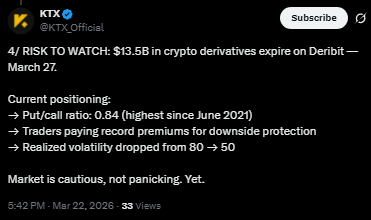
A major crypto options expiry is set to influence the market this week, with nearly $13.5 billion in Bitcoin and Ethereum options expiring on Friday. This marks one of the largest quarterly expiries of 2026, drawing strong attention from traders and institutions. At the same time, macro developments and geopolitical headlines are adding to the uncertainty, making this expiry window a critical moment for price action.
For traders, this expiry could act as a short-term volatility trigger, especially as Bitcoin trades near a key derivatives-driven level.
What is Crypto Options Expiry?
Crypto options expiry refers to the date when options contracts settle and become invalid. During large expiries, markets often see increased volatility as traders close, roll over, or hedge positions.
Understanding Max Pain and Market Impact
The max pain level is the price at which the largest number of options expire worthless, benefiting option sellers. For this expiry, Bitcoin’s max pain is estimated near $85,000–$86,000, making it a key level to watch. With Bitcoin trading near this range, the market is already close to equilibrium. This reduces the likelihood of extreme price deviation before expiry but increases the chance of consolidation. In simple terms, price action may remain compressed as expiry approaches.
This behavior is driven by hedging activity. Market makers continuously adjust positions to stay neutral. As expiry nears, this process intensifies due to rising gamma. The result is a natural pull toward the max pain zone, especially in the final 24 hours.
Why This Expiry Stands Out
This is not a routine monthly expiry. Quarterly expiries carry significantly higher open interest, and this one is among the largest seen this year. Bitcoin options alone account for over $10 billion, while Ethereum contributes the remaining share. Similar large-scale crypto options expiries, ranging between $14B–$18B, have historically triggered short-term volatility in Bitcoin price action.
Adding to this, the put/call ratio stands near 0.85. This indicates a slight bullish tilt but not enough to establish dominance. The market remains balanced, with traders positioning for movement rather than direction.
At the same time, volatility-focused strategies such as straddles and strangles are gaining traction. This signals that traders expect a strong move but remain uncertain about its direction. The combination of high open interest and volatility positioning creates a setup where even small triggers can lead to amplified reactions.
Source: KTX
What Traders Should Watch Till March 31, 2026
As expiry approaches, two scenarios are shaping expectations. The first is a gradual move toward the max pain zone. In this case, price remains stable, and volatility stays compressed until settlement. This has been the dominant pattern in previous quarterly expiries.
The second scenario involves a breakout driven by external catalysts. If strong directional momentum builds before settlement, it can override the max pain effect. In such cases, price may move sharply beyond key levels, supported by increased volume.
Once the expiry concludes, the market often transitions into a new phase. Historical data shows that volatility expands in the 3-7 days following major expiries. This happens as hedging pressure disappears and underlying trends regain control. This transition period has consistently delivered some of the most decisive moves of the month.
Conclusion
The $13.5 billion crypto options expiry could act as a key catalyst for Bitcoin’s next move. While short-term price action may remain compressed near the $86K max pain level, volatility is likely to expand after settlement, making this a crucial window for traders. In the current environment, patience and timing remain key. The convergence of large expiry flows and broader market developments makes this a pivotal window for the crypto market.


