



Bitcoin has reclaimed above the $70,000 mark, reigniting debate over whether the market is stabilising or simply reacting to short-term positioning shifts. While the bounce has eased immediate downside fears, traders caution that this move alone does not confirm a sustained trend reversal.
Several market watchers note that Bitcoin is now entering a decision zone, where price acceptance matters more than momentum. With volatility still elevated and macro risks unresolved, the market is once again split between those expecting continuation higher and those preparing for another rejection.
The key question now is not whether Bitcoin bounced, but what happens next around the levels traders are actively watching.
According to market analyst Ted Pillows, Bitcoin’s rebound above $70,000 shifts attention toward a major resistance band between $74,000 and $76,000, a zone that also aligns with long-term cost bases for large institutional holders. At the same time, analysts warn that losing the $66,000–$68,000 range could quickly put recent lows back in play.
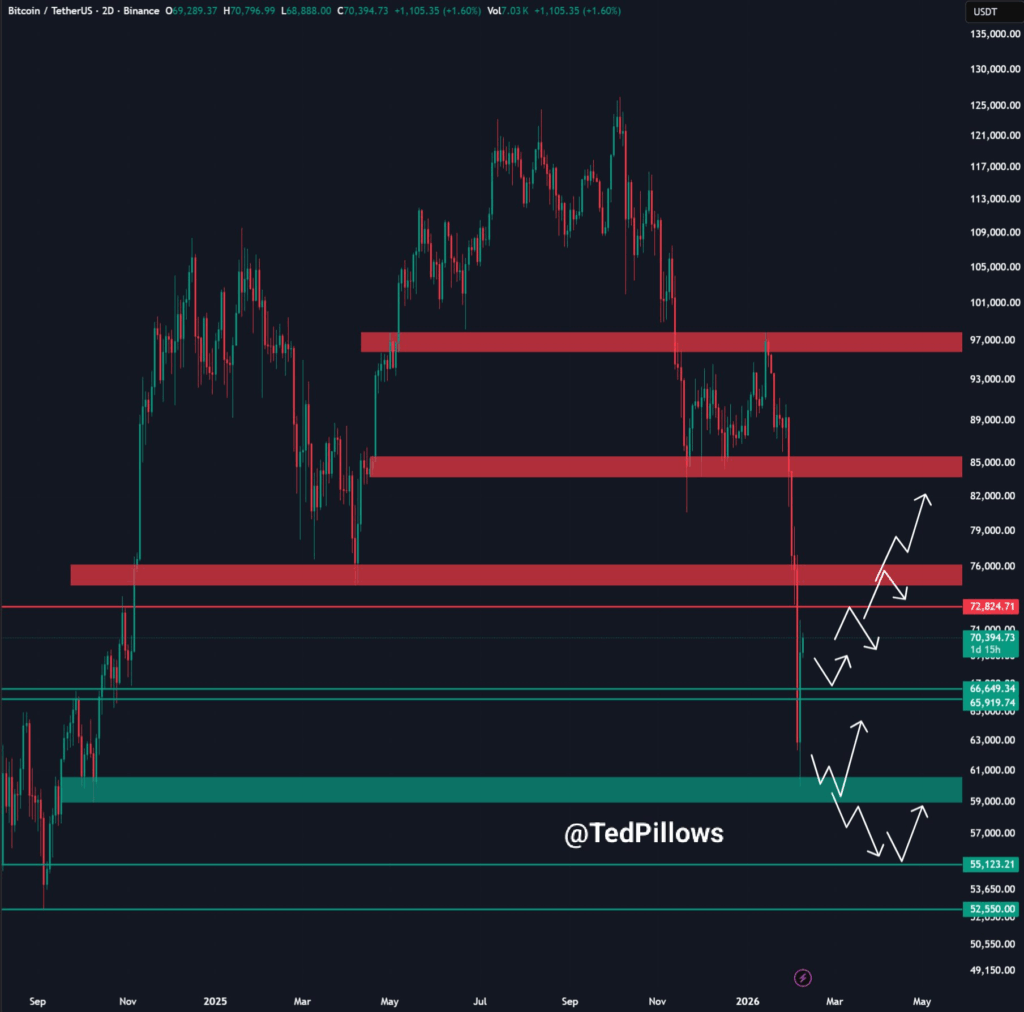
This sets up two very different paths for the market.
Bitcoin Bounce vs Breakdown: The Two Core Scenarios
Every Bitcoin support test resolves into one of two outcomes. The challenge is recognizing which one is developing without reacting too early.
Scenario 1: Acceptance Above $70K Opens the Door Higher
In a constructive outcome, Bitcoin holds above the $70,000 region and begins building acceptance rather than reacting impulsively. Traders point to the $74,000–$76,000 zone as the next major area of interest, where previous supply and long-term positioning could test buyer conviction.
A move into this range would not need to be explosive to be meaningful. In fact, analysts suggest that slower, steadier price action would be healthier, signalling that buyers are absorbing supply rather than chasing short squeezes.
Under this scenario, volatility would likely compress, leverage would reduce, and the market would attempt to re-establish structure after weeks of instability.
Read more: Bitcoin Price Prediction
Scenario 2: Rejection and a Return to Range Volatility
The alternative path remains very much on the table.
If Bitcoin fails to maintain ground above reclaimed levels and slips back below the $66,000–$68,000 zone, traders warn that downside pressure could re-emerge quickly. Such a move would suggest the recent rally was driven more by positioning and short covering than genuine demand.
In this case, price action is likely to revert to range-bound volatility, with sharp moves in both directions as the market continues to search for equilibrium. This would reinforce the view that Bitcoin is still navigating a broader consolidation phase rather than transitioning cleanly into its next leg higher.
Also Read: How to find Support and Resistance Zones in Crypto
Why Bitcoin Support Zones Create So Many False Signals
Support zones are prime areas for what traders call “getting wicked out.”
The reason is structural:
- Stops cluster just below obvious levels
- Market makers seek liquidity
- Volatility increases when leverage is high
Sharp dips below support followed by quick recoveries are not accidents. They are a natural outcome of how liquidity and positioning work during uncertain phases.
Trading aggressively inside these zones often leads to frustration rather than clarity.
How to Approach Bitcoin Support Levels More Effectively
The key is aligning strategy with timeframe.
For long-term participants:
- Intraday volatility matters less than weekly structure
- Focus on where Bitcoin closes, not where it briefly trades
For short-term traders:
- Avoid placing stops exactly at obvious levels
- Reduce leverage near major support zones
- Wait for confirmation instead of predicting reversals
In volatile conditions, patience is a strategy.
The Macro Context Matters
Bitcoin does not move in isolation. During periods of global risk-off sentiment, correlations across markets rise.
Support tests often coincide with:
- Equity market sell-offs
- Liquidity tightening
- Volatility in bonds or currencies
In these environments, Bitcoin tends to react faster than traditional assets due to its 24/7 nature and higher leverage. This doesn’t mean Bitcoin is failing, it means it is participating in broader risk repricing.
Trade BTC in INR on 
Deposit and withdraw in INR (₹).
No Conversion to Crypto Required.

Conclusion
Bitcoin support levels are less about precision and more about behavior. Bounces do not equal safety. Breakdowns do not equal failure. What matters is how the market responds over time, whether selling pressure fades, leverage resets, and structure stabilizes.
Understanding support as a process, not a prediction, helps traders avoid emotional decisions during volatile phases. The market will eventually reveal its direction. The goal is to still be positioned mentally and financially when it does.