



Falcon Finance has gained roughly 58% since late August, making FF one of the few large gainers in a falling market. Traders point to the tokenization pipeline the protocol opened in El Salvador, though the chart shows no reaction on the day of that launch.
FF Price Today and the Volume Behind the Move
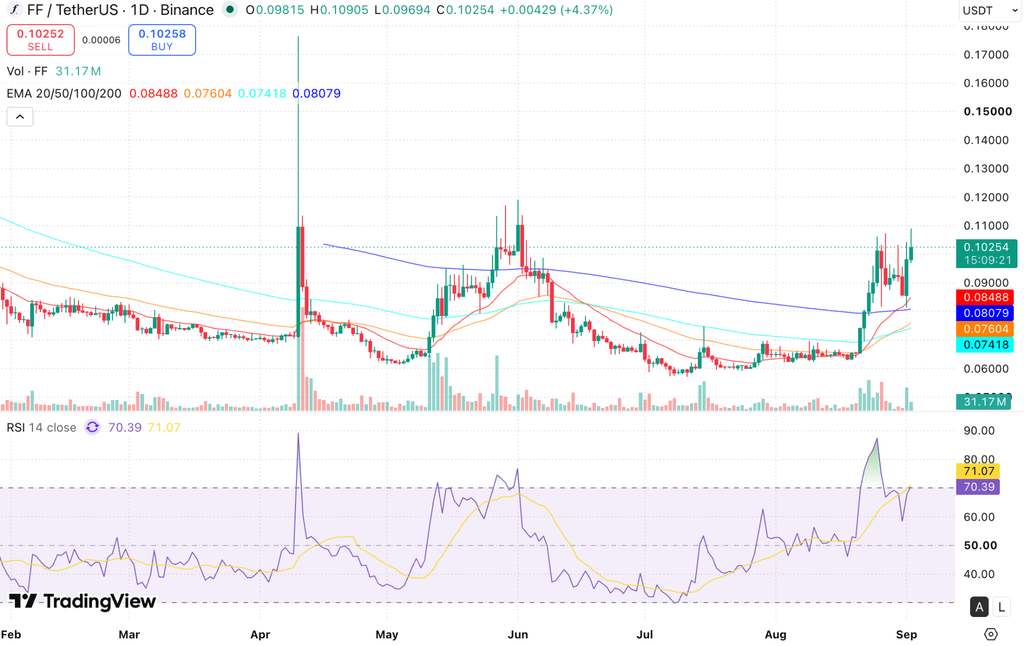
Falcon Finance traded at $0.1025 on 2 September, up 4.37% on the session after touching $0.10905, with a market capitalization of $311.4 million. CoinMarketCap’s rolling 24-hour figure shows a larger 21.19% gain, because most of the move landed in the previous session.
FF has climbed roughly 58% from about $0.065 in late August, rising while Bitcoin, Ethereum and Solana fell. Turnover reached $65.71 million, up 577.89% and equal to 21.1% of market cap, which points to real participation rather than a squeeze in a thin book. On Binance, though, this session sits below the volume of the late-August surge. More in the guide to crypto trading volume.
What Falcon Finance Launched in El Salvador
On 18 August Falcon opened a regulated real-world asset tokenization pipeline in El Salvador, under the country’s Digital Assets Issuance Law and supervised by its digital assets regulator.
FF traded flat near $0.065 through mid-August and showed no reaction to the announcement, breaking higher a week later. The pipeline explains why FF is on watchlists, not what moved it this week.
How the Tokenized GPU Forward Works
The first instrument is a GPU forward, aimed at a gap in AI infrastructure funding. Four to eight months typically pass between paying for high-end graphics processors and installing them in a data center, and the hardware earns nothing in between.
The forward is a debt obligation issued below par that accretes to par once the GPUs produce lease income, with NEAR AI as anchor buyer of the compute capacity. If it trades with enough depth it becomes eligible collateral for minting USDf. More in this explainer on real-world asset tokenization.
Why USDf Supply Complicates the Rally
USDf stood at $1.18 billion on 31 August against reserves of $1.67 billion, a collateralization ratio of 141.6%, so the peg looks well covered. The collateral set has also broadened through 2026 to take in tokenized equities, gold vaults, Mexican government bonds and short-duration treasuries.
Supply is the harder number, because USDf circulation passed $2.2 billion in November 2025 and has since contracted by roughly 46%, while protocol revenue runs near $15,000 a day. The range of collateral has grown while the float behind it has shrunk.
FF Price Levels and Momentum to Watch
The moving averages have not confirmed a trend. The 20-day EMA sits at $0.0849 and the 200-day at $0.0808, but the 50-day and 100-day are lower at $0.0760 and $0.0742. In an uptrend the shorter averages line up above the longer ones, so a 200-day above both marks a recovery from a long decline rather than a trend in place.
Momentum is cooling as well, with the 14-day RSI at 70.39, under its moving average at 71.07 and far below the 87 printed during the late-August surge. Price has edged to a marginally higher high while RSI has made a much lower one.
Overhead sits the session high at $0.10905, then the June peak near $0.1195. Beneath spot, the 20-day EMA at $0.0849 is first support, with the 200-day at $0.0808 below it, and price sits 20.8% above that 20-day average. Dilution adds pressure, since only 3.07 billion tokens circulate out of a 10 billion maximum.
Source: TradingView
What FF Traders Should Watch Next
On the charts, the 50-day and 100-day averages need to climb above the 200-day before this counts as a trend rather than a bounce. USDf supply has to turn back up before buybacks matter. The test for the GPU forward is whether it draws secondary trading, since most tokenized assets stay thin after issuance.
Disclaimer: This article is for informational purposes only and does not constitute investment advice. Crypto assets are unregulated and highly volatile. Readers should conduct their own research before making any trading decisions.
FAQs
1. Why is Falcon Finance price rising?
Falcon Finance price is rising on a sharp increase in trading activity, with FF near $0.1025 and 24-hour volume up 577.89% to $65.71 million. The token has gained roughly 58% since late August. Traders point to the El Salvador tokenization pipeline, though the chart shows no reaction to that announcement until a week afterwards.
2. What is Falcon Finance’s tokenized GPU financing?
Falcon Finance’s GPU financing is a tokenized forward contract funding the gap between buying high-end graphics processors and deploying them in a data center. It is issued below par and accretes to par once the hardware earns lease income, with NEAR AI as anchor buyer of the capacity.
3. Is FF a good investment?
Whether FF suits your portfolio depends on your risk tolerance and time horizon. Falcon holds reserves of $1.67 billion against $1.18 billion of USDf, but the token sits far below its 2025 record, USDf supply has shrunk, its moving averages have yet to confirm an uptrend, and under a third of the supply circulates.
4. What is USDf and how does Falcon Finance earn revenue?
USDf is Falcon’s overcollateralized synthetic dollar, minted against deposited collateral including tokenized real-world assets. Users stake it as sUSDf to earn yield from institutional trading strategies, and the protocol takes fees on that activity, running near $15,000 a day.


