
Tim Cook’s final day as Apple CEO comes with Iran escalation bidding oil, Nikkei down as Trump posts Kharg Island video, and SK Hynix eyeing Intel for HBM4E.
TLDR
Today is Tim Cook’s final day as Apple CEO. John Ternus takes over Tuesday. Trump posted AI-generated videos of Iran’s Kharg Island under attack, sending Brent above $90, Nikkei lower and Japan semis into a hard sell. SK Hynix reportedly considering Intel Foundry for HBM4E base dies, the first crack in TSMC’s grip on advanced memory packaging. NFP Friday and the September 17 FOMC remain the two catalysts framing the rest of the week.
Market Regime
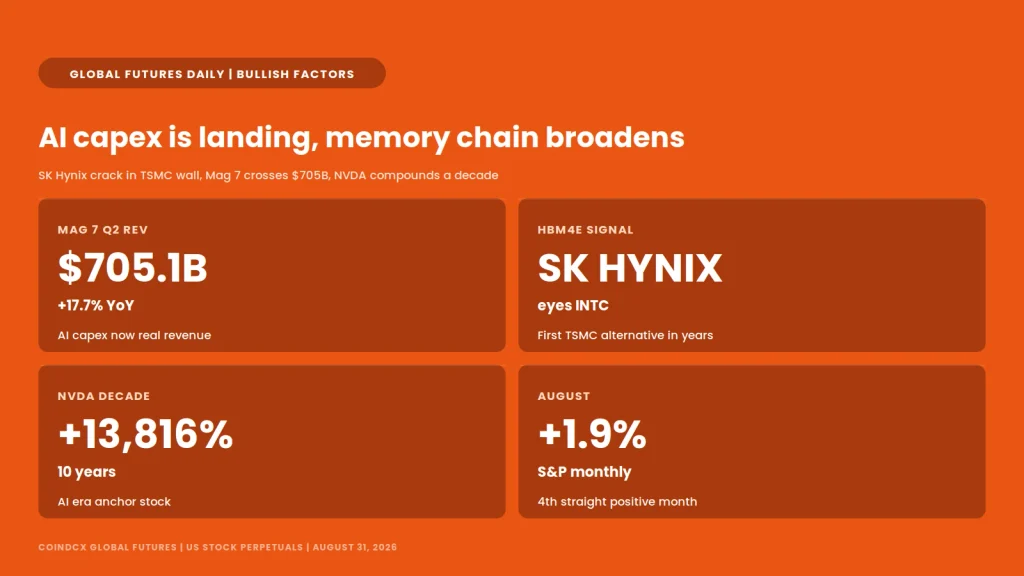
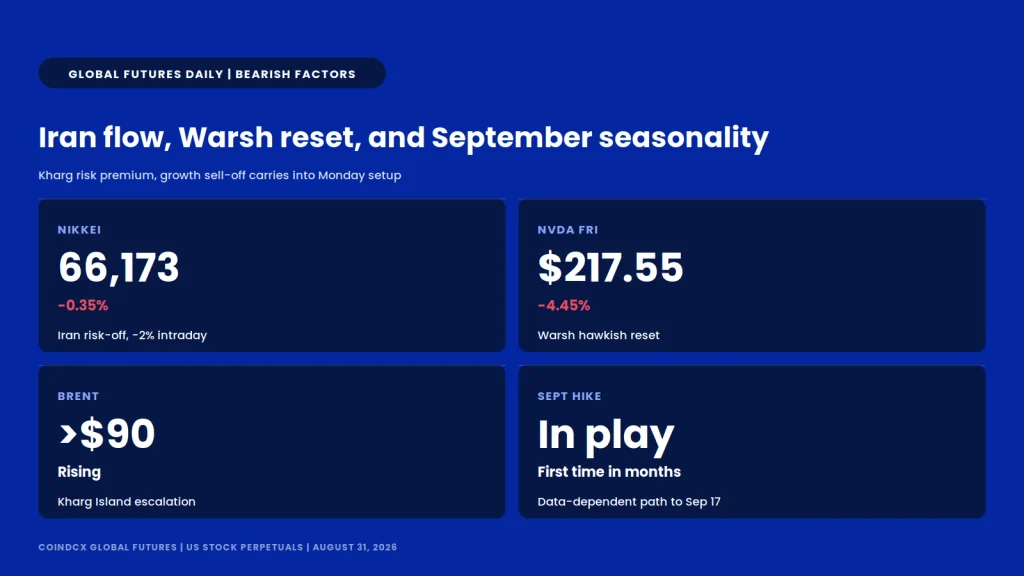
The tape is heading into September with two crosscurrents. Fed Chair Kevin Warsh’s Jackson Hole remarks reset expectations for a September rate hike, pushing the 10-year to 4.72% and taking growth names down Friday. Nasdaq shed 0.52%, NVDA lost 4.45%, and MRVL crashed 10.3% despite beating estimates and raising its outlook. The August print still held for the broader index, S&P 500 up 0.5% on the week and 1.9% on the month, but positioning has flipped from complacency to defense over 72 hours.
This morning brings Iran risk stacked on top. Trump posted AI-generated videos claiming Kharg Island under attack, US and Iranian forces traded fire near the Strait of Hormuz over the weekend, and Nikkei opened 2% lower before paring the loss to a 0.35% close. Brent trades above $90. The regime that breaks the setup is not Fed policy or an isolated growth reset. It is a confirmed strike on Iranian energy infrastructure that removes roughly 1.5 million barrels per day of crude from the market. That single tail is what every desk is monitoring today.
Bullish Factors
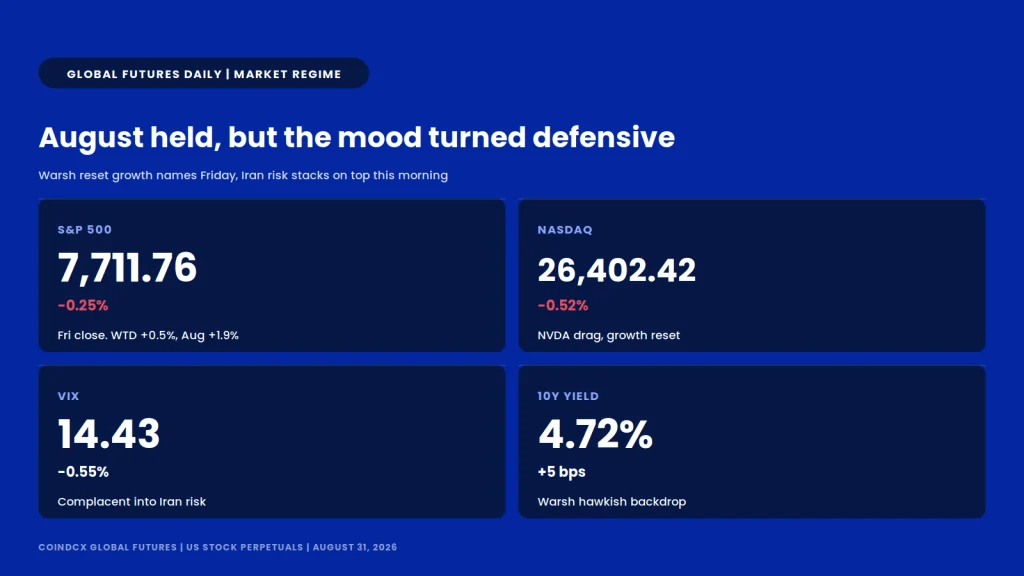
- Mag 7 Q2 revenue crossed $705 billion, up from $599 billion a year ago. Combined revenue growth of 17.7% year over year. AI capex spending is now translating into recognized revenue at the seven biggest tech names, not just guidance.
- SK Hynix considering Intel Foundry for HBM4E base dies. First TSMC alternative for advanced memory packaging in years. Multi-vendor strategy strengthens SK Hynix’s pricing hand and gives Intel Foundry its biggest anchor customer signal since the 18A ramp. INTC upside on the read.
- NVDA up 13,816% over the past ten years. Nvidia sits at $217.55 as of Friday close, one of the biggest single-stock compounders in modern market history. The decade print is the anchor number for every AI trade retail is looking at.
- August held. S&P 500 gained on the month even with Friday’s dip. Fourth straight positive month. Setup into a historically weak September is not as bad as it could be.
- Cook to Ternus handover is clean. Ternus is an internal succession, no surprise, engineering-first CEO for the AI product cycle. Market has had four months to price this since the April 20 announcement.
Bearish Factors
- Trump Kharg Island post. Trump shared two AI-generated videos claiming Iran’s Kharg Island being blown to smithereens. No confirmed strike on energy infrastructure yet, but US did hit Iranian rocket launchers on Larak Island Sunday and Iran retaliated Monday morning. Kharg handles 90% of Iran’s crude exports.
- Nikkei down $150 billion intraday. Japan tech got the hardest hit. Advantest down 7.09%, Disco down 4.75%, Ibiden down 3.94%, Murata down 4.31%. Direct read-across for AI supply chain names on US markets when they open at 7:00 PM IST.
- Warsh hawkish. Fed chair comments at Jackson Hole reset expectations. A September rate hike is being priced for the first time in months. 10-year rose to 4.72%.
- NVDA down 4.45% Friday. Growth names took the harder hit into the weekend. Nasdaq lagged the S&P by nearly double. Post-Warsh drift heading into a September FOMC where a hike is now live.
- September seasonality. Historically the weakest month for stocks. This September lands with rate policy, Iran, and a mega-cap CEO transition all in the same 30-day window.
Asian Markets This Morning
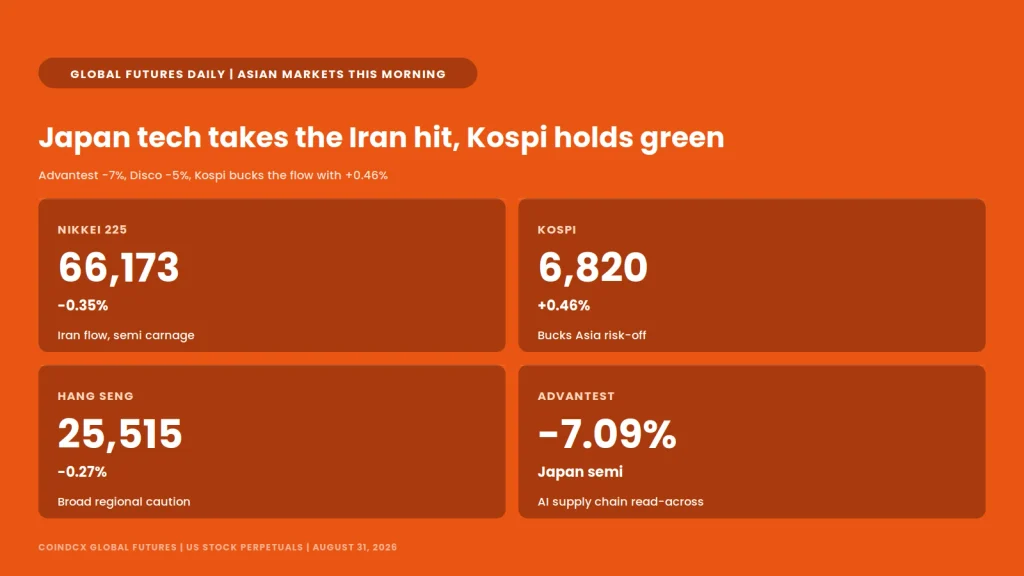
Nikkei 225 closed at 66,173, down 0.35%. Intraday sell-off was steeper, over $150 billion in market cap wiped at the open before the index pared into the session. Japan tech led the pressure. Advantest fell 7.09%, Disco fell 4.75%, Ibiden fell 3.94%, Murata dropped 4.31%, and Tokyo Electron declined 3.75%. Hong Kong’s Hang Seng closed at 25,515, down 0.27%. South Korea’s Kospi held into positive territory at 6,820, up 0.46% for the day, one of the few Asia benchmarks green despite the Iran flow. Sensex and Nifty in India both opened lower on the same catalyst. Brent trades above $90.
What Moved Wall Street Today
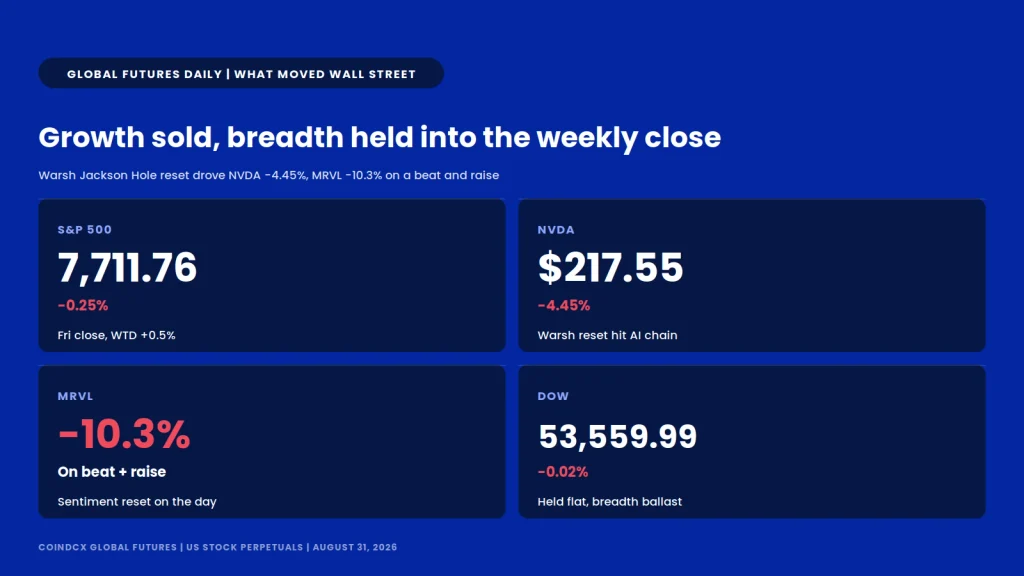
Wall Street closed Friday with growth names on the back foot. The S&P 500 shed 0.25% to close at 7,711.76. Nasdaq lagged, down 0.52% to 26,402.42, pushed lower by NVDA which fell 4.45% to $217.55 on Warsh’s Jackson Hole comments. The Dow ended nearly flat at 53,559.99, down 0.02%. VIX closed at 14.43, still complacent given the mood. MRVL was the day’s biggest single-stock story, down 10.3% despite beating estimates and raising its outlook. The week ended positive on the broad index though. S&P added 0.5% on the week, Nasdaq gained 0.9%, Dow climbed 0.5%. August closed as the fourth straight positive month for the S&P.
Assets in Focus
AAPL
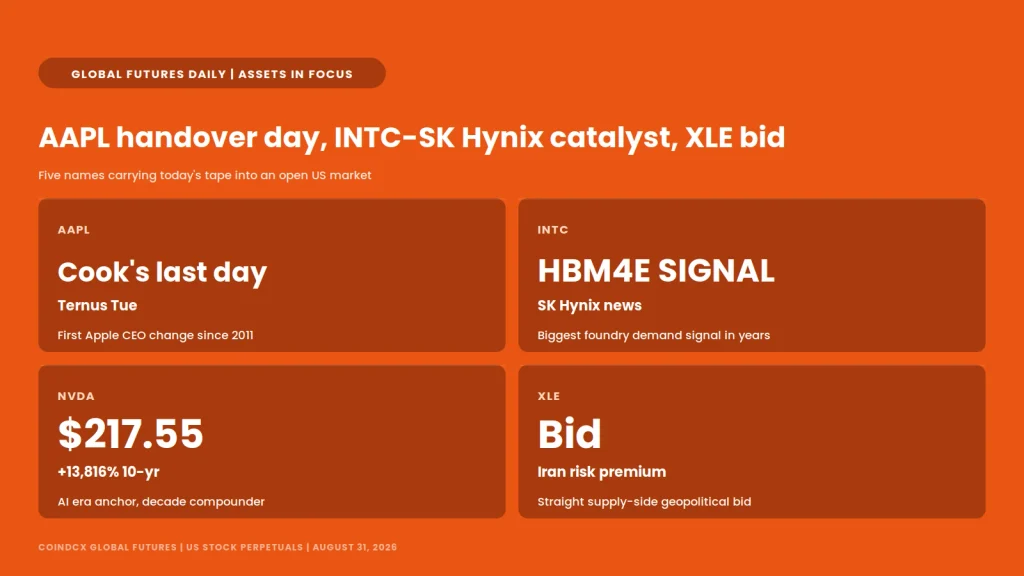
Today, August 31, is Tim Cook’s final day as CEO of Apple. John Ternus takes over Tuesday September 1, and Cook becomes executive chairman of the board. This is the first Apple CEO transition since 2011, when Cook took over from Steve Jobs. Apple has grown from roughly $350 billion in market cap at that handover to nearly $4 trillion today, a compounding rate few companies have ever matched. Ternus has been SVP of Hardware Engineering since 2013, led iPhone hardware, Vision Pro, and the M-series silicon transition away from Intel. The market absorbed the April announcement without drama and AAPL sits near record highs. The bigger question is not the handover mechanics but the AI narrative Apple needs to prove in Ternus’s first year at the top.
INTC
SK Hynix is reportedly considering Intel Foundry to make base dies for HBM4E, the seventh generation of high-bandwidth memory. Until now, SK Hynix has used only TSMC for outsourced base die production. Industry sources cited Monday August 31 indicate the plan could begin at the HBM4E generation itself. A multi-vendor strategy reduces SK Hynix’s supply chain concentration and gives it bargaining leverage on pricing with TSMC. For Intel Foundry, this is the biggest anchor customer signal since the 18A ramp. INTC has been rebuilding capacity and customer commitments for two years. This is a demand-side confirmation that the ecosystem is ready to move volume through Intel again. Read-across is positive for INTC, slightly negative for TSM on the memory line.
NVDA
Nvidia sits at $217.55 as of Friday close, up 13,816% over the past ten years. That is one of the biggest single-stock compounders in modern market history and the reference point for the entire AI capex thesis. Every AI trade retail looks at, from AMD to SMCI to MU, anchors back to Nvidia’s ability to translate demand into revenue. Friday was rough, down 4.45% on the Warsh Jackson Hole hawkish reset, and near-term setup is fragile heading into a September FOMC where a rate hike is being priced. But the ten-year frame is the number that carries into this week’s positioning. NVDA fiscal Q2 print last week showed revenue at $96.22 billion, up 106% year over year, with data center at $89 billion. Compute is revenue.
XLE
Energy is bid on the Iran escalation. XLE, the Global Futures index for US energy stocks, is the direct expression on the platform. Trump’s AI-generated Kharg Island video, combined with US strikes on Iranian rocket launchers Sunday and Iranian retaliation Monday morning, has pushed Brent above $90. Any confirmed strike on Iranian energy infrastructure would remove roughly 1.5 million barrels per day of crude, about 90% of Iran’s total exports. That single-catalyst risk premium is what XLE is pricing today. The move is not being driven by demand or refinery data. It is a straight supply-side geopolitical bid.
MU
Memory is the second-order read of the SK Hynix news. If SK Hynix diversifies HBM4E base die production away from TSMC-only, the whole memory chain gets a supply-side confidence lift heading into the 2027 build cycle. MU is the US-listed memory pure play and remains on the CoinDCX Global Futures Trending list. BofA had reiterated a Buy target of $200-250 for MU on a FY30 basis earlier in August, tied to the same HBM demand story that is now getting a supply reinforcement. The memory supercycle narrative that carried MU and SNDK through Q2 remains intact, and the SK Hynix news adds another data point to it.
Index Levels to Watch
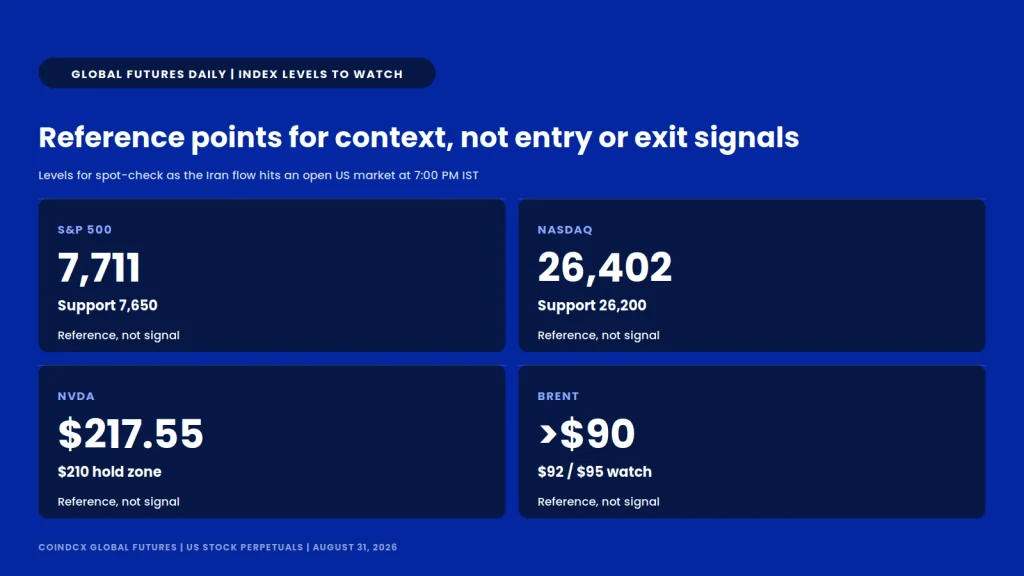
- S&P 500. Last close 7,711.76. Reference support at 7,650 and 7,600. Resistance at 7,750 and record highs above 7,800.
- Nasdaq. Last close 26,402.42. Reference support at 26,200 and 26,000. Resistance at 26,600 and 26,800.
- Nikkei 225. Currently 66,173. Reference support at 65,500. Resistance at 67,000.
- Brent Crude. Above $90. Reference watch at $92 and $95 on further escalation, $88 on de-escalation.
- NVDA. At $217.55. Reference at $210 hold, $220 reclaim, $228 breakout.
- AAPL. Near record highs. Reference at Friday close as the pivot for the Tuesday handover session.
Disclaimer
This blog is for informational purposes only and does not constitute investment advice. The information provided is based on publicly available data and is subject to change without notice. Trading US stock perpetuals via CoinDCX Global Futures involves risk of loss. Past performance is not indicative of future results. Please consult a SEBI-registered financial advisor before making any investment decisions.
Frequently Asked Questions
Q1. Is today Tim Cook's last day as Apple CEO?
Yes. August 31, 2026 is Tim Cook's final day as CEO of Apple. John Ternus takes over as CEO on Tuesday September 1. Cook transitions into the executive chairman role on Apple's board of directors.
Q2. What did Trump post about Iran's Kharg Island?
Trump shared two AI-generated videos on Truth Social claiming Iran's Kharg Island was being blown to smithereens. There is no confirmed strike on Iranian energy infrastructure as of this writing. US Central Command did strike Iranian rocket launchers on Larak Island near the Strait of Hormuz on Sunday, and Iran retaliated Monday morning. Kharg Island handles roughly 90% of Iran's crude exports, about 1.5 million barrels per day.
Q3. Why did the Nikkei fall today?
Japan's Nikkei 225 opened lower and traded over 2% down intraday before paring the move to a 0.35% loss at close. The sell-off was driven by renewed US-Iran strikes over the weekend and concern about energy supply disruption. Japan tech got the hardest hit. Advantest fell 7.09%, Disco fell 4.75%, Ibiden fell 3.94%. AI supply chain names were the natural expression of the Iran flow into Asia tech.
Q4. What is SK Hynix planning to do with Intel Foundry?
According to industry sources cited August 31, SK Hynix is considering Intel Foundry as a second manufacturer for HBM4E base dies, the seventh generation of high-bandwidth memory. Until now, SK Hynix has used TSMC exclusively for outsourced base die production. The move would diversify supply and strengthen SK Hynix's bargaining position on pricing. Manufacturing could start at the HBM4E generation itself.
Q5. When is the September Fed meeting and NFP release?
The September FOMC meeting is scheduled for September 17, 2026. Fed Chair Kevin Warsh's Jackson Hole remarks on August 28 reset expectations toward a possible rate hike. Nonfarm Payrolls for August will release Friday September 4 at 6:00 PM IST and are the biggest catalyst of the week ahead of FOMC.