

Anthropic filed its S-1 on October 26, 2026, and the numbers pulled in two directions: revenue up about 14x in a year, and an $80.7B net loss on paper. This guide separates what the filing confirms from what the press has reported, and lists what to check before the IPO prices.
Anthropic IPO at a glance
| Key detail | Status |
| Has Anthropic filed? | Yes. The public S-1 was filed on October 26, 2026. |
| Ticker and exchange | “ANT” on the Nasdaq Global Select Market (applied for) |
| IPO date | Not confirmed in the filing. Press reports point to mid-November. |
| Price range and share count | Not yet disclosed |
| Valuation | Reported at $1.5T to $2T. This is press reporting, not offering terms. |
| Size of the raise | Reported at up to $100B. Also not an offering term yet. |
| Can you buy it today? | No. The company is still private. Trading starts only after listing. |
The S-1 is a preliminary prospectus. It says the information in it is incomplete and may change.
What is an S-1, and what has Anthropic actually confirmed?
An S-1 is the registration statement a company files with the US Securities and Exchange Commission (SEC) before a public offering. It covers the business, the financials, who controls the company and the risks. A filing does not mean shares are trading, and the SEC does not endorse the offering.
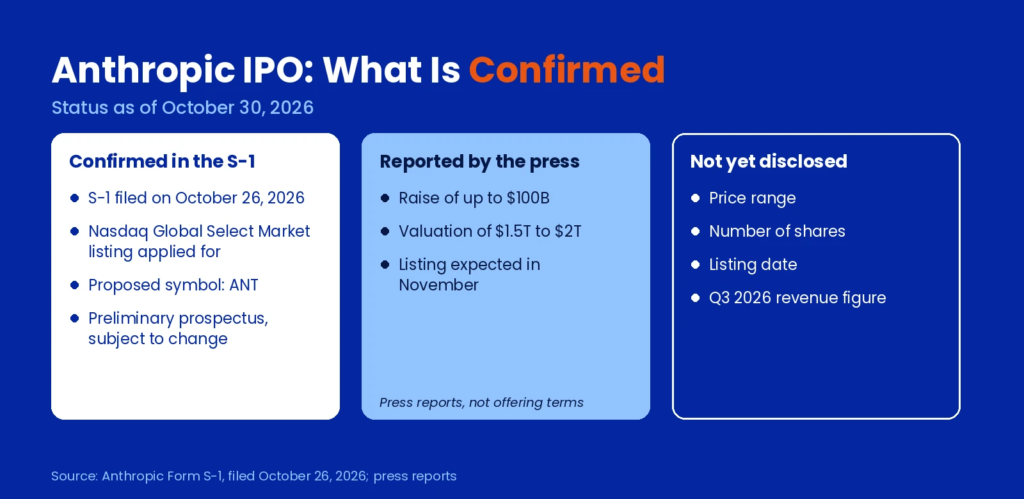
The $1.5T to $2T valuation, the raise of up to $100B and the mid-November date all come from press reports. A valuation is not a share price. You need both the offer price and the share count to work one out from the other.
The numbers that matter, and how to read them
Seven figures from the filing do most of the work. For each one, the table says what it shows and what to watch next.
| Number | What it shows | How to read it | What to watch next |
| $16.3B H1 2026 revenue, about 14x the $1.2B in H1 2025 | How fast it is growing | A valuation at listing will price in more growth. The filing says past growth does not predict future growth. | Q3 2026 revenue, which this draft leaves blank |
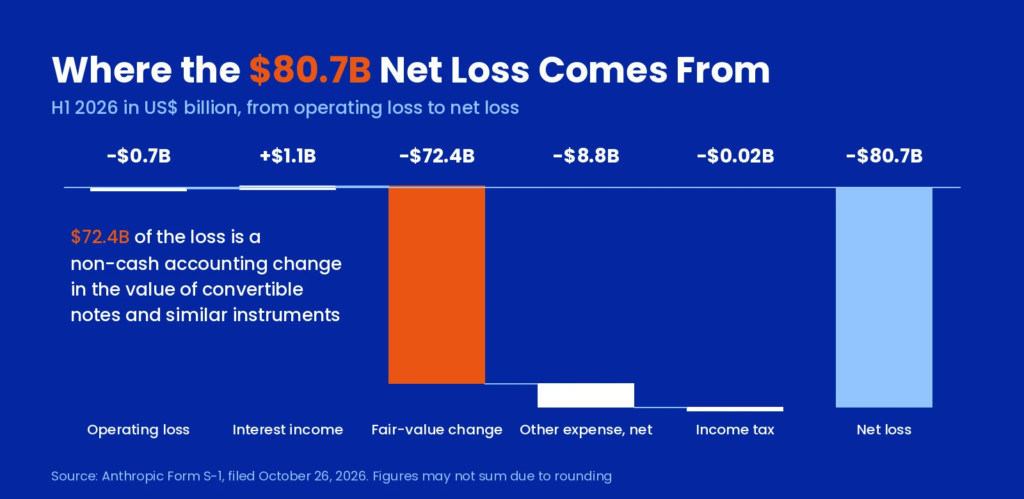
| $8.9B compute and infrastructure cost, about 55% of H1 revenue | The biggest cost line | Revenue grew 1,368% in the June quarter. Compute costs grew 300%. Costs are rising slower than sales, but they are still the largest expense. | Whether that gap holds as new capacity arrives |
| $693M operating loss vs $80.7B net loss | Business results vs accounting | $72.4B of the net loss is a non-cash change in the fair value of notes and similar instruments. It is not cash spent. | Pro forma results once the notes convert at the IPO |
| Q2 2026 operating profit | The direction of travel | Press analysis of the S-1 shows a Q1 loss and a Q2 profit, about $974M by one analyst’s count. H1 as a whole is still a $693M operating loss. | Whether Q3 stays profitable |
| $131.7B cash and short-term investments (June 30, 2026) | Liquidity | A large cushion, but compute commitments are larger (see below). | The full commitment schedule |
| $542B to $567B future compute commitments, as tallied by Fortune | The size of the bills ahead | The S-1’s own total is blank in this draft. Press totals differ by what they count. | How revenue growth covers these costs |
| About 25% of 9-month 2026 revenue came from five customers | Customer concentration | No single customer was above 10%, per Yahoo Finance’s read of the filing. | Changes in this share in later filings |
Figures are from the S-1 unless a source is named. “H1” means the six months ended June 30.
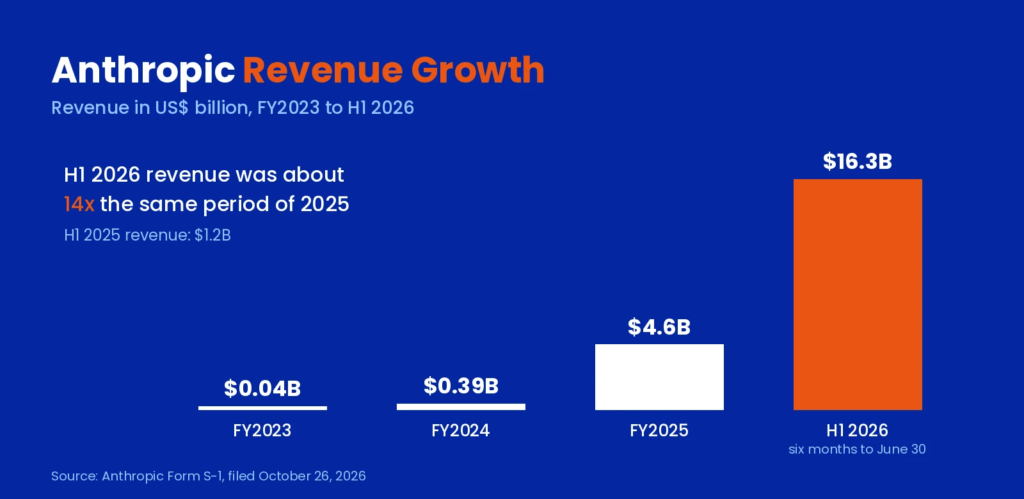
Anthropic’s financials, FY2023 to H1 2026
| US$ million | FY2023 | FY2024 | FY2025 | H1 2025 | H1 2026 |
| Revenue | 41 | 386 | 4,585 | 1,163 | 16,286 |
| Compute and infrastructure | 433 | 2,522 | 7,326 | 2,334 | 8,945 |
| Total operating expenses | 592 | 3,366 | 12,645 | 3,298 | 16,979 |
| Operating loss | -551 | -2,980 | -8,060 | -2,135 | -693 |
| Net loss | -1,531 | -8,309 | -41,965 | -12,969 | -80,748 |
| Adjusted operating income (non-GAAP) | -522 | -2,788 | -4,854 | -1,849 | 1,618 |
Source: Anthropic S-1. FY2025 expenses include a $1.5B settlement the filing calls the Bartz settlement. Adjusted operating income is a non-GAAP measure that the company defines and reconciles in the filing.
H1 2026 revenue was about 14x the same period of 2025. Full-year 2025 was about 12x 2024. Operating expenses of $17.0B were just above revenue of $16.3B, which gives the $693M operating loss. On the company’s adjusted basis, H1 2026 shows $1.6B of income, a 10% margin.
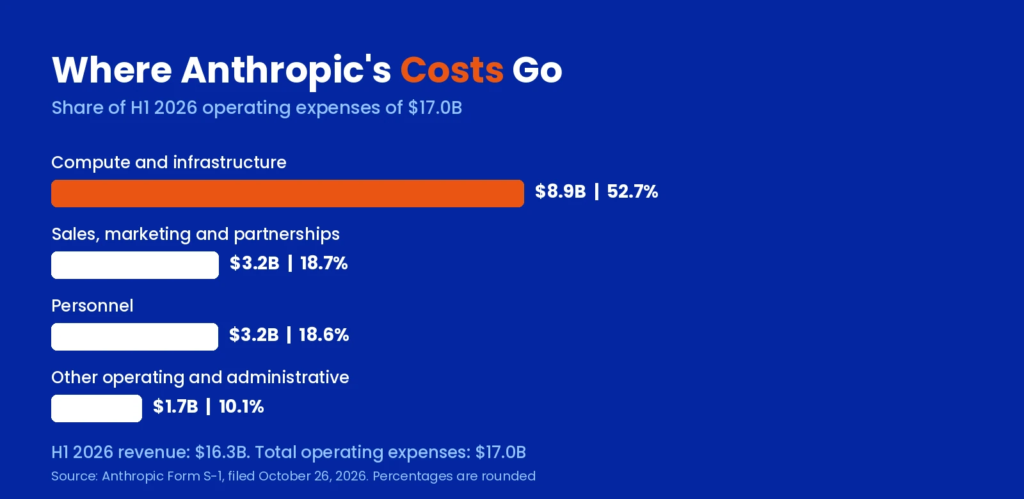
Why is the net loss $80.7B?
Most of it is not cash. $72.4B is a change in the fair value of convertible notes, derivative liabilities and simple agreements for future equity (SAFEs). The filing links this mainly to a higher company valuation, which raises what those instruments are worth on paper.
Two shortcuts are wrong. Calling the whole loss cash burn overstates the problem. Treating the positive adjusted operating income as profit overstates the other way, because the GAAP result is a net loss.
Balance sheet
On June 30, 2026, Anthropic held $131.7B in cash, cash equivalents and short-term investments. It has raised $141.1B in total. It also showed an accumulated deficit of $132.9B and a stockholders’ deficit of $127.6B. The deficit largely reflects how redeemable convertible preferred stock is carried outside permanent equity until it converts at the IPO.
The compute bill: the number the S-1 leaves unclear
The biggest question in the filing is not revenue. It is how Anthropic pays for the computing power it has promised to buy. In this draft, the contractual obligations table has its total left blank, so outside tallies differ.
- What the filing says: it estimates $125B to $150B of further compute payments that sit outside the obligations table.
- Fortune’s tally: $542B to $567B of future compute and infrastructure commitments.
- Higher tallies: other reports, including Axios, go as high as about $750B by counting leases and chip financing.
- Why they differ: some items are minimum payments, some are leases that have not started, and some depend on capacity coming online. Totals depend on what each outlet adds in.
The risk of filing names is simple. Anthropic says it must grow revenue fast to cover these commitments. Fortune also notes that Anthropic typically contracts for compute 12 to 18 months ahead, that customers can leave without long-term contracts, and that the filing warns new capacity will squeeze margins.
For readers tracking the IPO, this is the number to watch. Until the filing is amended, treat any single total as an estimate.
What Anthropic does, and the case for and against
Anthropic was founded in 2021 and describes itself as a research lab first. It sells its Claude models through the Claude Platform for developers, Claude Code for coding and Claude Cowork for knowledge work. Claude is also sold through Amazon Web Services, Google Cloud and Microsoft Azure. Revenue is mostly pay-per-use, measured in tokens, with subscriptions making up about 20% of H1 2026 revenue.
The filing reports net revenue retention of about 900% as of September 30, 2026. That compares what existing customers spend now with a year ago, and it excludes consumer subscriptions.
| Factor | What supporters point to | What skeptics point to |
| Growth | Revenue about 14x in a year, with about 900% net revenue retention | Some analysts note growth is slowing from its peak and depends on new model releases |
| Profit | A Q2 2026 operating profit after a Q1 loss | A GAAP net loss of $80.7B in H1 2026 and a $693M operating loss for the half |
| Cash | $131.7B in cash and short-term investments | Compute commitments of $542B or more |
| Customers | More than 11,900 customers spending $100K or more | About 25% of 9-month revenue came from five customers, and customers can leave without long-term contracts |
| Supply | Three major clouds and several chip suppliers | Some cloud partners also build competing models, and compute is in tight supply |
| Safety and liability | A public benefit mission and a safety-first release process | The filing runs over 90 pages of risk factors, including catastrophic misuse and liability risks |
Sources for the table: Anthropic S-1, CNBC, Yahoo Finance, Fortune and Exponential View.
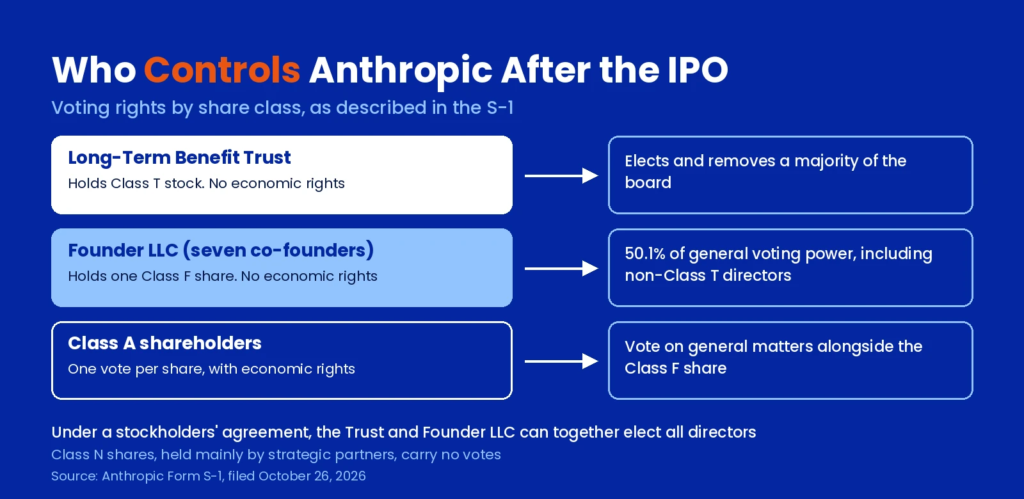
Who controls Anthropic after the IPO?
Anthropic is a Delaware public benefit corporation, so directors must weigh shareholder returns against a stated public benefit. Its share structure also differs from most listed companies.
- Long-Term Benefit Trust: five financially disinterested trustees hold the Class T share, which lets the Trust elect and remove a majority of the board.
- Founder LLC: the seven co-founders will hold one Class F share with 50.1% of general voting power.
- Class A shares: the class being offered, with one vote per share.
- Controlled company: Anthropic qualifies under Nasdaq rules, which allow some governance exemptions. It says it does not expect to use them, except for its nominating and corporate governance committee.
- Public benefit commitments: the company put shares equal to 5% of fully diluted shares into a public benefit fund. Each co-founder has pledged 80% of personal equity to philanthropy.
Anthropic IPO details and what to check next
| Item | Status |
| Filing date | October 26, 2026 |
| Exchange and symbol | Nasdaq Global Select Market, “ANT” (applied for) |
| Price range | Not yet disclosed |
| Number of shares | Not yet disclosed |
| Listing date | Not yet disclosed. Press reports say mid-November. |
| Lead underwriters | Goldman Sachs and Morgan Stanley, with J.P. Morgan, Citigroup, Barclays, Wells Fargo Securities and others |
| Retail allocation | Brokers that will receive retail shares have not been announced, per Yahoo Finance |
| Use of proceeds | Working capital, compute and infrastructure, hiring, possible acquisitions, and tax obligations on employee stock units |
The company does not receive proceeds from shares sold by selling stockholders. The S-1 also reflects a 10-for-1 forward split of Class A and Class N common stock on September 17, 2026.
What to check when the price range is filed
- The price range and share count. Together they give the implied valuation.
- How many shares are new and how many are sold by existing holders. New shares bring money to the company. Existing-holder sales do not.
- Q3 2026 revenue and the compute commitment totals, both blank in this draft.
- Lock-up terms, which decide when existing holders can sell.
- Any change to the governance terms above.
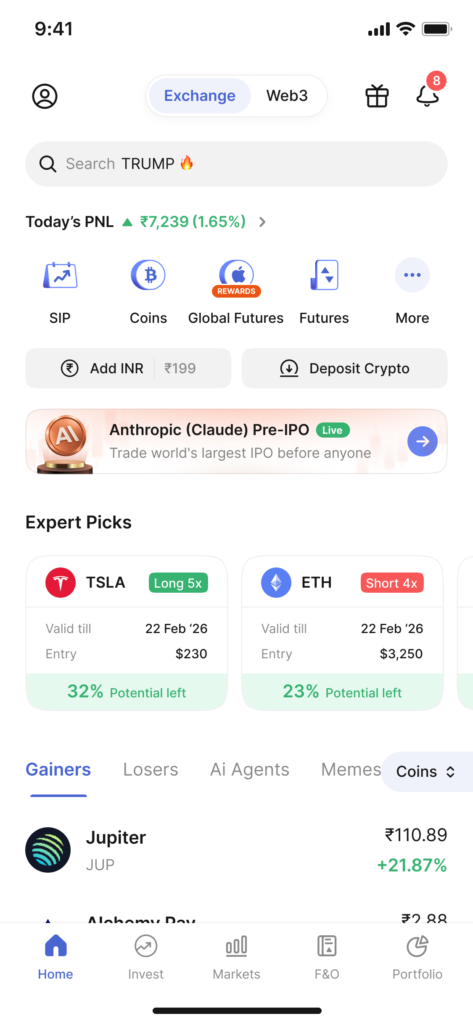
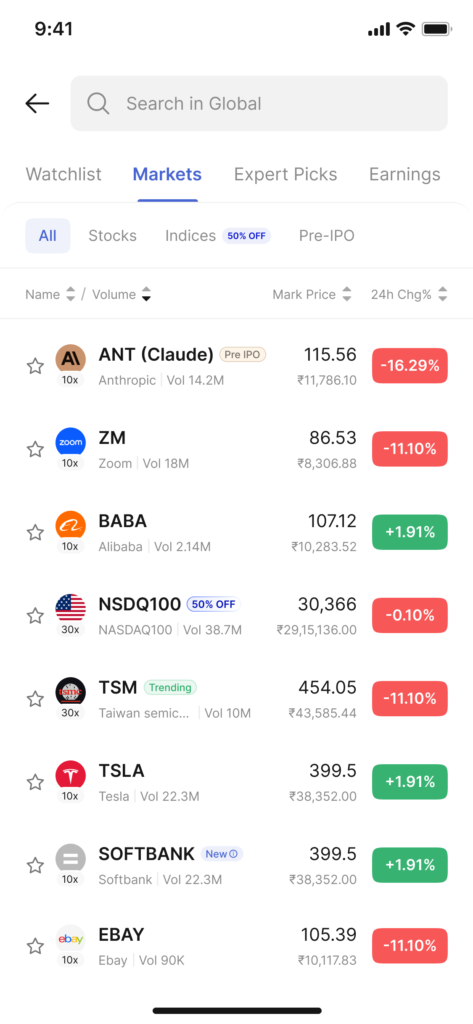
Trade Anthropic before it lists, only on CoinDCX Pre-IPO Futures.

What is a Pre-IPO contract?
A Pre-IPO contract is a futures (derivative) contract that tracks the expected price of a company’s shares before it lists on the stock market. You trade the contract’s price in INR instead of buying shares. It goes up or down with that price. It does not give you shares, shareholder rights or an IPO allotment. Derivative contracts, not shares.
Why Anthropic’s IPO is in focus
- Filed: Anthropic filed its public S-1 on 26 October 2026 to list on Nasdaq as “ANT”.
- Valuation: the last private valuation was $965B (Series H, May 2026). The IPO valuation is reported at around $1.5T.
- Size: the raise is reported at up to $100B, which would be the largest IPO on record.
- Growth: revenue rose from $386M in 2024 to a reported $16.8B in Q3 2026 alone. The Q3 figure is reported, not yet filed.
- Timing: pricing is expected around 19–20 November 2026. The price range is expected in an amended S-1 around 10 November. Dates are not official.
How to get exposure today
Anthropic Pre-IPO Futures are live on CoinDCX, with entry from ₹100 in INR.
- Open the CoinDCX app and complete KYC.
- Go to [Global Futures] and search “Anthropic Pre-IPO”.
- Add INR margin.
- Choose your position size, and leverage if applicable. Then place your order.
FAQs
1. What is a pre-IPO?
A pre-IPO is the stage before a company lists on a stock exchange. Its shares, also called unlisted shares, are held by founders, employees and private investors, and trade on no public market.
2. Is buying pre-IPO a good idea?
The risk of buying pre-IPO depends on your risk appetite. Prices can differ from the final IPO price, listings can be delayed or cancelled, and unlisted shares can be hard to sell. Understand the contract terms before you trade.
3. What is the difference between IPO and pre-IPO?
An IPO is when a company offers shares to the public and lists on an exchange. Pre-IPO is the stage before that. A pre-IPO contract gives price exposure only, with no shares or IPO allotment.
4. Can I buy shares pre-IPO?
Usually only through private deals or specialist intermediaries, with low liquidity and possible lock-in periods. For overseas listings, direct access is generally restricted for Indian retail investors. A pre-IPO contract instead lets you trade a company’s expected pre-listing price in INR, as a derivative, not shares.
5. When is the Anthropic IPO date?
Anthropic has not announced an IPO date. Media reports point to the week of November 19 or 20.
6. What is the Anthropic IPO price?
It has not been disclosed yet. The price range on the filing’s cover page is empty.
7. What is Anthropic’s ticker symbol?
Anthropic has applied to list on the Nasdaq Global Select Market under the ticker “ANT”. It would trade in US dollars once listed.
8. Can you buy Anthropic stock now?
You can trade Anthropic Pre-IPO Futures on CoinDCX, which are derivative contracts that track its expected price, not shares.
9. How much is Anthropic worth?
Press reports put the expected IPO valuation at $1.5T to $2T. The filing does not state a valuation, and the final IPO price will decide it.
Disclaimer
This article is for information only and is not investment advice. Figures come from Anthropic’s preliminary S-1 and press reports, and may change in later amendments. IPO investing and derivatives trading carry significant risk, including loss of capital. Read the official filing and speak to a qualified financial professional before you decide.