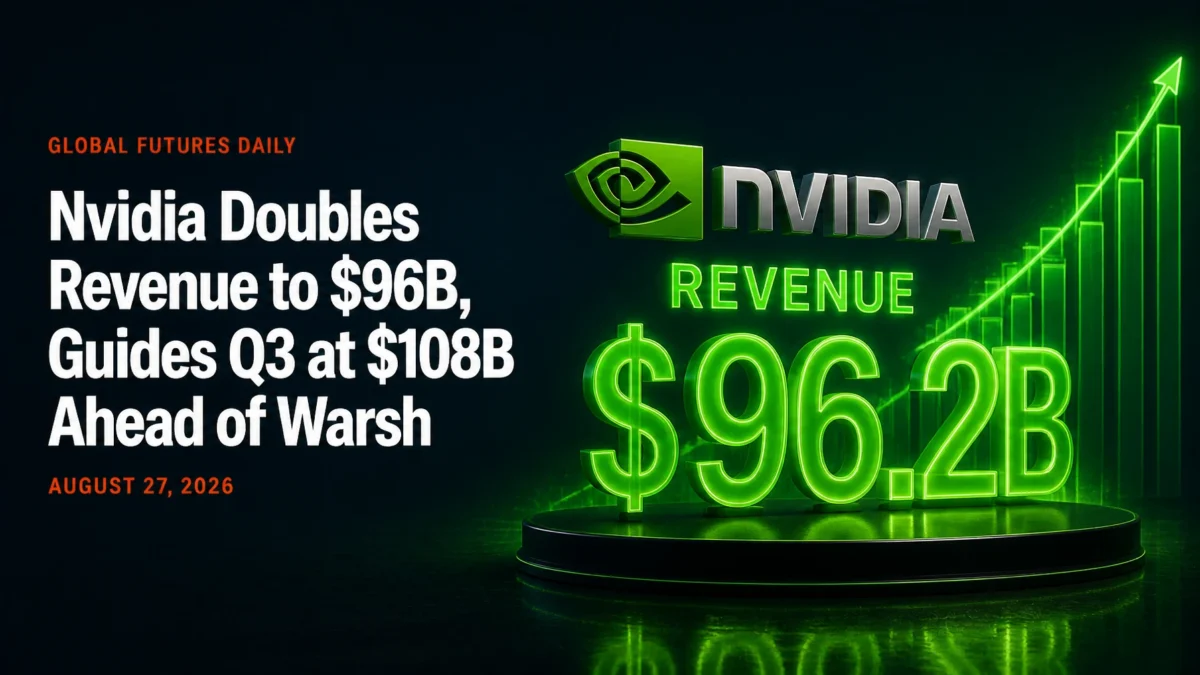


Nvidia doubled revenue to $96.2B in Q2 FY27, guided Q3 to $108B, projected 70% FY28 growth, and AWS confirmed 2M more GPUs. NVDA +6% premarket, Warsh Fri.
TLDR
Nvidia doubled quarterly revenue to $96.2 billion in fiscal Q2 2027, beat both revenue and EPS estimates for the 15th quarter in a row, and guided Q3 to $108 billion, roughly $3 billion above Wall Street consensus. CFO Colette Kress penciled in 70% revenue growth for all of fiscal 2028, calling that figure supply-constrained because underlying demand is running higher. AWS and Nvidia used the same window to announce a plan for two million more Blackwell Ultra, Rubin and Rubin Ultra GPUs on AWS in 2027 and 2028, on top of the one million pledged at GTC 2026. NVDA closed Wednesday down about 1%, its eighth losing day of the last nine, then jumped roughly 6% in Thursday premarket. Wall Street ended flat as sticky July core PCE kept September hike odds live and Fed Chair Kevin Warsh’s Jackson Hole keynote lands Friday 7:30 PM IST. Assets in focus: NVDA, AMZN, AMD, DRAM.
Market Regime
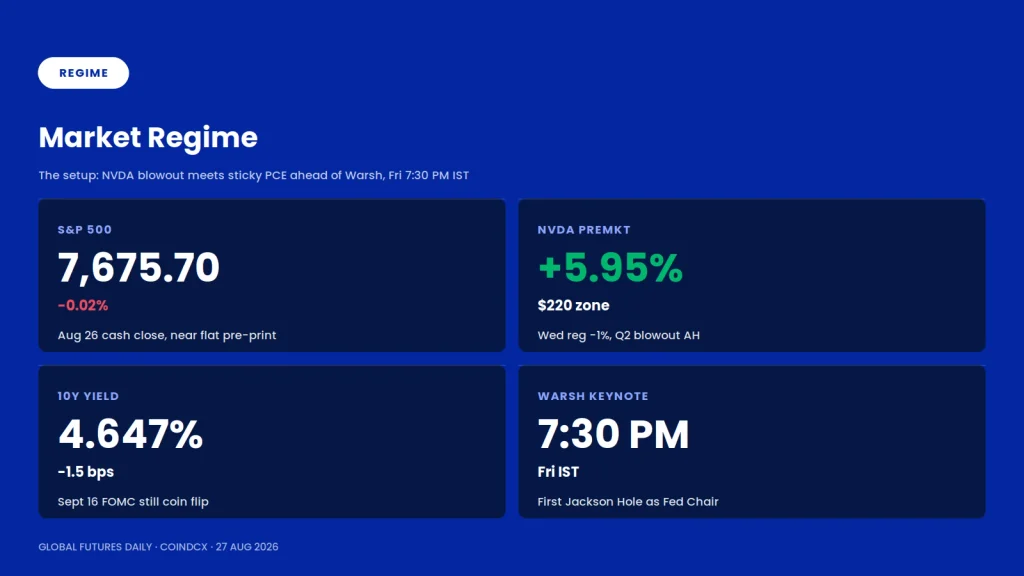
This was the make-or-break print for the AI trade and Nvidia cleared it on numbers, guidance and a headline partnership. Revenue of $96.22 billion beat the $92.07 billion consensus by 4.51%, non-GAAP EPS of $2.22 beat $2.09 by 6.29%, and Data Center revenue of $89.02 billion rose 117% year over year with hyperscale up 101.5% and AI clouds, industrial and enterprise up 138.1%. Jensen Huang framed the story as an inflection: AI has moved from research spend to billable output, tokens are productive and profitable, and, in his words, compute is now revenue. Stock reaction lagged the numbers into the print with NVDA slipping 1% Wednesday, its eighth losing session in nine, before the after-hours pop of nearly 5% widened to about 6% in Thursday premarket once Q3 guidance and the AWS deal landed.
What can still break it sits on the tape and the calendar. Kress guided Q4 fiscal 2027 gross margin to bottom at 71-72%, blaming memory prices, and said memory scarcity today is being driven in large part by the AI buildout itself. Wednesday’s July core PCE printed 0.2% month over month in line but the annual reading was firmer than expected, keeping the September 16 FOMC hike-cut question a live coin flip and the 10-year yield at 4.647% Thursday morning Asia with the 30-year still near 5.24%. The bigger calendar event lands Friday 7:30 PM IST when Fed Chair Kevin Warsh delivers his first Jackson Hole keynote, having flagged that the speech will frame the big questions rather than give near-term policy guidance. Between here and there, Wall Street cash reopens tonight 7:00 PM IST with NVDA futures pointing sharply higher and the rest of the tape trying to piggyback.
Bullish Factors
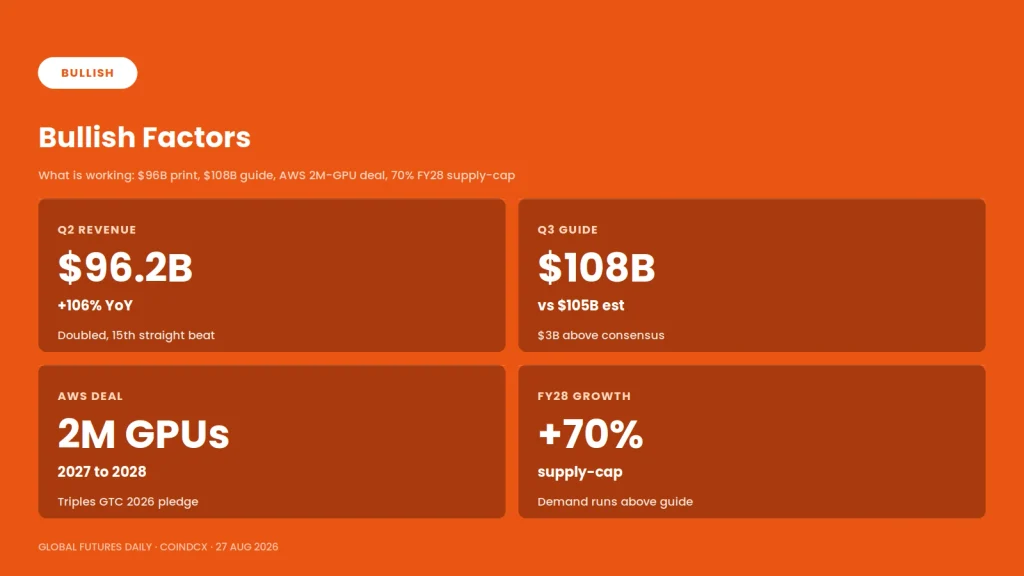
- Revenue doubled year over year to $96.2 billion, up 18% quarter over quarter and roughly $60 billion in net income for the quarter, which sits at or near the most profitable quarter any US listed company has ever posted excluding one-off accounting gains.
- Q3 fiscal 2027 revenue guidance $108 billion, about $3 billion above the $104.9 billion consensus and implying roughly $12 billion of quarter-on-quarter growth, all despite the guide continuing to exclude any China data center sales.
- AWS and Nvidia announced two million additional Blackwell Ultra, Rubin and Rubin Ultra GPUs in 2027-2028, tripling the one million GPU commitment made at GTC 2026 in less than six months, plus Vera CPUs going into Amazon’s Trainium racks and 100,000 GPUs earmarked for US government AI factories.
- Kress penciled fiscal 2028 revenue growth at approximately 70%, described as supply-constrained, meaning underlying demand is running above that number. Vera Rubin, the next-generation platform, is now in full production.
Bearish Factors
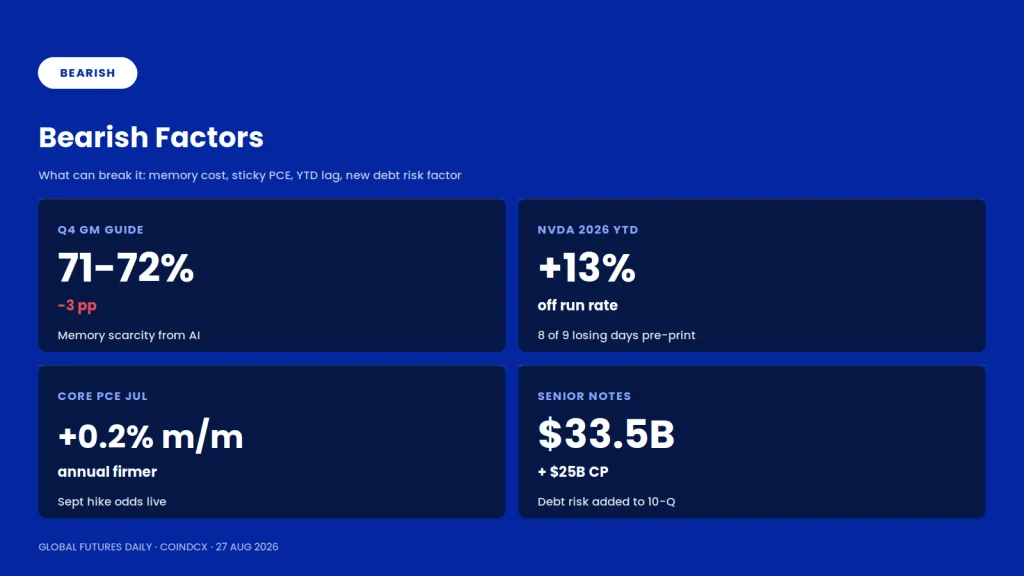
- Q4 fiscal 2027 gross margin guided to bottom at 71-72% versus 75.0% this quarter, with Kress attributing the drop to memory prices and noting that memory scarcity today is being driven in large part by the AI buildout itself. Signals broader margin pressure across the AI hardware stack.
- Sticky July core PCE. Headline monthly at 0.2% topped consensus and core matched at 0.2% in line, but annual readings were firmer than expected. September 16 FOMC hike odds remain a coin flip and Warsh’s Friday keynote could shift the range in either direction without warning.
- NVDA up just about 13% year to date 2026 heading into the print, well off the monster gain trajectory of recent years, and Wednesday’s session was its eighth losing day of the last nine as investors pulled forward the earnings-day playbook.
- Nvidia’s 10-Q added indebtedness as a risk factor with $33.5 billion in senior notes outstanding as of July 26 and a $25 billion commercial paper program, cautioning that rising obligations could adversely affect financial condition and cash flows. Balance sheet risk is now on the disclosure page.
Asian Markets This Morning
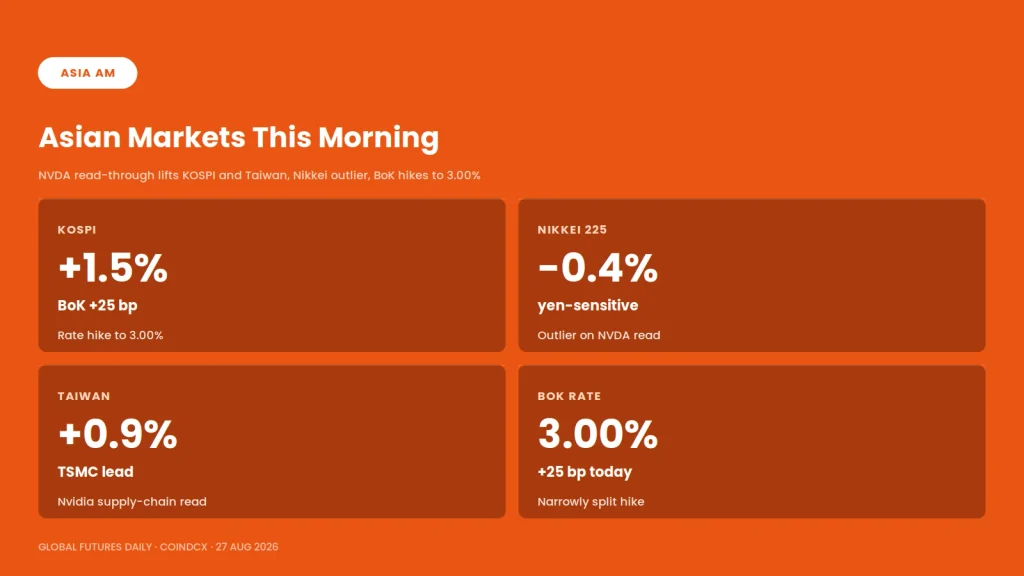
Asia opened green on the Nvidia read-through, with KOSPI +1.5% paring earlier gains after Bank of Korea raised the benchmark rate by 25 basis points to 3.00%, in line with a narrowly split market view. Taiwan added 0.9% on strength in TSMC and Advantest as direct Nvidia supply-chain reads, and MSCI’s broadest index of Asia-Pacific shares outside Japan opened positive. Nikkei 225 was the outlier at -0.4%, giving back some of its recent run and dragged by yen-sensitive exporters, though tech names within the index tracked higher. Hang Seng opened firmer on the AI hardware read into Chinese memory and semi names, keeping the CXMT-BABA-linked complex active as a read-through beneficiary.
What Moved Wall Street
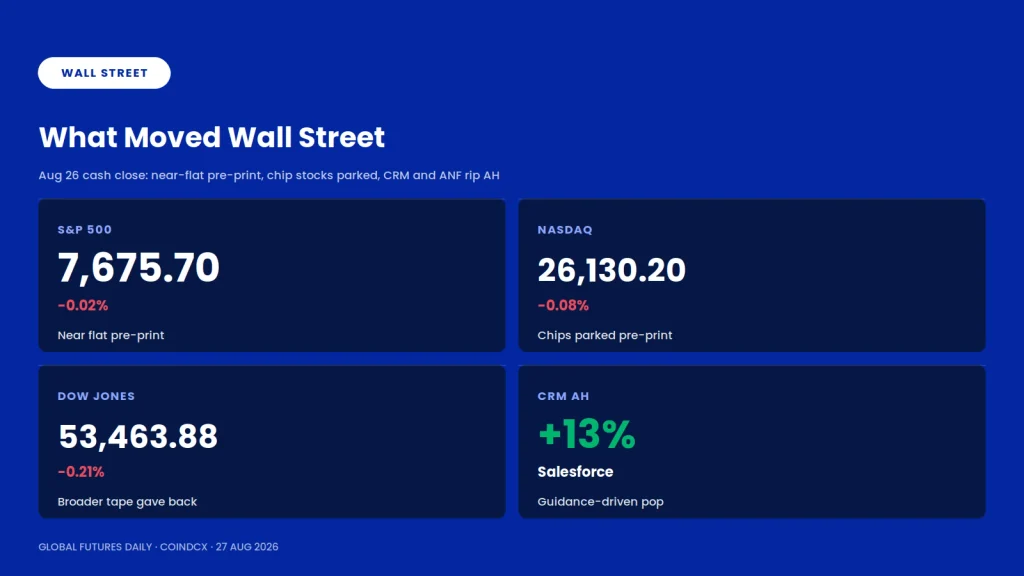
Wednesday cash close was near-flat ahead of the Nvidia print. S&P 500 shed 0.02% to 7,675.70, Nasdaq Composite eased 0.08% to 26,130.20 and Dow lost 113.52 points or 0.21% to 53,463.88. The 10-year yield ticked to around 4.63% after July core PCE landed at 0.2% month over month, in line with expectations, but firmer than hoped on the annual print. WTI crude closed under $83 as Iran-Oman Hormuz talks eased the tail-risk premium, keeping oil off recent highs. After the bell, Salesforce added roughly 13% on better-than-expected forward guidance, Abercrombie & Fitch rallied double digits after a Q2 beat and guidance raise, and Nvidia widened to about +5% in after-hours and about +6% in Thursday premarket after the earnings call and AWS announcement. Dow futures added around 180 points overnight, tracking the Nvidia halo.
Assets in Focus
NVDA
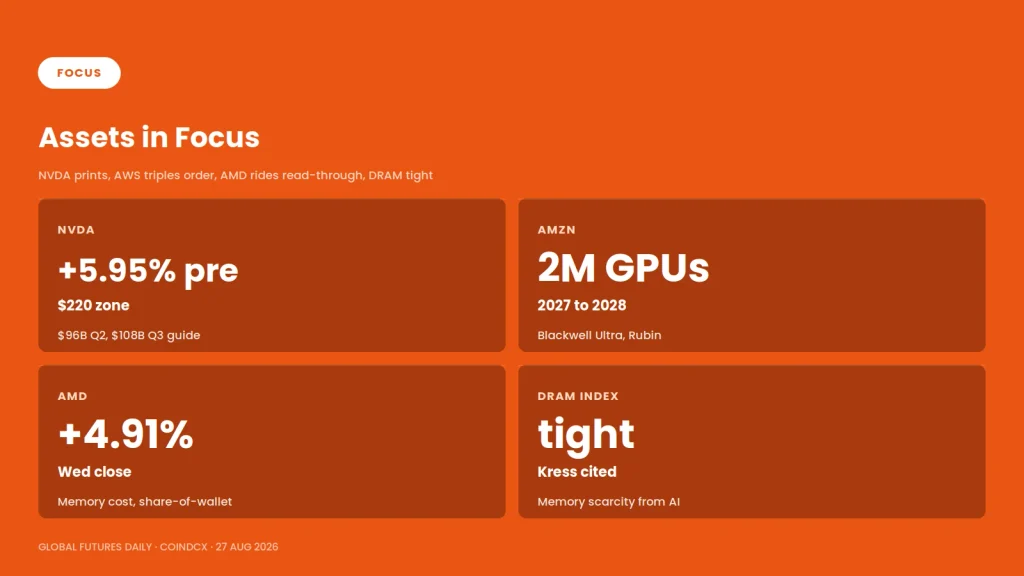
Fiscal Q2 2027 was Nvidia’s biggest quarter on record. Revenue $96.22 billion up 106% year over year and up 18% quarter over quarter. GAAP EPS $2.46 up 128% year over year, non-GAAP EPS $2.22 up 6.29% versus $2.09 consensus. GAAP operating income $63.7 billion up 124%. Gross margin 75.0% GAAP and non-GAAP. Data Center revenue $89.02 billion up 117%, split between hyperscale at $48.71 billion and AI clouds, industrial and enterprise at $40.31 billion up 138.1%. Q3 revenue guidance $108 billion versus roughly $104.9 billion consensus. Fiscal 2028 revenue growth guide approximately 70%, described as supply-constrained. $26 billion returned to shareholders in the quarter. $18 billion of equity investments planned for the balance of fiscal 2027. NVDA closed Wednesday down about 1%, then traded roughly 6% higher in Thursday premarket, testing the $220 zone. Available on the CoinDCX Global Futures app.
AMZN
AWS and Nvidia used the earnings call window to announce a plan to deploy 2 million additional Nvidia GPUs across AWS’s global infrastructure in 2027 and 2028, covering the Blackwell Ultra, Rubin and Rubin Ultra generations. AWS had already consumed the 1 million GPU commitment from GTC 2026 and demand continued to run ahead of expectations. The deal also puts Nvidia Vera CPUs and NVLink Fusion with custom memory inside Amazon’s Trainium racks, tying Nvidia’s interconnect architecture directly into AWS’s custom silicon stack, and reserves 100,000 GPUs for US government AI factories. The size and speed of the expansion is the read for hyperscaler capex durability into 2027-2028 and directly supports Nvidia’s 70% fiscal 2028 growth guide. Available on the CoinDCX Global Futures app.
AMD
Nvidia’s own 10-Q identified competition from AMD, Google and others as a watched risk factor even inside a blowout print, and AMD closed Wednesday +4.91% ahead of the read. The read-through for AMD is two-way. Positive: hyperscaler AI capex is running well ahead of the pace priced in six months ago, and any allocation Nvidia cannot fill sits with AMD’s Instinct line as the closest substitute. Negative: memory pricing pressure that Kress flagged for Q4 fiscal 2027 gross margin hits every AI accelerator design, not just Nvidia’s, and AMD is exposed on the same front. Traders will watch how much of the AWS-Nvidia announcement shifts share-of-wallet expectations for the 2027-2028 window. Available on the CoinDCX Global Futures app.
DRAM Index
Kress’s line that memory scarcity today is being driven in large part by the AI buildout itself is the most useful trade of the print for retail. The DRAM index has been a memory-cycle proxy through the SNDK, Micron and SK Hynix run of the last two months, and Nvidia’s Q4 fiscal 2027 gross margin guide of 71-72% bottoms because of memory pass-through cost. That guide effectively confirms sustained tight supply into calendar Q1 2027. The DRAM index remains the cleanest tradable read of that memory scarcity thesis on the CoinDCX Global Futures app.
Index Levels to Watch
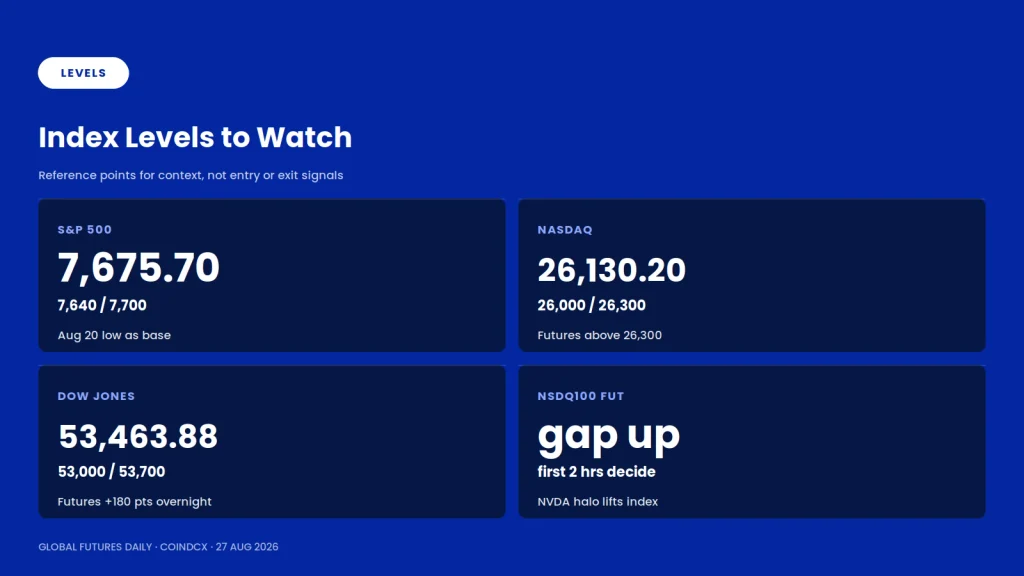
- S&P 500: 7,675.70 close, next reference points 7,700 upper and 7,640 lower, with the Aug 20 low of 7,641.16 as the recent support base.
- Nasdaq Composite: 26,130.20 close, reference range 26,000 lower and 26,300 upper, with premarket futures pointing above 26,300 on the Nvidia gap-up.
- Dow Jones Industrial Average: 53,463.88 close, reference points 53,000 lower and 53,700 upper, futures adding roughly 180 points overnight.
- NSDQ100 futures: pointing sharply higher on the Nvidia print, the level to watch is whether the gap-open holds through the first two hours of US cash tonight.
Disclaimer
Cryptocurrency and equity derivatives investments are subject to market risks. Please read all related documents carefully. This blog is intended for informational purposes only and does not constitute investment advice or a recommendation to buy, sell or hold any asset. Past performance is not indicative of future results. The reference levels in this blog are provided as context for market discussion, not as trade entry or exit signals. CoinDCX and its affiliates are not liable for any losses arising from the use of this information.
Frequently Asked Questions
Q1. Did Nvidia beat Q2 fiscal 2027 estimates?
Yes. Nvidia reported revenue of $96.22 billion versus $92.07 billion consensus, a 4.51% beat, and non-GAAP EPS of $2.22 versus $2.09 consensus, a 6.29% beat. This was the 15th consecutive quarter Nvidia has beaten Wall Street estimates.
Q2. What is Nvidia's Q3 revenue guidance?
Nvidia guided Q3 fiscal 2027 revenue to approximately $108 billion, above the roughly $104.9 billion Wall Street consensus. The guide continues to assume zero data center AI chip sales to China.
Q3. What is the AWS and Nvidia GPU deal?
AWS and Nvidia announced a plan to deploy 2 million additional Nvidia Blackwell Ultra, Rubin and Rubin Ultra GPUs across AWS infrastructure in 2027 and 2028. This tripling of the earlier 1 million commitment from GTC 2026 also includes Nvidia Vera CPUs going into Amazon's Trainium racks and 100,000 GPUs for US government AI factories.
Q4. Why is Nvidia stock rising in premarket Thursday?
NVDA jumped roughly 6% in Thursday premarket after the fiscal Q2 2027 print beat on revenue and EPS, guidance for Q3 came in about $3 billion above consensus, Kress projected 70% revenue growth for all of fiscal 2028 as supply-constrained, and AWS confirmed a 2 million additional GPU deployment for 2027-2028. Regular Wednesday close was down about 1% ahead of the print.
Q5. What did Nvidia say about memory prices?
CFO Colette Kress guided Q4 fiscal 2027 gross margin to bottom in the 71-72% range, down from 75.0% this quarter, and attributed the drop to memory prices, saying memory scarcity today is being driven in large part by the AI buildout itself.
Q6. What is Fed Chair Warsh speaking about at Jackson Hole Friday?
Fed Chair Kevin Warsh delivers his first Jackson Hole keynote on Friday at 7:30 PM IST. He has said the speech will frame the big questions on the Fed's future path rather than give near-term policy guidance, so it is being watched for tone and range of scenarios rather than a signal on the September 16 FOMC decision.