


INJ rose about 8% and is still climbing, closing 4.67% higher at $5.96 and reclaiming its 200-day average for the first time in months. The price surge comes after an Injective affiliate registered with the US Securities and Exchange Commission as a transfer agent, giving it the legal standing to keep official ownership records for tokenized securities. The registration covers a recordkeeping business, not the INJ token itself.
What the SEC Transfer Agent Registration Permits
Injective Institutional Services, an affiliate of the Injective ecosystem, became a registered transfer agent on 19 August after applying in July. A transfer agent keeps the official record of who owns a security, updates it when ownership changes, and handles distributions and corporate actions.
The function sounds administrative and is anything but. In US securities markets that record is the legal answer to who owns what, which puts the role at the centre of settlement and investor rights.
Why This Matters for Tokenized Assets
Tokenized securities have carried an awkward split since they first appeared. The blockchain records a transfer, but the legally authoritative ownership record has usually sat in a separate database run by a regulated intermediary, leaving two versions of the truth to reconcile.
SEC staff have said a registered transfer agent may use distributed ledger technology as its official master securityholder file, provided the requirements are met. That is what makes this registration useful: the on-chain record can become the authoritative one rather than a pointer to a database somewhere else.
The registration extends Injective’s push into real-world assets, including the trade receivables pilot with POSCO International and LG CNS covered in our earlier report on the Injective trade finance pilot. Tokenized real-world assets on public blockchains reached roughly $31 billion by July.
What the SEC Registration Does Not Cover
While the SEC has registered an affiliate to perform a recordkeeping function, it has neither approved the INJ coin, nor endorsed the Injective blockchain. A transfer agent registration is permission to do a specific job, not a verdict on anything else.
The claim of being first also needs qualifying. Injective describes itself as the first Layer 1 blockchain holding both the real-world asset infrastructure and the regulatory readiness for tokenization. Several crypto firms already hold transfer agent registrations, including Securitize, Superstate and Texture Capital, though those operate as intermediaries on top of blockchains rather than alongside a chain they control.
INJ Price Reclaims Its 200-Day Average
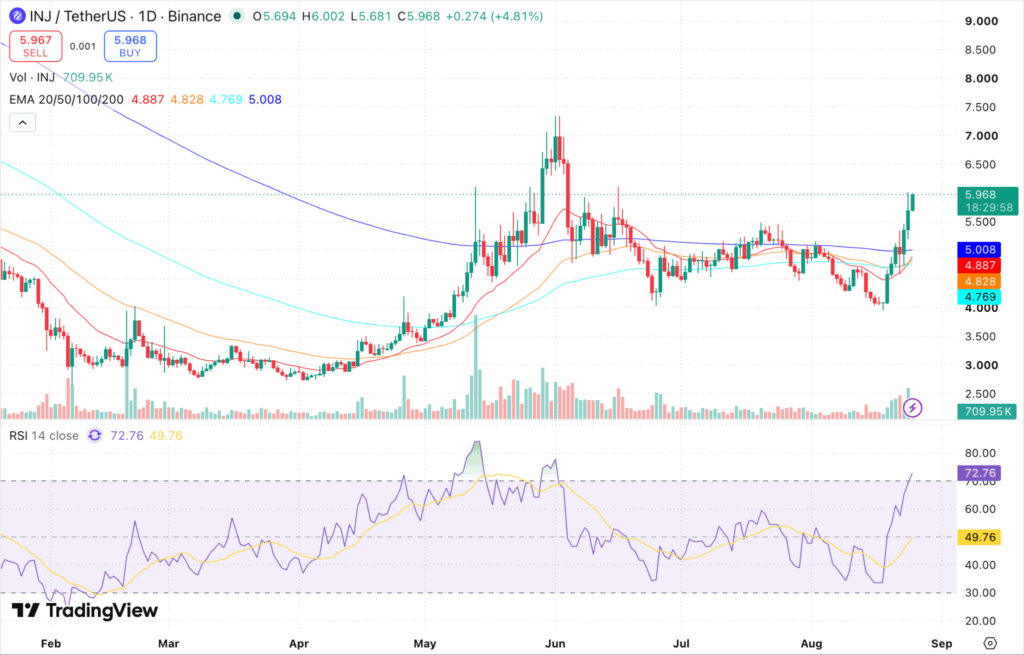
INJ closed the daily session at $5.96, up 4.67% from an open of $5.694, after trading between $5.681 and $6.002. The token is up roughly 29% to 35% from where it sat when the registration was announced, so the rally has extended rather than faded.
The chart position has changed meaningfully. Injective now trades above its 20, 50, 100 and 200-day exponential moving averages, which sit tightly bunched between $4.769 and $5.008, a spread of just 5%. Averages compressed into that narrow band usually mean a long period of going nowhere, and price breaking clear of all four is what a trend change looks like at the start.
INJ/USDT, Source: TradingView
Momentum supports it without being stretched. The MACD line at 0.186 has crossed above its signal at ‑0.001, giving a positive histogram of 0.187, and the reading is a fresh crossover from around zero rather than a late-stage one. The relative strength index at 72.68 sits just above the 70 mark conventionally treated as overbought, and the price is 22% above its 20-day average, which is warm rather than extreme.
Trade INJ in INR on 
Deposit and withdraw in INR (₹).
No Conversion to Crypto Required.

Can the Registration Sustain the INJ Rally?
Registration creates permission, not revenue. INJ covers transaction fees, staking and governance, so the token benefits only if issuers choose Injective to administer tokenized assets and that activity lifts network usage.
The test is adoption, and it has not happened yet. Injective now holds a piece of regulated market plumbing that few blockchains have, but whether securities issuers use it depends on the quality of assets brought on-chain, institutional willingness and whether blockchain settlement can compete with systems that already work. The INJ price has moved on the possibility rather than the proof.
Discover where Injective Price is headed next
FAQs
1. Why is the Injective price rallying?
Injective price is rallying because an affiliate, Injective Institutional Services, registered with the SEC as a transfer agent on 19 August, letting it keep official ownership records for tokenized securities. INJ rose about 8% on the news and has since closed at $5.96.
2. Did the SEC approve the INJ token?
The SEC did not approve the INJ token. The registration applies to an affiliate company performing a securities recordkeeping function, and it carries no judgement on INJ, on the Injective blockchain or on any asset issued there.
3. What does a transfer agent do?
A transfer agent maintains the official record of who owns a security, processes ownership changes and supports distributions and corporate actions. For tokenized securities, that record can now sit on a blockchain if regulatory requirements are met.
4. Does the Injective-SEC registration increase demand for INJ?
The Injective-SEC registration does not create demand for INJ by itself, since it grants permission rather than generating revenue. INJ covers fees, staking and governance, so the token benefits only if issuers use the infrastructure and network activity rises.
Disclaimer: Crypto products and NFTs are unregulated and can be highly risky. There may be no regulatory recourse for any loss from such transactions. This article is for informational purposes only and does not constitute financial, investment or trading advice. Conduct your own research before making any investment decision.


