
MSFT and META print Wednesday, AAPL and AMZN Thursday. FOMC Wed, PCE and BoJ Thu. Oil off 7% into a $11T Big Tech earnings week.
TLDR
Wall Street enters the busiest week of the quarter with roughly eleven trillion dollars of Big Tech market cap set to report inside 48 hours. Microsoft and Meta print after the close on Wednesday July 29, and Apple and Amazon follow on Thursday July 30. The Federal Reserve delivers its rate decision Wednesday, with June PCE, Q2 GDP advance, and the Bank of Japan all landing Thursday. US futures gapped up Monday morning after the US and Iran paused strikes over the weekend, sending Brent crude down almost seven percent to below 86 dollars per barrel. Nasdaq 100 futures were up around 1.6 percent, S&P 500 futures up 0.8 percent, and Dow futures up 0.6 to 1.1 percent into the open.
Market Regime
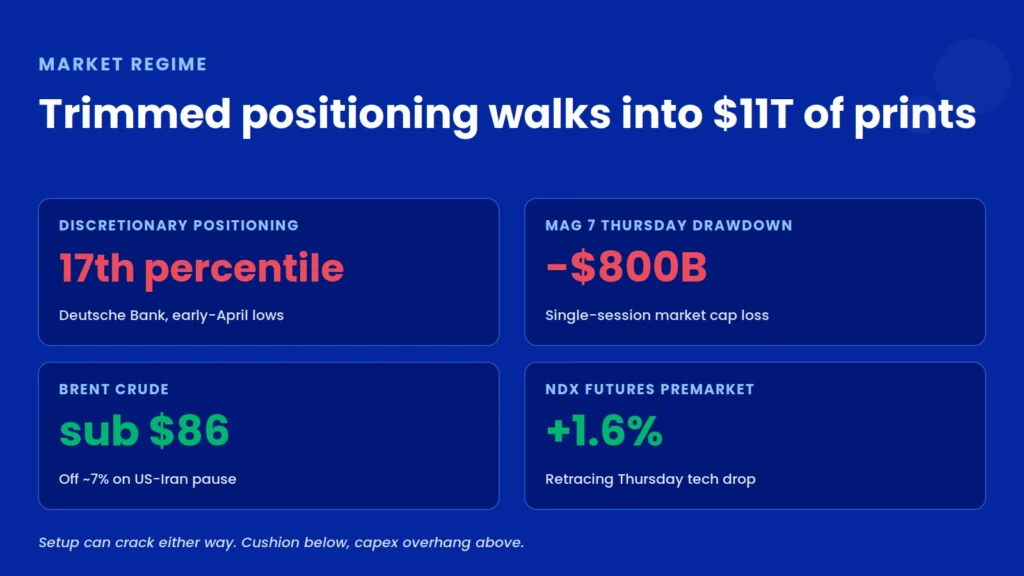
The setup coming into the week is unusual. All three US benchmarks posted weekly losses on Friday, with the Nasdaq off roughly two percent for the week and Thursday’s session marking the worst single-day drop for the S&P 500 and Nasdaq since June 23. The Magnificent Seven shed close to 800 billion dollars of market value in a single Thursday session, driven by anxiety over AI capital expenditure guidance from Alphabet and Tesla the night before. Deutsche Bank strategist Parag Thatte notes discretionary investor positioning has already fallen to the 17th percentile, matching early April lows.
Which means the market is walking into this week with positioning already trimmed, oil suddenly collapsing, and four of the most valuable companies on the planet about to hand over guidance on the exact capex line that broke Thursday’s tape. The Fed sits between the two AMC print nights. It is a setup that can crack either way. Bulls have a cushion from light positioning and easing energy prices. Bears have the still-open question of whether AI infrastructure spending is finally translating into revenue, or just compressing margins across the group.
Bullish Factors
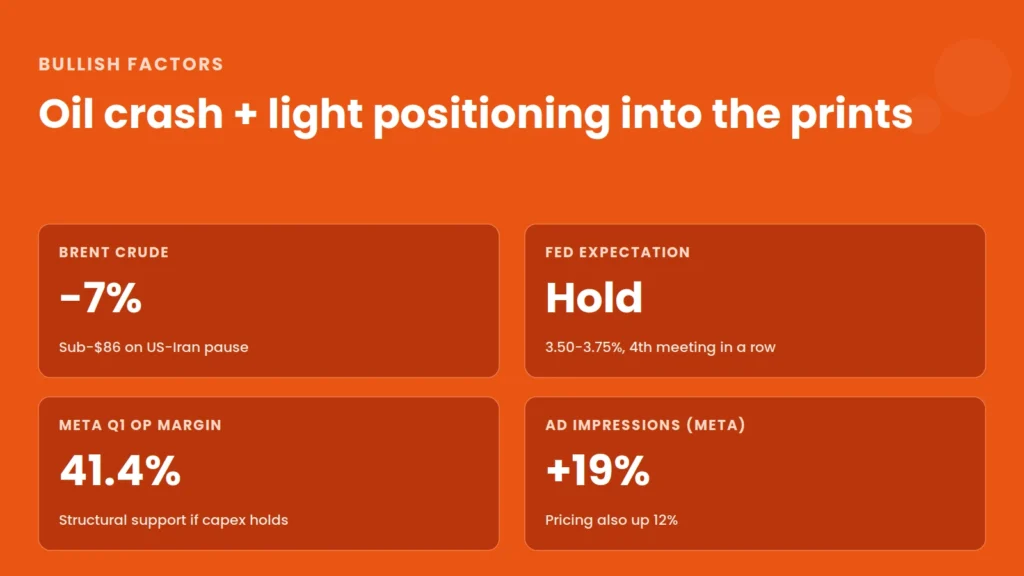
- Brent crude down about seven percent to sub 86 dollars per barrel after US and Iran paused strikes over the weekend, easing inflation pressure on the Fed and cutting the input cost drag on industrials and consumer names.
- Discretionary investor positioning at the 17th percentile per Deutsche Bank, well below levels implied by earnings and macro growth, leaving room for mechanical buying on any Big Tech beat.
- Nasdaq 100 futures up roughly 1.6 percent premarket, pointing to a full retrace of Thursday’s tech-led drop before Wednesday’s MSFT and META prints.
- FOMC widely expected to hold at 3.50 to 3.75 percent for the fourth consecutive meeting, removing surprise risk from the rate decision itself and shifting focus to Chair Warsh’s press conference tone.
- Meta’s Q1 operating margin at 41.4 percent and ad impression growth at 19 percent give the print structural support if capex guidance holds inside the 125 to 145 billion dollar range.
Bearish Factors
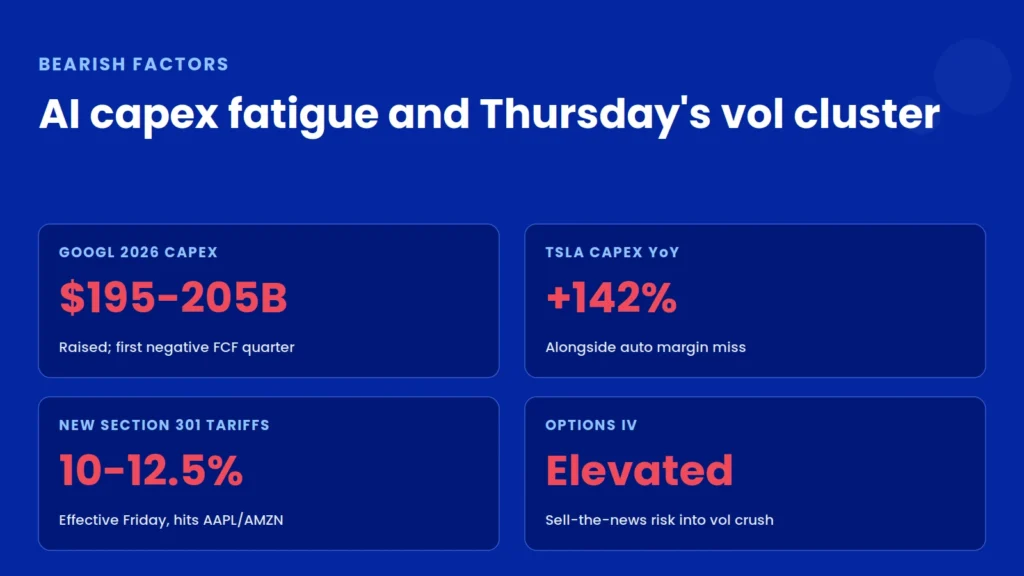
- AI capex fatigue is now the dominant narrative after Alphabet raised its 2026 capex range to 195 to 205 billion dollars with the first negative free cash flow quarter, and Tesla warned on capex up 142 percent year over year alongside a margin miss.
- Options pricing across MSFT, META, AAPL, and AMZN is inflated ahead of the prints, meaning even a solid beat can produce a sell-the-news reaction as implied vol collapses.
- Section 301 tariffs at 10 to 12.5 percent on nearly all US imports took effect on Friday, adding a fresh margin question for Apple and Amazon on Thursday night.
- Bank of Japan decision on Thursday July 30 collides with the FOMC press conference the day before, the June PCE print, and Apple plus Amazon after the bell, concentrating vol risk into a single 24-hour window.
- Kospi opened in the red overnight even with Nikkei and Hang Seng higher, a sign that semiconductor names remain on the defensive ahead of SK Hynix earnings on Wednesday.
Asian Markets This Morning
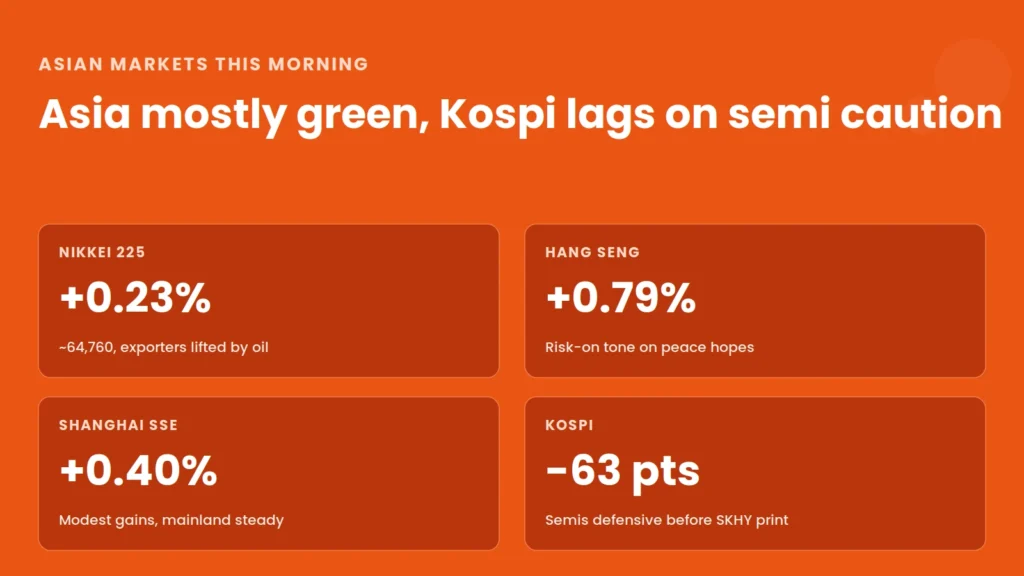
Asia opened mostly higher on the crude collapse. Japan’s Nikkei 225 was up 0.23 percent to around 64,760 as the weaker oil tape supported exporters. Hong Kong’s Hang Seng gained 0.79 percent, and Shanghai’s SSE Composite added about 0.40 percent. The exception was South Korea’s Kospi, which slipped roughly 63 points into the red, reflecting continued caution on semis with SK Hynix due to report Wednesday. Overall the tone across Asia was risk on, with the oil pause weighing more than the residual Thursday selloff in US tech.
What Moved Wall Street Friday
Friday’s session was a stabilization attempt after Thursday’s rout. The S&P 500 added 3.68 points or 0.05 percent to close at 7,411.98. The Dow Jones Industrial Average rose 235.60 points or 0.46 percent to 51,947.25, helped by a 3.52 percent jump in Apple. The Nasdaq Composite fell 161.87 points or 0.64 percent to 24,975.82. Intel dropped 7.89 percent despite a Q2 beat, punished on guidance concerns. All three indexes posted weekly losses. Brent crude fell almost four percent Friday to settle at 96.78 dollars, before the weekend pause sent it lower still. Ten year Treasury yields eased in the bond market.
Assets in Focus
MSFT (Microsoft)
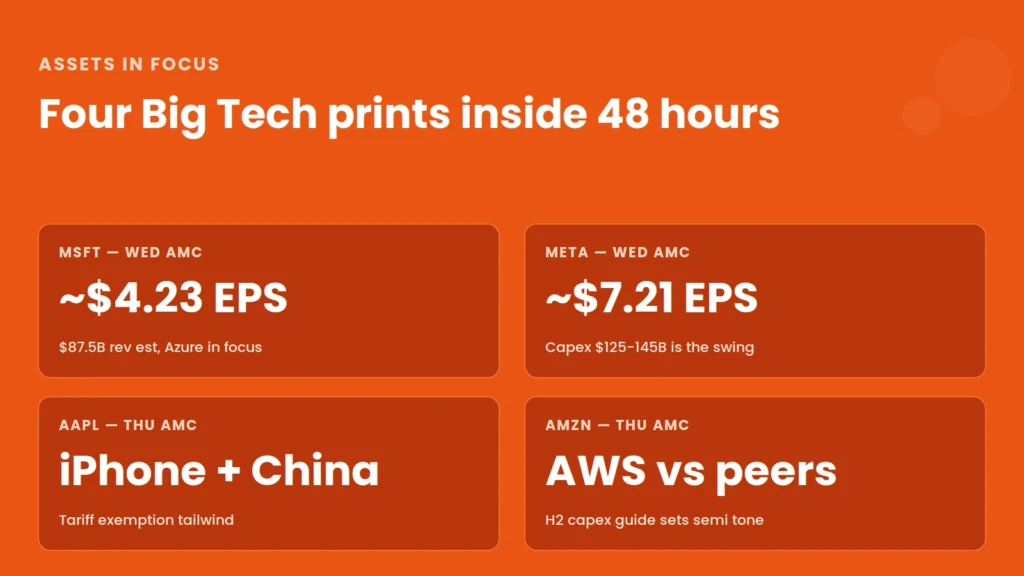
Reports fiscal Q4 2026 after the close Wednesday July 29 at roughly 5:30 PM PT. Consensus is looking for EPS of about 4.22 to 4.24 dollars on revenue of 87.5 to 87.67 billion dollars. The stock has lagged the group with year to date performance down roughly 18 percent, so the print carries setup relief if it comes in clean. Focus is on Azure growth, whether AI infrastructure spending is translating into monetization or just margin compression, and the trajectory of Microsoft 365 Copilot commercialization.
META (Meta Platforms)
Also reports after the close Wednesday July 29. Consensus EPS is 7.18 to 7.24 dollars. Meta enters the print near record highs with ad impressions up 19 percent and ad pricing up 12 percent. The swing factor is full year 2026 capex guidance, currently at 125 to 145 billion dollars, and whether operating margin holds above Q1’s 41.4 percent given Reality Labs losses and expanding AI infrastructure spend. A hold on both metrics keeps the stock supported. Guidance revision higher would collide with the same capex worry that hit Alphabet and Tesla.
AAPL (Apple)
Reports fiscal Q3 after the close Thursday July 30. The stock rallied 3.52 percent Friday and led the Dow into the print, helped by tariff exemptions on select electronics and iPhone Air momentum. Focus areas are iPhone unit growth, services margin, China revenue trajectory into the new tariff regime, and any Vision Pro or AI feature disclosure. Apple typically prints in the middle of the week for peer group derisking, but this year lands on the same night as Amazon.
AMZN (Amazon)
Reports Q2 after the close Thursday July 30. Focus is on AWS growth versus Azure and Google Cloud, retail operating margin, advertising revenue trajectory, and capex guidance for the second half. Amazon’s AWS commentary tends to move the semiconductor group into and out of the AI capex narrative, so the print carries read-across risk for NVDA, AMD, and the DRAM index heading into August.
GOOGL (Alphabet, already reported)
Reports remain in focus from last Wednesday. Cloud grew 82 percent year over year, but management hiked 2026 capex guidance to 195 to 205 billion dollars and posted the first negative free cash flow quarter, which triggered Thursday’s Magnificent Seven drawdown. The capex bar for MSFT and META this Wednesday is now defined by the Alphabet number.
TSLA (Tesla, already reported)
Q2 delivered a revenue beat at 28.24 billion dollars but an EPS miss at 0.33 dollars against 0.51 dollar consensus, auto margin ex credits of 16.3 percent, and free cash flow negative 1.09 billion dollars. Capex up 142 percent year over year framed the Thursday tech drawdown alongside Alphabet. The stock remains a reference point for AI capex sentiment.
Index Levels to Watch
These are reference points for context, not entry or exit signals. The S&P 500 closed Friday at 7,411.98 and sits below its 50 day moving average near 7,470 after Thursday’s break. The 100 day sits well below at 7,172, giving a wide technical range for the week. The Nasdaq 100 has already given back the Alphabet cloud tailwind and enters Wednesday’s MSFT and META prints below its own trend. The Nikkei 225 traded near 64,760 in Monday’s Asian session, and Kospi remains softer than the rest of Asia on semi concerns. Brent crude below 86 dollars per barrel is the macro variable that keeps the Fed backdrop cleaner into Wednesday’s decision.
Disclaimer
This content is for informational and educational purposes only and does not constitute investment advice, a recommendation, or an offer to buy or sell any security. Global Futures products carry risk, including the risk of loss. Please read all product documentation and consult a SEBI registered advisor before making any trading or investment decision.
Frequently Asked Questions
Q1. Which Big Tech companies report earnings this week?
Microsoft and Meta Platforms report after the close on Wednesday July 29. Apple and Amazon report after the close on Thursday July 30. Alphabet, Tesla, IBM, and Intel already reported the previous week.
Q2. What is the combined market cap reporting this week?
MSFT, META, AAPL, and AMZN together represent roughly eleven trillion dollars in combined market capitalization, all reporting inside a 48 hour window. This makes it the largest concentration of Big Tech earnings scheduled for any single week of the year.
Q3. What is the FOMC expected to do on Wednesday?
The Federal Reserve is widely expected to hold rates at 3.50 to 3.75 percent for the fourth consecutive meeting. Focus will be on Chair Kevin Warsh's press conference for signals on the September path, particularly whether recent energy price swings shift the inflation outlook.
Q4. Why is Thursday July 30 considered a high volatility day?
Thursday combines the June PCE print, the Q2 GDP advance estimate, the Bank of Japan rate decision and Outlook Report, and after the close earnings from Apple and Amazon. Multiple macro and earnings catalysts landing in one 24 hour window concentrates the week's risk on a single day.
Q5. What is driving the drop in oil prices Monday?
The United States and Iran paused strikes over the weekend, allowing space for potential diplomatic negotiations. Brent crude fell nearly seven percent to below 86 dollars per barrel in early Monday trade, easing inflation pressure on the Fed and lifting the broader risk on tone in US and Asian futures.