


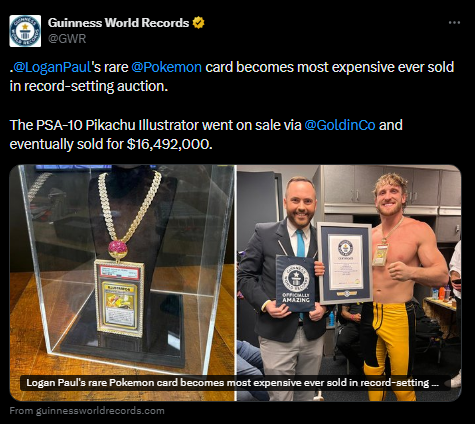
Logan Paul has secured a Guinness World Record after selling his rare Pokémon card for $16,492,000, making it the most expensive card ever sold at auction. The PSA-10 Pikachu Illustrator, widely regarded as one of the rarest trading cards in existence, attracted global attention during the record-setting sale.
The milestone, however, arrives years after the card was linked to a fractional NFT controversy that sparked debate within the digital asset community. The historic auction not only reshapes trading card valuations but also reopens discussion around past ownership structures tied to the asset.
Record-Setting Sale Marks Trading Card History
Authorized by Guinness World Records, the final confirmation emphasized that it was the highest publicly recorded card sale so far. Only 39 Pikachu Illustrator cards were made in the 1990s, and almost none of them are in perfect condition. A near-perfect grade of PSA-10 implies almost flawless quality, which is a factor that highly attracts collectors’ demand.
Paul made a purchase of the card in July 2021 at a price of $5.3 million. The latest auction value represents a hefty increase over the past four years. The final figure was pushed by competitive bids to nearly $16.5 million, which has set a new standard for the international collectibles market.
This deal corresponds to a theme found in premium collectibles repeatedly. Products demonstrating confirmed scarcity, excellent grading standards, and reliable chain of ownership will always be able to garner higher prices even when the financial markets are unstable.
Source: Guinness World Records
Fractional NFT Episode Revisited
The record transaction has also renewed attention on the card’s prior fractional listing. In 2022, Paul offered partial ownership of the Pikachu Illustrator on Liquid Marketplace. While the initial plan allowed up to 51% fractionalization, only 5.4% of the card was ultimately sold, raising approximately $270,000 from fractional owners.
The platform later went offline, leading to investor frustration and legal scrutiny in Canada. The Ontario Securities Commission initiated proceedings related to the platform’s operations, though Paul was not named in the lawsuit.
In a public statement, Paul clarified that he repurchased the fractionalized portion in May 2024 under the original pricing terms. He further stated that he financed efforts to restore platform access, allowing users to withdraw their funds. According to his statement, affected users were notified once withdrawals resumed.
This sequence of events separates the asset’s ownership from the operational issues faced by the platform. With the full sale now completed, the card’s ownership history stands clarified ahead of its record recognition.
Read more: What Is Treasure NFT – Is It a Real or Fake Token
NFT Market Cap Declines Amid Broader Slowdown
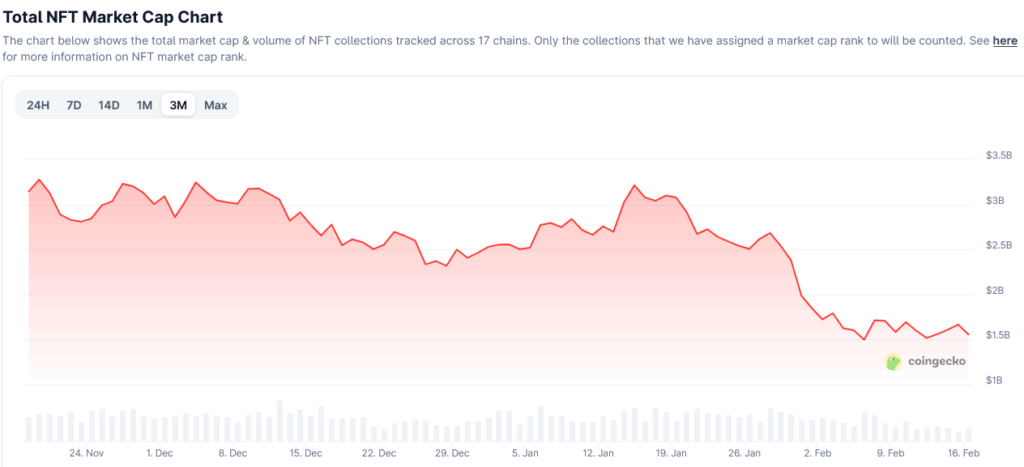
The timing of the sale stands in contrast to conditions within the digital collectibles sector. The Total NFT Market Cap Chart shows a decline of more than 50% over the past three months, with market capitalization falling from around $3.2 billion to nearly $1.55 billion.
A few NFT market players have declared that they will close down the operations of their decentralized exchanges over the recent weeks in the wake of a drop in trading activity as well as a decrease in the number of investors. The decline is symptomatic of the continual existence of wild price swings in tokenized digital assets.
In such a scenario, a sale of a physical, authenticated trading card forms a unique exception. On one hand, NFT prices are highly volatile; on the other hand, rare physical collectibles with professional grading and a well-documented history always seem to be stable and in strong demand by buyers.
Source: CoinGecko
Read more: How to Create an NFT for Free?
Conclusion
Logan Paul’s $16.5 million sale of the PSA-10 Pikachu Illustrator sets a Guinness World Record and establishes a new high point for trading card auctions. The transaction concludes a chapter that previously drew scrutiny over fractional ownership and platform disruptions.
At a time when the NFT market cap has sharply declined, the record-breaking auction highlights the enduring strength of authenticated rare collectibles. The sale not only reshapes card market valuations but also underscores the difference between speculative digital tokens and established physical assets with verified scarcity.