


Global asset management giant BlackRock has officially filed its S-1 with the U.S. Securities and Exchange Commission (SEC) for its upcoming iShares Bitcoin Premium Income ETF. While the fund’s ticker and fee structure have not yet been disclosed, the filing provides insight into the firm’s strategy for blending Bitcoin exposure with income-generating mechanisms. According to the prospectus, the ETF aims to “track the performance of the price of bitcoin while providing premium income through an actively managed strategy of writing (selling) call options primarily on IBIT shares and, from time to time, on ETP indices.”
This step further strengthens BlackRock’s presence in the crypto world, following its series of filings and launches in recent years. Being one of the biggest traditional financial institutions worldwide, its entry into crypto ETFs is a sign of a sustained initiative to integrate mainstream finance with digital assets. Market players and industry experts are currently trying to determine from the filing how this new product might influence overall market trends, retail adoption, and institutional involvement.
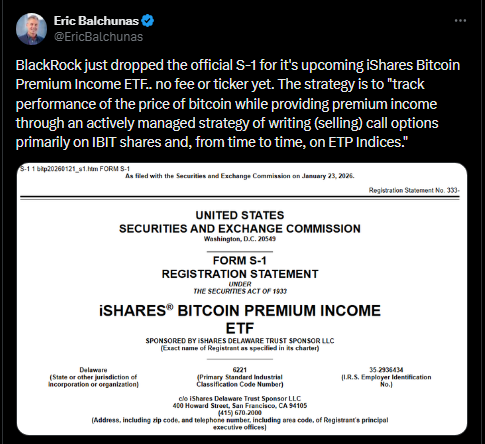
Source: ETF expert, Eric Balchunas via X
ETF Strategy Concentrates on Generating Premium Income
The iShares Bitcoin Premium Income ETF aims not only to provide investors with direct exposure to Bitcoin but also to increase returns through a strategy called call option writing. By selling call options, the fund receives premiums from investors who want to buy the underlying assets at predetermined prices. In this way, the ETF can make additional profits from Bitcoin’s price increase.
Experts note that such a strategy is designed to stabilize returns in flat or only slightly bullish markets; however, it may limit upside in the event of rapid price jumps. The focus on active management of the options portfolio shows BlackRock’s effort to strike a balance between risk and income, unlike traditional passive ETFs that merely track an underlying asset. Market players are curious about how this product will be distinguished from other Bitcoin ETFs, especially regarding risk-adjusted returns and overall market adoption.
Read more: What is Bitcoin ETF? A Complete Guide
Implications for the Crypto Market
BlackRock’s filing highlights its commitment to expanding its crypto investment lists and developing products for both retail and institutional investors. Historically, the firm has approached crypto with a measured, regulatory-compliant strategy, as evidenced by its cautious yet deliberate filings for spot- and futures-based Bitcoin ETFs. By offering an ETF that combines Bitcoin exposure with income generation, BlackRock could appeal to investors seeking alternatives to direct crypto holdings while still participating in the digital asset market.
Market participants believe that the introduction of this new ETF may affect liquidity and price behavior across the entire Bitcoin market. With institutional money gradually entering regulated investment instruments, the Bitcoin price volatility may be reduced, and the adoption of Bitcoin may be fast-tracked, especially for those investors who find it difficult to deal with private keys or crypto-exchanges. The set-up of this ETF is thus another step in a growing line of fancy ETFs that have varied crypto exposure as their main objective rather than simply following the price.
Trade Bitcoin in INR on 
Deposit and withdraw in INR (₹).
No Conversion to Crypto Required.

Conclusion
The BlackRock iShares Bitcoin Premium Income ETF is a major breakthrough in the traditional finance and digital assets merger. Mixing call option strategies with the fund’s Bitcoin exposure, it aims to deliver a combination of growth and income, attracting a range of investors.
Although the information on expenses and the ETF ticker is not yet available, this filing highlights BlackRock’s ongoing efforts to expand its crypto investment portfolio and to provide crypto market access through regulated, well-structured routes. During the ETF regulatory review, the launch’s impact on institutional adoption and the evolution of the crypto investment products market will be the center of attention.


