



In a move as decisive as it is disruptive, China has issued a sweeping crackdown on crypto-related activities, effectively cutting ties with the decentralised financial world it once helped power.
The once bustling crypto corridors of Asia’s largest economy have fallen silent overnight. This decisive clampdown marks a turning point not only for Chinese investors but for the global crypto ecosystem. It is a stark reminder that sovereign power still holds sway over decentralised ambitions. The question now is not just how markets will react but how the rest of the world will respond.
China’s Crypto Crackdown: What’s Really Going On?
A Flashback: The 2021 Ban
China’s journey to total crypto prohibition unfolded in waves:
- 2013: The People’s Bank of China barred financial institutions from processing Bitcoin transactions.
- 2017: ICOs and domestic crypto exchanges were banned, citing investor protection and financial risk.
- 2021: The crackdown intensified, financial institutions were blocked from facilitating crypto services, and miners were systematically shut down. By September, mining and trading of crypto assets were formally declared illegal.
This sweeping policy move rapidly dismantled the country’s once-dominant mining infrastructure and drove offshore migration of major mining operations.
Why the Heavy Hand?
China’s approach stems from multiple concerns:
- Financial stability and fraud risks: Crypto assets were viewed as volatile and prone to misuse.
- Capital flight: Crypto offered an avenue to bypass strict capital controls, facilitating significant outflows.
- Energy and environmental impact: Mining’s energy consumption, often powered by coal-heavy grids, conflicted with China’s sustainability goals.
- Digital Yuan positioning: As China launched its central bank digital currency (e-CNY), private crypto tokens emerged as direct competition, prompting suppression.
China Expands Crypto Ban in 2026
RWA Tokenization and Stablecoins Targeted
In February 2026, China significantly expanded its crypto ban, reinforcing that all crypto-related activities remain illegal on the mainland while explicitly banning real-world asset (RWA) tokenization and unapproved offshore yuan-pegged stablecoins.
In a joint notice issued by the People’s Bank of China (PBOC) alongside top regulators, including the National Development and Reform Commission, Ministry of Public Security, securities regulator, and foreign-exchange watchdog , authorities stated that crypto-related activities continue to disrupt financial order and pose systemic risks.
The notice reaffirmed that crypto tokens such as Bitcoin, stablecoins, and tokenized assets do not have legal standing in China and cannot circulate as money.
RWA Tokenization Now Explicitly Banned
For the first time, Chinese regulators clearly extended the crypto ban to real-world asset tokenization, defining it as the use of cryptography and distributed ledger technology to convert ownership or income rights into token-like certificates that can be issued or traded. Unless carried out on approved financial infrastructure with explicit regulatory consent, all RWA tokenization activity, including technical services, intermediaries, and issuance platforms, is prohibited.
Foreign entities are also barred from providing illegal tokenization services to domestic counterparts. Offshore structures linked to Chinese assets will be subject to “same business, same risk, same rules” supervision, requiring filings or prior approval.
Also Read: Top Real World Assets (RWA Coins) to Watch in 2026
What This Means for Crypto in China
While China’s 2021 ban already outlawed crypto trading and mining, the 2026 directive closes remaining gray areas, particularly around:
- Tokenized real-world assets
- Offshore stablecoin issuance
- Cross-border crypto services tied to domestic assets
At the same time, China continues to promote state-backed digital currency initiatives, including the e-CNY, reinforcing its preference for centralized, fully regulated digital finance over decentralized crypto systems.
How did the Crypto Market React?
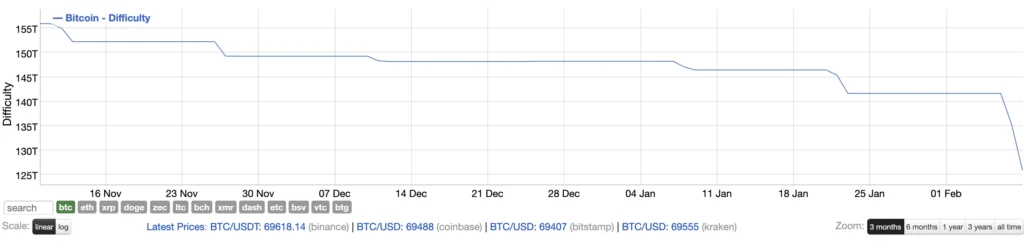
While prices remained largely sideways in the immediate aftermath, the impact was more visible in mining economics. Bitcoin mining difficulty recorded its sharpest drop, falling by over 11.1% (from 141.6T down to 125.8T). This is the largest drop since July 2021, when China officially cracked down on crypto mining.
Why China Maintains a Hardline Crypto Policy
Officially, China frames its crypto ban as a measure to reduce financial risk, prevent fraud, and protect capital controls. In practice, the policy also reflects a broader strategy to prioritize state-controlled digital finance, including the e-CNY, while preventing parallel monetary systems from gaining traction. Rather than eliminating digital assets entirely, Beijing’s approach focuses on restricting crypto activity to approved, centralized, and fully regulated frameworks.
Policy Direction After the 2026 Update
While earlier discussions in 2025 hinted at limited experimentation with yuan-linked digital assets, the February 2026 directive sharply narrowed that scope. Regulators made it clear that only explicitly approved, state-backed infrastructure may be used for any form of digital asset issuance, including stablecoins or tokenized representations. This signals not liberalization, but greater precision and enforcement of China’s crypto ban.
In Summary
| Theme | Insight |
|---|---|
| Full Ban Since | 2021 (trading, mining, crypto services) |
| Roots of the Ban | Capital controls, financial risk, environmental concerns, e-CNY competition |
| Current Landscape | Crypto activity illegal; ownership in gray area; enforcement expanding |
| Emerging Trend | Tighter enforcement, RWA tokenization ban, approval-only digital finance |
Conclusion
China’s crypto stance is no longer ambiguous. The February 2026 update shows the policy is less about reversing course and more about eliminating gray zones. Decentralized crypto has no role under Beijing’s framework, while digital assets that operate on state-owned, permissioned rails may continue to evolve behind the same regulatory wall.


