
Bitcoin Halving Events Completed: Everything You Need to Know

  • 00Days
  • 00Hours
  • 00Minutes
  • 00Seconds

Prepare for the transformative impact of Bitcoin’s fifth halving expected on April 17, 2028, at block height 1,050,000. Gain insights into its significance, underlying reasons, and potential trading strategies and strategies for miners. As Bitcoin continues its journey, embrace the changes this pivotal milestone brings.

Historic Bitcoin Halving Events

Bitcoin halving events, pivotal in Bitcoin’s history, instigate significant shifts in the crypto landscape. Back in January 2009, the Genesis block rewarded miners with 50 BTC per block, and since then, the process has happened roughly every 4 years. The next halving, tentatively in April 17, 2028, at block height 1,050,000 in the fifth Bitcoin halving, and will reduce block rewards from 3.125 BTC to 1.5625 BTC.

Event Date Block Number Block Reward BTC Price
Launch of Bitcoin
January 2009
0 (genesis block)
50 BTC
NA
First Halving
November 2012
210,000
25 BTC
$15
Second Halving
July 2016
420,000
12.5 BTC
$651
Third Halving
May 2020
630,000
6.25 BTC
$8800
Fourth Halving
April 20, 2024 (IST)
840,000
3.125 BTC
~$64,000
Next Halving
April 2028
1,050,000
1.5625 BTC
Yet to Happen

Bitcoin Halving’s Impact on BTC Price

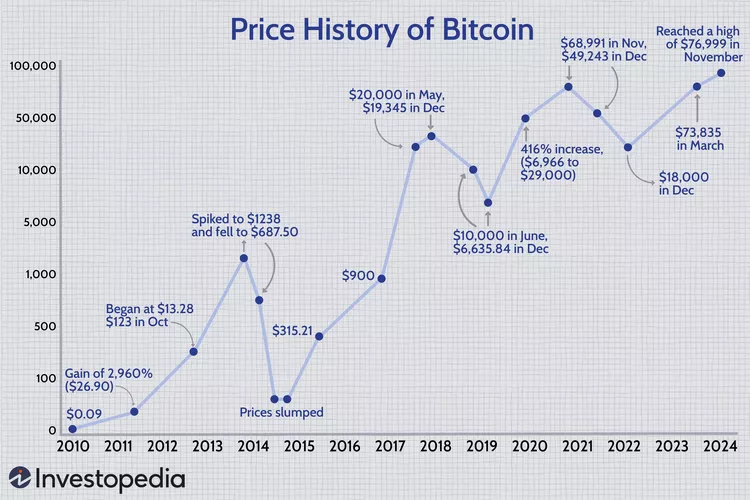
Bitcoin halving events have historically been key catalysts for market movement, often leading to significant price fluctuations and renewed investor interest. Each halving reduces the block reward, tightening Bitcoin’s supply and influencing both short-term volatility and long-term price appreciation. With the 2024 halving now behind us, let’s revisit previous halvings to understand how they shaped Bitcoin’s price trajectory and market sentiment.

Read more: Buy Bitcoin in INR

First Halving (November 28, 2012)
  • Immediate increase: Bitcoin doubled to over $30 within months post-halving.
  • Introduction of scarcity: Shifted Bitcoin’s perception to a store of value.
  • Precursor to future cycles: Established a pattern of reduced rewards influencing BTC price.
Second Halving (July 9, 2016)
  • Substantial surge: Bitcoin doubled to around $1,000 within a year of the event.
  • Reinforcement of scarcity: Further emphasized Bitcoin’s limited supply.
  • Boosted legitimacy: Increased media attention, affirming Bitcoin as an asset class.
Third Halving (May 11, 2020)
  • Volatility to peak: Bitcoin reached an all-time high, exceeding $29,000 by year-end.
  • Sustained scarcity impact: Continued reduction in new BTC supply influenced value.
  • Strengthened credibility: Solidified Bitcoin as a hedge against uncertainties, affirming its store of value status.
Fourth Halving (April 19, 2024)
  • Price: Bitcoin price has been rallying all through 2023, ahead of the halving – and this trend can be expected to continue. Historically, in the months following the halving – we have seen massive price hikes in Bitcoin.
  • Scarcity: The scarcity of Bitcoin will go up even more as the block reward for miners will be cut by another 50%, falling to 3.125 BTC for every verified block on the chain.
  • Deflationary Asset: This would further cement Bitcoin’s position as a truly deflationary asset in the broader financial market space.
Fifth Halving (April tentative, 2028)
  • Price Momentum: After rallying through late 2023 and into early 2024, Bitcoin has maintained strong momentum in 2025, supported by institutional inflows, ETF traction, and growing on-chain activity. While the halving is now behind us (April 2024), historical patterns suggest that Bitcoin often sees its strongest rallies 12–18 months post-halving, a trend that many analysts believe could repeat by late 2025 or early 2026.
  • Scarcity Effect: Following the 2024 halving, the block reward was reduced from 6.25 to 3.125 BTC, further limiting the rate of new supply. With over 93% of all Bitcoin already mined, this increasing scarcity continues to reinforce its store-of-value narrative and could act as a long-term price driver.
  • Deflationary Thesis Strengthens: This halving has once again highlighted Bitcoin’s role as a deflationary digital asset, unlike fiat currencies that are subject to continuous inflation. With a fixed supply cap of 21 million and diminishing issuance, Bitcoin is increasingly viewed as a hedge against macroeconomic uncertainty and fiat debasement.

Start Trading Bitcoin (BTC) Now

Bitcoin Price Prediction 2025

1. MicroStrategy’s Strategy Unit Continues Buying

Michael Saylor’s Strategy subsidiary added another 245 BTC (~$26 million) last month (June), increasing its holdings to 592,345 BTC at an average price of $70,681 BTC. Its YTD yield now stands near 19%, with targets of 25% by year-end, showcasing persistent institutional demand even amid market dips.

2. Dormant “Whale” Wallets Stir Activity

Recent on-chain analytics reveal reactivations from long-dormant wallets, some inactive for over a decade, moving 300 BTC (~$30 million). These moves suggest strategic repositioning by early holders rather than panic selling, indicating confidence in the longer-term trajectory.

3. New CME Futures Gap Surfaces

A new CME futures gap between $103,462 and $106,407 was detected in mid‑May. Given that roughly 80% of CME gaps get “filled,” there’s a high likelihood BTC will revisit this zone before any sustained breakout.

BTC/USD | Souce: TradingView

Bitcoin Mining Statistics: Over 93.74% Mined Already!

After the Bitcoin Halving 2024 went live, the latest mining statistics reveal a significant milestone, over 93.74% of the total Bitcoin supply has been successfully mined. With a maximum supply capped at 21 million, the current total mined Bitcoin stands at 19,686,975. This accomplishment underscores the finite nature of Bitcoin, a key component of its value proposition.

Bitcoin’s decentralized network relies on miners to validate transactions and secure the network, a process rewarded with newly minted Bitcoin. As the mining process approaches its eventual completion, scarcity becomes an increasingly prominent feature, potentially influencing the crypto’s value dynamics.

*Data as of June 24, 2025.


How Miners are Preparing for Bitcoin Halving 2025?

With the 2024 halving now behind us, miners are adapting strategies encompassing efficiency, sustainability, diversified income, risk management, and collaboration. These measures aim to navigate the impact of halving events, ensuring profitability and innovation within the mining industry.

Efficiency and Scaling
  • Upgrading hardware with ASICs for faster solving and lower power consumption and optimizing mining setups in locations with cheaper electricity and renewable energy.
Energy Efficiency and Sustainability
  • Transitioning to greener energy sources to reduce the carbon footprint and exploring solar or wind power to lower energy costs and promote sustainability.
Diversified Income Sources
  • Exploring DeFi platforms, staking, or additional services for income diversification.
Strategic Risk Management
  • Utilizing options trading, hedging, and maintaining cash reserves for market volatility along with timing Bitcoin sales strategically to maximize earnings amidst price fluctuations.
Collaboration and Partnerships
  • Forming alliances within the mining community for economies of scale and competitiveness. Also, partnering with hardware manufacturers, energy providers, and financial institutions for technological advancements and financing.

How does Bitcoin halving impact the overall crypto market?​

Scarcity Boosts Demand
  • Bitcoin Halving decreases new supply, heightening scarcity and often sparking increased demand, historically aligning with upward price trends.
Volatility Surrounding Event
  • Anticipation and aftermath contribute to market volatility, with traders closely monitoring price fluctuations.
Market Sentiment Influence
  • Bitcoin Halving’s market sentiment significantly influences broader crypto trends, serving as a pivotal point for strategic decision-making.
Long-Term Price Appreciation
  • Post-Halving, Bitcoin’s intensified scarcity tends to lead to long-term price appreciation, impacting overall market valuations.
Ecosystem Impact
  • Bitcoin Halving ripples through supply-demand dynamics, affecting prices and sentiment, shaping the trajectory of various altcoins in the crypto ecosystem. The 2024 Halving is expected to amplify these dynamics.

Why is Bitcoin Halving Undertaken?​

Bitcoin Halving is a deliberate and essential feature designed to regulate the crypto’s supply. The process, occurring every four years, reduces the reward miners receive for validating transactions by 50%. On every Bitcoin halving date, this reduction mitigates the inflation rate, preventing the rapid influx of new Bitcoin into circulation. By curbing supply, Bitcoin Halving sustains scarcity, aligning with its finite supply cap of 21 million coins.

The significance lies in its role as a deflationary mechanism, anchoring the crypto’s value proposition. As Bitcoin Halving curtails the creation of new BTCs, it enhances scarcity, thereby influencing market dynamics. This intentional scarcity fosters a delicate balance between supply and demand, reinforcing Bitcoin’s decentralized and finite digital asset appeal.

Bitcoin SV (BSV) Halving

Like its rival, Bitcoin, Bitcoin SV (BSV) also faces a predetermined Bitcoin Halving date scheduled for 2025. This mechanism halves miner rewards, reducing supply and potentially impacting BSV’s price and network.

After forking from Bitcoin Cash in 2018, BSV experienced its first halving in Feb 2020, dropping rewards from 12.5 to 6.25 BSV per block. The second Halving occurred in April 2024 where reward dropped to 3.125 BSV.

Next Halving is Expected around mid-2028, targeting block 1,050,000, when the reward will decrease from 3.125 to 1.5625 BSV.

While historical data from the 2020 halving showed mixed results, the next Bitcoin Halving Countdown has many BSV enthusiasts holding their breath.

Bitcoin Cash (BCH) Halving

Like Bitcoin and BSV, Bitcoin Cash (BCH) follows a strict halving schedule, cutting miner rewards every 210,000 blocks to strengthen scarcity and support its price dynamics.

With the 2nd BCH halving completed on April 8, 2024, block rewards were reduced from 6.25 BCH to 3.125 BCH per block. As of June 2025, this event has already influenced supply, positioning BCH for its next reward cut in 2028, estimated at block 840,000.

Bitcoin Halving Countdown
  • 00Days
  • 00Hours
  • 00Minutes
  • 00Seconds

Frequently Asked Questions

Bitcoin Halving refers to an event programmed into the Bitcoin protocol, cutting block rewards miners earn in half approximately every four years. This process reduces the rate of Bitcoin issuance, promoting scarcity and thus influencing Bitcoin’s supply mining.

Bitcoin Halving Date is April 2024 is live and it was successfully completed early on April 20, When miners achieved a block height of 840,000.

Historically, Bitcoin Halving events have been associated with price increases due to reduced supply and increased scarcity. However, price movements are influenced by various market factors, and while previous halvings have led to price surges, they don’t guarantee future outcomes. But current projections hint at a positive outcome.

Investors eyeing Bitcoin’s halving should consider market volatility and potential price fluctuations. Strategies might involve diversification, assessing risk tolerance, and possibly using dollar-cost averaging to spread investment over time.

Bitcoin miners are adapting their operations to optimize efficiency and profitability. This includes upgrading equipment, adjusting mining strategies, and assessing operational costs to remain competitive amid the reduced block rewards following the halving.

The final Bitcoin halving event is estimated to happen sometime in the year 2140. By this time, there will be 21 million Bitcoin in circulation, and no more Bitcoin will be created through mining. Miners will only be compensated through transaction fees.

The first Bitcoin halving happened back in November 2012, and the last Bitcoin halving happened back in May 2020. The most recent one took place early on April 20, 2024.

Yes, Bitcoin halvings do have indirect effect on altcoins, as hype around Bitcoin brings more attention to the crypto market as a whole, and, thus, more attention on new, up-and-coming crypto projects and their tokens.

While pinpointing what 1 Bitcoin will be worth in 2024 is a speculative activity, price predictions based on technical analyses indicate that if the current momentum continues, Bitcoin price can create new all-time highs.

When all the Bitcoin is mined, no more Bitcoin can be created through mining and thus miners will be rewarded BTCs in the form of transaction fees.

There are roughly 31 Bitcoin halvings remaining until all Bitcoins are mined. This means the reward for mining new blocks will be cut in half 31 more times before the total supply of 21 million Bitcoins is reached. However, it’s important to note that this is just an estimate based on the current block generation time and halving schedule.

Yes, Bitcoin halving creates significant price volatility as halving directly impacts the mining reward structure, creating scarcity and pushing up demand. Additionally, the Bitcoin halving event has become a very hyped event happening every four years and thus remains at the focal point of attention.

Satoshi Nakamoto implemented a planned coin issuance schedule to create scarcity, control inflation, and mimic the attributes of precious metals like gold, providing a sound monetary policy for Bitcoin.

Latest Blogs