



Grayscale announced that its spot Zcash ETF crossed $500 million in assets under management (AUM) two weeks after listing on NYSE Arca, coinciding with the launch of ZCSH options trading. Approximately 20% of the fund’s capital originated from Grayscale’s parent organization via an in-kind contribution. Spot ZEC settled near $1,186 on Coinbase following an extended upward move that carried the asset 28% above its 20-day moving average.
What Grayscale Announced on 8 September
The Grayscale Zcash ETF (ZCSH) reached $500 million in AUM following its 25 August listing on NYSE Arca. Listed options on the fund also began trading on NYSE Arca, broadening the suite of exchange-traded risk management and income tools available for the product. ZCSH remains the only exchange-traded product globally providing spot exposure to ZEC.
Steve Vanourny, Head of Index at Grayscale, said the fund had drawn cumulative inflows of more than $70 million since launch. The product is not registered under the Investment Company Act of 1940, so it carries different disclosures from a standard ETF.
Capital Inflow Breakdown and In-Kind Contributions
DCG International Investments Ltd., a wholly owned subsidiary of Digital Currency Group (the indirect parent of sponsor Grayscale Investments Sponsors LLC), allocated approximately $100 million to the fund.
The transaction was executed via an authorized participant delivering 85,705.32563297 ZEC tokens rather than cash, reflecting a valuation near $1,167 per coin. An earlier institutional disclosure had planned for a $100 million contribution representing roughly 200,000 ZEC, capturing the asset’s rapid price expansion between filing updates. Regulatory filings note that DCG and its affiliates may buy, hold, or monetize fund shares and underlying assets over time for treasury and hedging purposes.
Short Liquidations and Market Dynamics
ZEC first closed above $1,000 on 4 September, when $34.5 million of short positions were liquidated in 24 hours on $1.2 billion of volume. A 12% opening gap became a 20% session as forced buybacks compounded it.
One trader, Garrett Jin, was short 32,760 coins and lost $18.5 million on the day. CoinMarketCap later put his unrealized loss at $25.7 million with a liquidation price near $2,540. The ETF supplied the narrative; leverage supplied the move.
ZEC Technical Price Levels
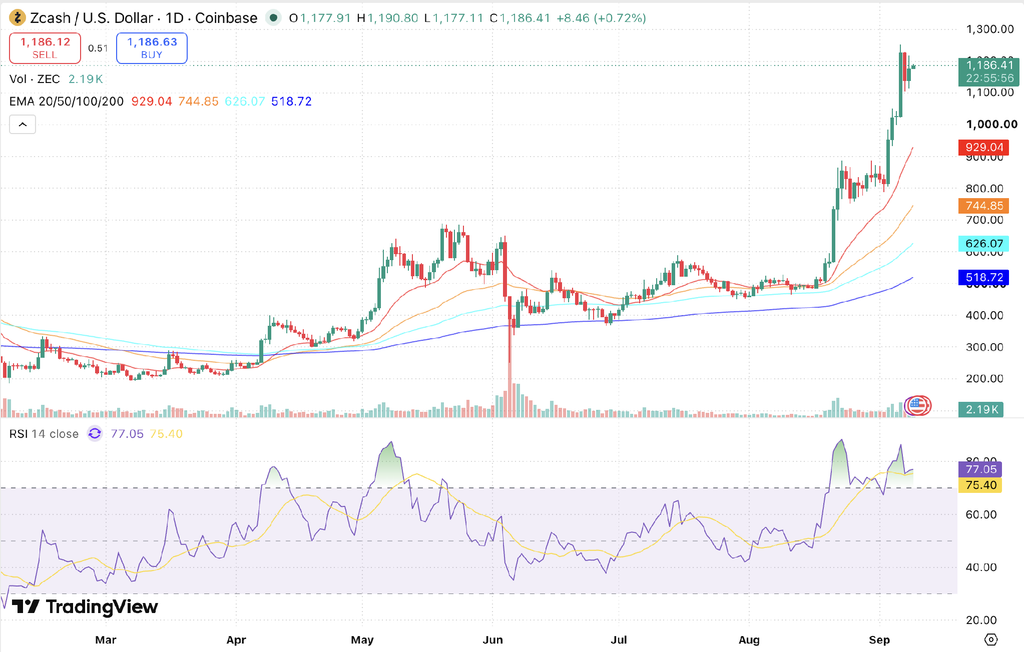
ZEC/USD daily chart with EMA 20/50/100/200 and RSI 14. Source: TradingView
After touching an intraday peak of $1,249 on 6 September, ZEC consolidated near $1,186. The asset maintains an ascending moving average structure, with its 20-day ($929.04), 50-day ($744.85), 100-day ($626.07), and 200-day ($518.72) exponential moving averages stacked sequentially below the current price.
ZEC trades 28% above its 20-day average and 129% above the 200-day, so the nearest trend support sits about 22% below spot. The 14-day RSI reads 77.05 against its own moving average at 75.40, which is overbought but still rising. CoinMarketCap places nearer support at $1,163 and $1,137, with $1,064 below that.
Read more: ZCash Price Prediction 2026-2040
Trade ZEC in INR on 
Deposit and withdraw in INR (₹).
No Conversion to Crypto Required.

Network Upgrades and Orchard Turnstile Controls
Security researcher Taylor Hornby found a flaw in the Orchard shielded pool in May, an under-constrained element in its cryptographic circuit that could in theory have let an attacker mint counterfeit ZEC. Developers shipped an emergency fix on 1 June and found no evidence of exploitation.
To permanently isolate the system, the Ironwood (NU6.3) upgrade activated at block height 3,428,143 on 28 July. Ironwood sealed the original Orchard pool to new deposits and introduced a strict turnstile accounting boundary. Under this protocol checkpoint, the total ZEC exiting Orchard into Ironwood or transparent addresses cannot exceed the net balance that legitimately entered, ensuring verifiable circulating supply limits across the network.
Market Context for Indian Traders
ZEC is not listed on CoinDCX, so ETF demand in New York does not add depth to Indian order books. Zcash carries a fixed 21 million cap and a halving schedule, with roughly 78.6% mined and an inflation rate below Bitcoin’s.
Japan, South Korea and several other markets have removed privacy coins from exchanges, and the EU intends to ban them under MiCA by 2027, yet a US-regulated ETF now trades on NYSE Arca. F2Pool co-founder Chun Wang called the rally a narrative bid on 8 September. Crypto.news checked his claims and found the Founders’ Reward equaled 10% of the maximum supply and ended in 2020, while shielded usage has risen from 8% to about 30%.
FAQs
1. How large is the Grayscale Zcash ETF?
The Grayscale Zcash ETF holds more than $500 million in assets as of 8 September, two weeks after listing on NYSE Arca under the ticker ZCSH. That total includes over $70 million of cumulative inflows and a $100 million in-kind investment from DCG International Investments, an affiliate of the fund’s sponsor.
2. Why did the Zcash price cross $1,000?
ZEC surpassed $1,000 on 4 September after $34.5 million of short positions were liquidated in a single day on $1.2 billion of volume. Forced buybacks turned a 12% gap into a 20% session, with the Grayscale ETF listing providing the wider narrative.
3. What Zcash price levels matter now?
ZEC closed at $1,186.41 after peaking near $1,249. CoinMarketCap places support at $1,163 and $1,137, with $1,064 beneath. The 20-day exponential moving average at $929.04 is the first trend support, about 22% below spot.
4. Is Zcash available on CoinDCX?
ZEC is not listed on CoinDCX. The Grayscale product trades on NYSE Arca and is available through US brokerage accounts, so ETF-driven demand does not directly affect spot liquidity on Indian exchanges.