


KEY TAKEAWAYS
- A bear market is a drop of more than 20% from a recent peak. Crypto has been in one since Bitcoin’s October 2025 high, and in the first week of October 2026 that decline reached exactly the one-year mark.
- CryptoQuant data showed the largest holders adding through the decline, and in late August the firm shifted its reading to the early phase of a new bull market. Its confirmation line, a sustained close above roughly $81,700, was reached in early October, lost in the final week of the month, and rejected again just below the level in early November.
- Each bear market bottom so far has been higher than the last, but nothing guarantees that pattern repeats, and the October 2025 high remains unreclaimed.
Whenever digital assets dominate headlines, the spotlight invariably falls on euphoric bull runs: explosive rallies, viral hype, and retail capital inflows. Yet the quieter, less celebrated counterpart, the crypto bear market, reveals the true resilience and foundation of the industry.
A bear market is more than a falling chart; it is an endurance test of patience and conviction. As asset prices compress and negative headlines dominate, sentiment often treats the asset class as finished. However, these contraction phases also clear out speculative noise, leaving sustainable, high-utility protocols to build unencumbered.
Studying bear markets provides essential perspective. Downturns are structural, necessary phases within market mechanics: bulls bring expansion, while bears bring valuation discipline. Historically, every major correction has laid the groundwork for the next expansion. Now a year old, the 2025–26 bear cycle is flashing the late-stage signals tracked below.
BTC Chart and Bitcoin Bear Market Analysis
Zooming out on Bitcoin’s price history reveals a distinct, repeating rhythm. Every parabolic expansion to an all-time high (ATH) has yielded to a protracted correction. Examining these drawdowns highlights not only the peaks, but also the structural duration and price floors that follow.
Bitcoin: Peaks and Bottoms Through the Years
Four cycles are now on record. Each one followed the same shape at a larger scale.
- 2017: Bitcoin reached nearly $20,000, specifically $19,666. Within a year, the market had completely flipped, and prices slid more than 80% by the end of 2018.
- 2021: Bitcoin ran up to nearly $69,000 and the story played out again on a bigger stage. The market bled slowly through the following year, and by late 2022 Bitcoin had crashed to $15,479.
- 2025: Bitcoin set its record high of $126,198 on 6 October 2025, clearing the $124,500 level it had touched in mid-August. Total crypto market capitalisation peaked alongside it at about $4.27 trillion. Unlike previous blow-off tops, this peak gave way to a slower structural cooling rather than an immediate collapse.
- 2026: Prices drifted down to roughly $88,000 through H1 2026. In June 2026, Bitcoin broke below $60,000 for the first time this cycle, tapping a 21-month low of $59,300. That base held: BTC consolidated through July, rallied roughly 24% in August, and reached $86,490 on 5 October before fading. A rebound to about $81,000 on 2 November failed just below the key $81,700 level, and by 10 November the price had broken below $73,000 intraday, its weakest since 20 August.
Where the Crypto Market Stands in November 2026
The rebound off the June floor has been cut roughly in half. The focal question has shifted again: not whether the recovery can establish structural support, but whether the June low stays out of reach of a deepening retracement.
As of mid November 2026, total crypto market capitalization stands at about $2.48 trillion, down from roughly $3.0 trillion at the start of October. Bitcoin trades between $73,000 and $75,400 after breaking below $73,000 intraday on 10 November, with dominance near 59.6%, still its highest range since May 2026. Ethereum sits around $2,100 and holds about 10% of the market. That leaves Bitcoin roughly 41% below its October 2025 record and the total market about 42% below its own peak, drawdowns that stood at 53% and 46% at the June low and had narrowed to about 32% and 30% in early October before widening again.
Technical Indicators
Technically, the recovery failed the same test twice. Bitcoin rose above the 365-day moving average around $81,700, the line CryptoQuant treats as the divide between bear and bull regimes, in early October, lost it in the final week of the month, and was rejected just below it again on 2 November at about $81,100. The price has since fallen through the major daily moving averages, with the 200-day EMA near $76,300 now overhead, and is testing support in the $73,000 to $73,800 zone that traders are defending. Until the price reclaims and holds the $81,700 to $82,000 zone, the long-term trend remains a recovery inside a bear market, and a deepening one.
Regulatory Developments
The regulatory catalyst resolved, and it resolved badly. The CLARITY Act, which had cleared the House in July 2025 and the Senate Banking Committee in May 2026, failed a Senate cloture vote 49-50 on 15 September 2026, short of the 60 votes required. With the November elections now past, policy advocates see the lame-duck session as a final window for 2026, though the path is contested and federal agencies continue to act without a statute. The market absorbed the September failure without breaking the June low, which remains a data point in the bulls’ favour even through the November slide.
How Long Do Crypto Bear Markets Last?
Examining historical duration reveals a striking symmetry: both the 2018 and 2022 bear markets lasted almost exactly 365 days from peak to trough. This suggests Bitcoin undergoes a natural, roughly one-year macro reset phase designed to purge leverage and allow balance sheets to rebuild.
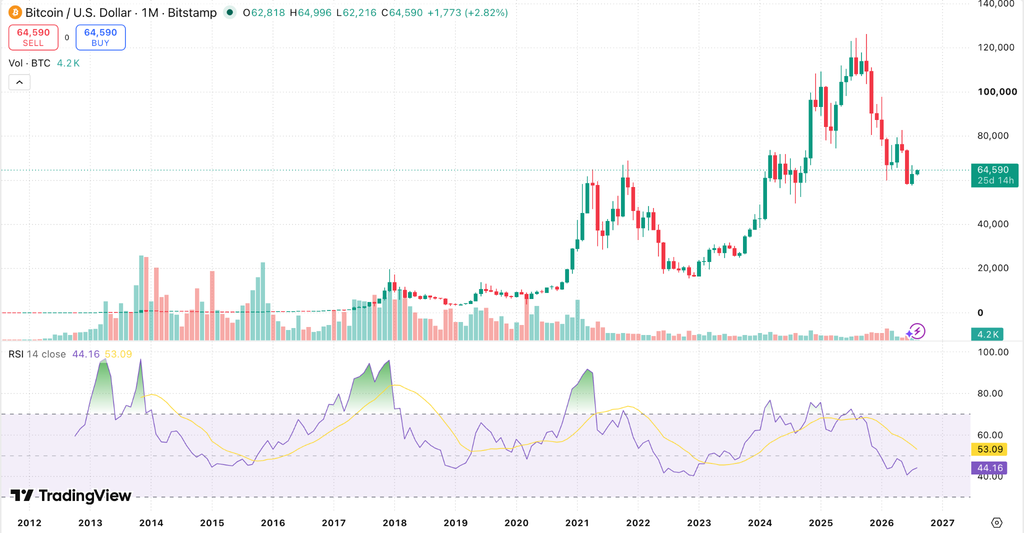
Measured from the 6 October 2025 peak, the current cycle crossed the 365-day mark in October 2026 and has kept falling past it. The June low of ~$59,300 arrived roughly eight months into the decline, fitting comfortably inside the historical window where cycle bottoms establish. However, the one-year milestone did not trigger a reversal. After a 45% recovery into early October, the market has retraced to ~$74,000 (+25% from the low, 41% below the peak). Duration alone is not a timing trigger; this cycle has now outrun the one-year length of 2018 and 2022 without delivering upside confirmation, making it the longest decline of the modern cycles.
The Two Phases of a Bear Market
Bear markets rarely fall in a straight line. They tend to move through two distinct phases, and knowing which one you are in changes how you read the price action.
- The first is a sharp break, usually driven by leverage unwinding, as in the 10 October 2025 event that wiped out roughly $19 billion of positions within a day.
- The second is the long grind: months of lower highs, thinning volume, and sideways basing, which is where this cycle sat through the first half of 2026 before the August turn.
Reading Sentiment in the Data
The Relative Strength Index at the bottom of the chart offers another clue about where a cycle sits.
When RSI shoots above 70, the market is usually in greed mode, and a top may be near. When RSI sinks into the 30s, fear and capitulation take over, and those moments have historically marked bottoms.
Google Trends: Retail Fear Peaked Before the Low
Search behavior offers an unvarnished view of retail positioning. Between late December 2025 and mid-2026, global Google search volume for “Bitcoin bear market” reached a five-year high, surpassing search spikes seen during the 2021 and 2022 crashes.
Retail investors rarely query bear markets at market tops; they search when panic peaks, volatility surges, and portfolio drawdowns accelerate. Historically, these search spikes align with capitulation events, exhausted selling pressure, and quiet accumulation by long-term holders. This held in 2026: search volume peaked ahead of the June price floor. Sentiment gauges have since run a full round trip: the Crypto Fear & Greed Index swung into Greed (low 70s) by early October, cooled to a Neutral 50 by late October, and fell to Fear at 32 by 10 November as prices broke below $73,000.
What On-Chain Data Says: Whales Accumulated Through the Decline
While retail sentiment reflected fear, on-chain mechanics showed institutional and high-net-worth entities systematically absorbing supply.
CryptoQuant’s Smart Money report (5 August 2026) revealed that large balance-tier holders across Bitcoin, Ethereum, and XRP actively bought throughout the decline:
- Bitcoin: Whale balances (excluding centralized exchanges, mining pools, ETFs, and corporate treasuries) climbed back to 3.06 million BTC, up from a December 2025 low of 2.87 million BTC. Accumulation accelerated significantly below $60,000 in June, leaving balances just below their 2025 peak of 3.23 million BTC.
- Ethereum: Wallets holding 10,000 to 100,000 ETH expanded holdings from 14 million ETH in mid-2025 to a record 19.6 million ETH. Wallets exceeding 100,000 ETH accumulated an additional 1.8 million ETH, absorbing supply shed by capitulating retail cohorts.
- XRP: Average spot order sizes remained clustered in CryptoQuant’s largest tier while trading between $1.00 and $1.20. A neutral cumulative volume delta (CVD) pointed to quiet, algorithmic liquidity absorption.
The accumulation thesis aged well, up to a point. Within three weeks of that report, Bitcoin had rallied roughly 24%, and CryptoQuant itself changed its framing: on 26 August it said Bitcoin had entered the early phase of a new bull market, with its Bull Score indicator jumping from 30 to 80 in a week. On 11 September, it put the confirmation line at a sustained close above the 365-day moving average, then near $81,700. Bitcoin cleared that line in early October, slipped back below it in the final week of the month, and was rejected just under it again on 2 November, so the confirmation the firm asked for remains outstanding and the price has since fallen toward $73,000.
What this does and does not tell you: CryptoQuant’s head of research, Julio Moreno, was explicit through the rally that confirmation requires the level to hold, not merely be touched, and the past six weeks proved the caution right twice. Whale balances keep improving on a one-year view, with the change in large-holder balances recovering from about -282,000 BTC to roughly -39,000 BTC, while CryptoQuant analyst Darkfost found retail-sized deposits to Binance at a six-month high in late October even as whale deposits fell. Against that, public mining companies have been persistent sellers, with Lookonchain counting 108,247 BTC, roughly $8.08 billion, sold by 14 listed miners across 2026. Rising whale balances reduce the supply available to sell; they do not set a floor, and the slide from $81,000 to below $73,000 showed exactly that.
What Past Bear Markets Tell Us?
Pulling the history together gives five points worth carrying into any downturn.
- A bear market has followed every major Bitcoin high.
- On average, these down cycles last about a year. The current one reached exactly that mark in the first week of October 2026.
- Bitcoin typically loses 70% to 85% of its value during a bear phase. This cycle’s maximum drawdown was shallower, roughly 53% at the June low, and stood near 41% in mid-November after widening from 32% in early October.
- Market sentiment swings from greed at the top to fear at the bottom. This cycle has run the arc twice: Greed at the October 2025 peak, five-year highs in ‘bear market’ searches by mid-2026, Greed readings again by early October 2026, and a slide back through Neutral to Fear at 32 by 10 November.
- Each bear market bottom so far has been higher than the last, which reflects Bitcoin’s long-term growth path rather than a guarantee about the next one.
What Can Be the Reasons for the Next Bear Market?
Bear markets never arrive without a reason. Each downturn has been sparked by a combination of shocks, some from inside the industry and some from the broader financial world.
Lessons from the Past
Three episodes explain most of what the market has learned about how downturns begin.
- 2014 to 2015: The collapse of Mt. Gox, then the largest Bitcoin exchange, wiped out investor trust overnight and caused Bitcoin’s value to plummet by over 80%.
- 2018: The ICO bubble burst. Hundreds of overhyped projects raised millions and delivered nothing, leaving retail investors burned and confidence shattered.
- 2022: The domino effect of Terra-Luna’s collapse and the failure of giants like FTX and Celsius produced one of the most painful bear markets in crypto history. Prices declined sharply from late 2021 highs before stabilising towards the end of 2022 and recovering during 2023.
These moments underline a simple truth: bear markets are usually born out of excess, overconfidence, or the collapse of a key piece of infrastructure.
What Could Trigger the Next Bear Market?
Looking ahead, seven risks could turn the current recovery back into fear and lead to another crypto market crash. None of them is a prediction; each is a pressure point worth watching.
1. Treasury Company Downfall
Entities like MicroStrategy, Metaplanet, and SharpLink have accumulated substantial corporate reserves, functioning as proxy balance sheets for the ecosystem. If balance-sheet distress, shareholder pressure, or regulatory action forced an institutional treasury to liquidate holdings, the resulting order-flow imbalance could cascade rapidly across spot order books. The adjacent pressure is already visible among listed miners: Lookonchain counts 108,247 BTC, roughly $8.08 billion, sold by 14 public mining companies across 2026, with MARA alone selling 40,581 BTC at an average near $74,400.
2. Macro-Economic Shocks
Crypto remains highly sensitive to global liquidity conditions. Persistent central bank tightening, unexpected interest rate hikes, or a strengthening US dollar reduce risk-asset appetite. The sequence since late October demonstrated the mechanism: the Federal Reserve held rates at 3.75%-4.00% on 28 October in a 10-2 vote, but October CPI, released on 10 November, printed hotter than forecast at 0.4% month over month, and markets moved to price a quarter-point hike at the 9 December meeting at roughly 85% odds. Bitcoin broke below $73,000 within hours of the CPI release, with ten-year Treasury yields back above 5%.
3. Over-Leverage and Derivatives
The crypto market still runs on leverage, and periods of euphoria see billions locked in leveraged bets. All it takes is one sharp move down to trigger liquidations and set off a chain reaction, as happened during the deleveraging event on 10 October 2025 that wiped out roughly $19 billion of leveraged positions within 24 hours, days after Bitcoin’s record high.
4. ETF Outflows or Regulatory Pushback
Spot Bitcoin ETFs represent the primary institutional liquidity channel, functioning as a bidirectional conduit. In 2026, prolonged outflows through May and June drained ~$7.2 billion, pushing year-to-date net flows to a negative $5.8 billion by mid-July.
While Q3 reversed this trend, adding $3.52 billion in August and pushing cumulative 2026 net flows to +$934 million by late September, the channel has swung negative again: roughly $773 million left on 22-23 October, and a further $1.28 billion between 2 and 6 November, with outflows extending into a fourth consecutive day by 11 November. Coupled with the CLARITY Act’s legislative stall in the Senate, institutional access remains hostage to shifting macro conditions.
5. Stablecoin Crisis
Stablecoins are the backbone of crypto trading and the settlement layer for most of its volume. A serious depeg or a regulatory shutdown of a major issuer such as USDT or USDC could freeze liquidity across exchanges and DeFi platforms, sparking a sell-off comparable to the Terra collapse.
6. Altcoin Bubble Burst
Bitcoin may drop 60% to 70% in a bear market, but altcoins tend to bleed harder. A wave of failures in meme coins, high-risk DeFi projects, or AI-hyped tokens could drag overall sentiment down and pull Bitcoin along with it.
7. Exchange Security Failures
On 29 October 2026, Binance suffered a breach of roughly $6.34 billion, the largest crypto theft on record, attributed by TRM Labs and Elliptic to North Korea-linked actors. Bitcoin fell about 6% on the alerts and then stabilised, a far milder reaction than Mt. Gox in 2014 or FTX in 2022, which analysts credit to deeper and more distributed liquidity. A repeat at scale, or a failure that froze customer funds, could still turn sentiment faster than any macro print.
Putting It All Together
The next bear market is unlikely to come from a single cause. It is more likely to be a combination that arrives at once.
A treasury giant forced to sell, ETF money drying up, and a macro shock hitting together would do far more damage than any one of them alone. What is certain is that bear markets do not arrive out of thin air. They start slowly, with cracks in confidence, and accelerate when fear takes over.
The lesson from history is that crypto bear markets do not end the story; they reset it. When the next one comes, the trigger could be larger than a failed project. It could be a blow to the institutions now promoting crypto.
Bear Market in BTC vs Bear Market in Altcoins
Not all bear markets are created equal. When Bitcoin turns south it hurts, and when altcoins follow the pain is usually far worse.
Bitcoin, being the oldest and most established, holds up better. In past cycles BTC has typically fallen 60% to 80% from its highs. Altcoins often plunge 70% to 95%, and many never recover at all.
The reason is simple. During bear markets investors seek safety, and in crypto that usually means Bitcoin. This shift shows up in Bitcoin dominance, which sits near 59.6% as of mid-November 2026, still its highest range since May 2026, and has stayed elevated through the decline, the rebound and the renewed slide. The damage has been similarly lopsided: Bitcoin trades about 41% below its peak while Ethereum sits roughly 57% and XRP about 71% below theirs, and on 10 November the major altcoins fell roughly twice as fast as Bitcoin. DeFi projects see total value locked shrink, meme coins lose their hype, and liquidity in smaller tokens dries up.
Only a handful of altcoins with real utility or strong ecosystems manage to bounce back in the next cycle. The rest fade into history. That is why experienced investors treat altcoins as high-risk, high-reward positions: strong in bull runs, dangerous when the tide turns.
What to Do in a Bear Market?
Bear markets are as much a test of behaviour as of analysis. Four habits separate the people who come through them from the people who do not.
- Do not panic sell: Panic is natural, but selling in fear almost always locks in losses. Crypto has been here before, and those who stayed calm were the ones who benefited most when the tide turned.
- Focus on quality: In good times, hype carries everything higher, including weak projects and outright scams. When the market turns, only projects with real communities, working products, and strong foundations survive.
- Do not try to time the bottom: Buying small amounts over time when prices are low takes the pressure off and puts you in a stronger position for the long run. This cycle made the point again: the June low was visible only in hindsight, and the sharpest gains came in a single August month.
- Use the quiet to learn: The hidden advantage of a bear market is time. With less hype and fewer distractions, it is the best moment to slow down, read, and prepare. The investors who use the quiet seasons are often the ones who do best when excitement returns.
Conclusion
Crypto bear markets feel uncertain, but they are a natural part of every market cycle. Periods of fear, macro pressure, and volatility usually signal a reset rather than an end.
The 2025-26 bear market has now outlasted the pattern it was tracking. Thirteen months on from the $126,198 peak, Bitcoin sits roughly 41% below the record, having recovered as much as 45% from June’s $59,300 low before the rebound was cut to about 25% by mid-November. Sentiment has run the full arc from five-year-high fear searches to Greed and back to Fear at 32, and the largest holders accumulated through the entire decline.
CryptoQuant’s early-bull framing now rests on a test the market has failed twice: a sustained hold above roughly $81,700, lost in late October and rejected again in early November. US regulatory clarity remains unresolved, with the CLARITY Act’s last 2026 window a contested lame-duck session, and monetary policy has turned against risk assets, with a quarter-point Federal Reserve hike priced for 9 December after a hot October CPI print. The 29 October Binance breach, the largest crypto theft on record, tested the market’s plumbing and did not break it.
A thirteen-month-old bear with a held low, an unreclaimed high and a deepening retracement is still late-cycle by historical measures, but late-cycle is not the same as finished, and the double rejection at $81,700 shows why the distinction matters. It is not a guarantee of a bottom, and it is not a reason to abandon position sizing. For investors, staying patient, focusing on strong projects, and understanding market cycles remain the things that matter most.
FAQs
Q1. Is Bitcoin entering a bear market?
No, Bitcoin is not entering a bear market now; it has been in one since the October 2025 peak, a decline that passed the one-year mark in October 2026. It trades near $74,000 in mid-November, roughly 41% below the record, after a rebound from the June low near $59,300 failed twice at the $81,700 level analysts watch for a regime change.
Q2. Why is Bitcoin bearish now?
The 2025-26 decline came from a familiar mix: profit-taking after the October 2025 record, a $19 billion leverage flush on 10 October 2025, spot ETF flows turning negative through the first half of 2026, tighter liquidity, and unresolved US regulation. A third-quarter recovery reversed in late October and early November, with renewed ETF outflows, a hotter-than-expected October CPI print, and markets pricing a Federal Reserve hike for 9 December.
Q3. What is a bear market in crypto?
A crypto bear market is an extended period marked by declining asset prices, diminished trading volumes, and risk-averse market sentiment. Typically following a cycle peak, it often lasts between eight and twelve months, with Bitcoin correcting 60% to 90%.
Q4. What happened to Bitcoin today?
Bitcoin trades between roughly $73,000 and $75,400 in mid-November 2026, after breaking below $73,000 intraday on 10 November, its weakest level since 20 August. The drop followed a hotter-than-expected October CPI print that left markets pricing a December Fed hike, and the price sits well below the $81,700 confirmation level analysts watch.
Q5. Bitcoin Bear Market 2026: what can we expect?
The 2026 cycle has followed historical duration norms without resolving. Following its $126,198 peak, BTC corrected for eight months before finding support at $59,300 in June, then recovered as much as 45% before fading to about $74,000 by mid-November. Subsequent direction depends on whether Bitcoin can defend the $73,000 zone and reclaim the $81,700 technical pivot, whether ETF outflows reverse, and how the Federal Reserve's 9 December decision lands.
Q6. Will there be a crypto bear market in 2026?
The market spent most of 2026 in one, with Bitcoin trading well below its October 2025 record and sentiment gauges in fear territory for extended stretches of the first half. A strong third-quarter recovery lifted prices as much as 45% off the June low and sentiment into Greed, but the rebound failed twice at the level that would confirm a new bull cycle, and by mid-November the market had given back roughly half of the recovery.
Q7. Why is the crypto market down today?
The market is down in mid-November 2026 on a familiar mix: a hotter-than-expected October CPI print that put a quarter-point December Fed hike at roughly 85% priced odds, about $1.28 billion of spot Bitcoin ETF outflows in the first week of November, forced liquidations of leveraged long positions, and lingering caution after the 29 October Binance breach. The CLARITY Act's unresolved status adds regulatory overhang.
Q8. Will there be a crypto winter in 2026?
A full crypto winter did not materialise in 2026, but conditions have cooled sharply since October. The June low held and flows returned in the third quarter; since then, ETFs have bled $1.28 billion in a week, sentiment has fallen to Fear at 32, and prices are back near $74,000. Whether conditions turn wintry again depends on the Federal Reserve's December decision, whether institutional flows resume, and whether the $73,000 and then $70,000 support zones hold.
Q9. When did Bitcoin reach its lowest price?
Bitcoin's all-time lowest recorded price was in 2010, when it traded at fractions of a cent shortly after launch. During the 2022 bear market, it fell to around $15,000 to $16,000, and in the current cycle it reached a 21-month low near $59,300 in June 2026, a level that has held since.
Q10. What caused the crypto bear market in 2022?
The 2022 bear market was driven by rapid central bank rate hikes, broad institutional risk aversion, and internal credit contagion following the collapses of the Terra-Luna ecosystem, Celsius Network, Three Arrows Capital, and FTX.